Chore Chart With Allowance: How to Pay Kids for Chores
You’ve printed a chore chart before. It went on the fridge, everyone was enthusiastic for nine days, and then it became wall decoration. Or the chart survived but the money didn’t — Friday came, nobody had counted anything, and you handed over a round number that had no relationship to what actually got done.
Both failures have the same cause. A chore chart is a checklist, and a checklist doesn’t do arithmetic. The moment you attach money to it you’ve created a small payroll, and payroll needs three things a printable grid can’t give you: a value on every task, a record of what happened, and a payday that produces the same answer every time.
Here’s how to build that, including a full worked week — and a number most parents haven’t run, which is what the obvious version of this system actually costs.
First, Split the List in Two
The single decision that determines whether this works is which chores you pay for. Most charts fail here by paying for everything.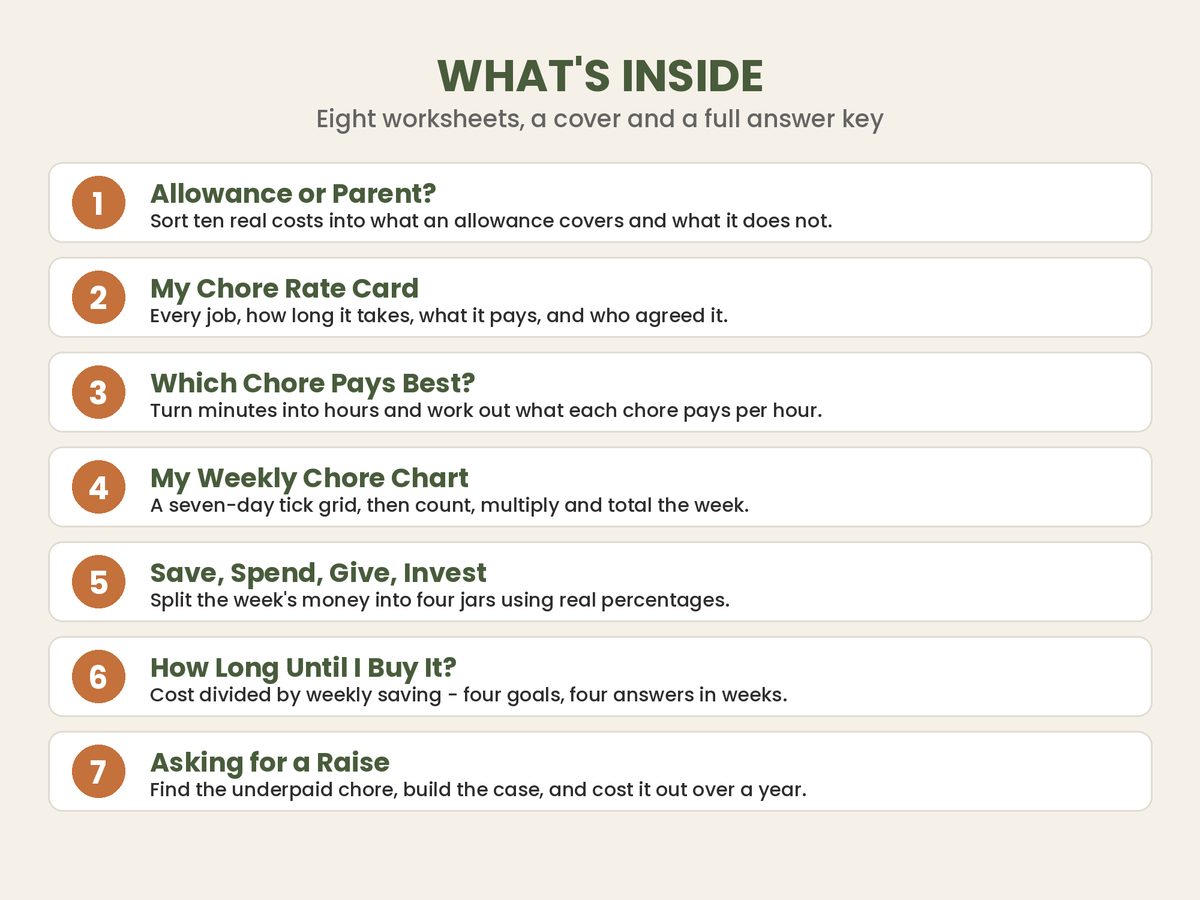
Family jobs are unpaid. These are the things a person does because they live in the house and are a member of it:
- Making their own bed
- Tidying their own bedroom
- Putting dirty clothes in the hamper
- Brushing teeth
- Homework done on time
- Reading for twenty minutes
None of these benefit anyone but the child doing them. Paying for them teaches something you probably don’t want taught — that basic self-maintenance is a service rendered to the household, invoiceable.
Earning chores are paid. These are the ones that take work off someone else:
- Loading and unloading the dishwasher
- Folding and putting away laundry
- Taking out the trash and recycling
- Feeding the pet, walking the dog
- Vacuuming, sweeping, cleaning the bathroom sink
- Helping cook dinner, washing the car, yard work
The line is not about difficulty. It’s about who benefits. A ten-year-old tidying their own room is housekeeping; a ten-year-old emptying the dishwasher is doing a job you would otherwise do.
Keeping the unpaid list is what stops the system collapsing into a transaction. Kids who are paid for everything eventually ask what they get for it before they’ll do anything, and that question is very hard to walk back.
Put a Number on Every Chore
Values need to be small, fixed, and written down where the child can see them. Small because they add up faster than you think. Fixed because a chore whose price is negotiated each time is a chore that gets negotiated each time. Written down because the whole point is that the child can work out what a Saturday is worth before deciding how to spend it.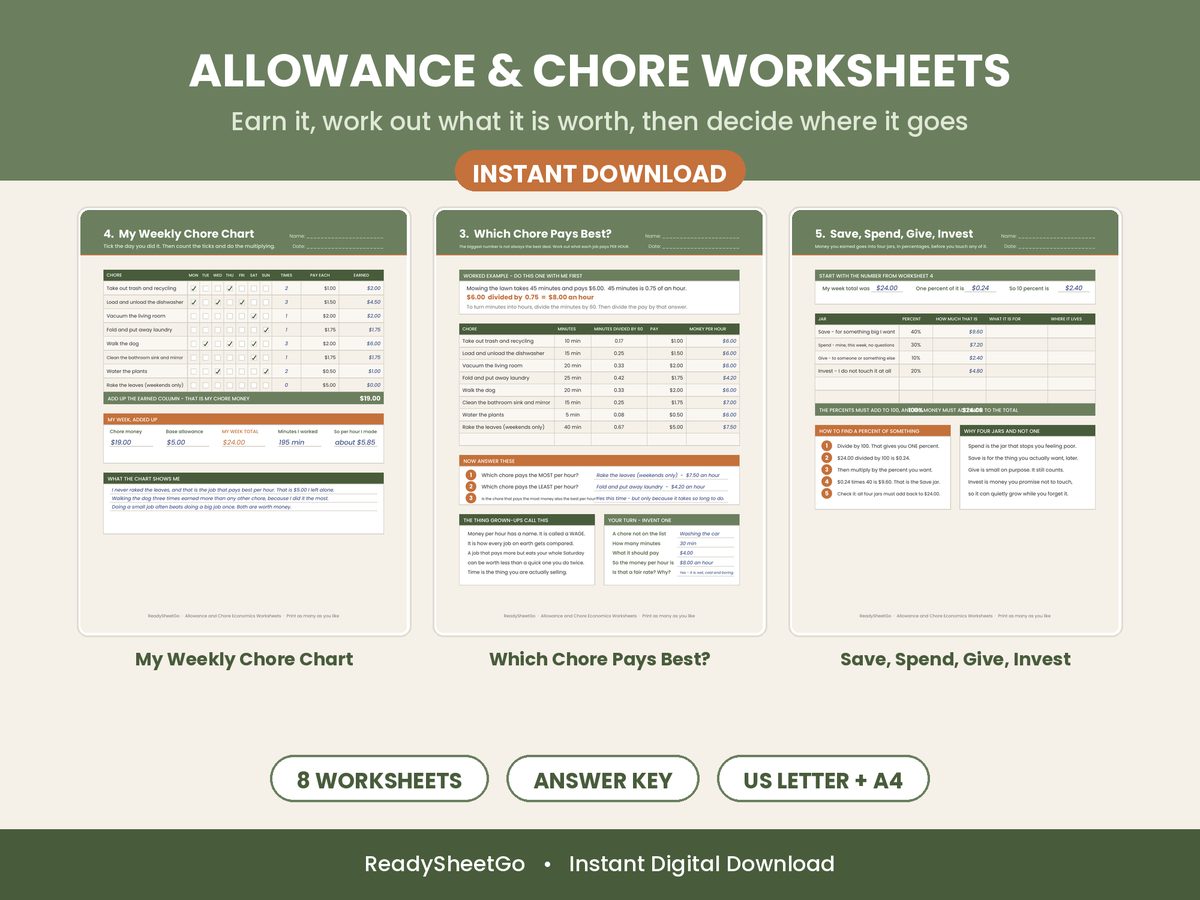
A working scale, with the youngest age each chore is realistic at:
| Chore | Value | Age |
|---|---|---|
| Brush teeth (AM & PM) | $0.25 | 3+ |
| Put dirty clothes in hamper | $0.25 | 3+ |
| Make bed | $0.50 | 3+ |
| Tidy living room / toys | $0.75 | 3+ |
| Set the table | $0.50 | 4+ |
| Feed the pet | $0.50 | 4+ |
| Water the plants | $0.50 | 4+ |
| Read for 20 minutes | $0.50 | 4+ |
| Tidy bedroom | $1.00 | 4+ |
| Clear & wipe table | $0.50 | 5+ |
| Practice instrument | $0.50 | 5+ |
| Homework done on time | $1.00 | 5+ |
| Take out trash / recycling | $0.75 | 6+ |
| Help with groceries | $0.75 | 6+ |
| Load / unload dishwasher | $1.00 | 7+ |
| Vacuum a room | $1.00 | 7+ |
| Sweep / mop floor | $1.00 | 7+ |
| Fold & put away laundry | $1.50 | 7+ |
| Clean bathroom sink | $1.00 | 8+ |
| Help cook dinner | $1.00 | 8+ |
| Make own lunch | $0.75 | 8+ |
| Walk the dog | $1.00 | 8+ |
| Yard work / weeding | $1.50 | 8+ |
| Wash the car | $2.00 | 9+ |
Copy that, cut the chores that don’t apply to your house, and change any value you disagree with. It’s a starting scale, not a standard.
The Number Nobody Runs First
Now the arithmetic, because this is where the system usually breaks and it breaks after you’ve promised it.
Emma is 10. She has a $5.00 weekly base allowance. Here is a genuinely good week — she did everything on the chart:
| Chore | Value | Times done | Earned |
|---|---|---|---|
| Make bed | $0.50 | 6 | $3.00 |
| Tidy bedroom | $1.00 | 2 | $2.00 |
| Load / unload dishwasher | $1.00 | 3 | $3.00 |
| Feed the pet | $0.50 | 7 | $3.50 |
| Homework done on time | $1.00 | 4 | $4.00 |
| Read for 20 minutes | $0.50 | 5 | $2.50 |
| Fold & put away laundry | $1.50 | 1 | $1.50 |
| Walk the dog | $1.00 | 2 | $2.00 |
| Chores subtotal | $21.50 | ||
| Base allowance | $5.00 | ||
| Total pay | $26.50 |
Twenty-six dollars and fifty cents. For one child. That is $1,378 a year — and if you have three children on the same scheme, roughly $4,100.
Nothing in that table is unreasonable on its own. Fifty cents to make a bed is nothing. Every value is under $1.50. The number is large because a week has seven days and small numbers repeat, and because Emma is being paid for six things that were never jobs.
Here is the same week, same work done, with the family jobs unpaid and the base allowance removed:
| Chore | Value | Times done | Earned |
|---|---|---|---|
| Load / unload dishwasher | $1.00 | 3 | $3.00 |
| Feed the pet | $0.50 | 7 | $3.50 |
| Fold & put away laundry | $1.50 | 1 | $1.50 |
| Walk the dog | $1.00 | 2 | $2.00 |
| Total pay | $10.00 |
Ten dollars a week, $520 a year. Emma still made her bed, still tidied her room, still did her homework and read — those are simply not billable. She has done four real jobs and been paid for four real jobs.
Run this calculation for your own household before you announce anything. Pick your paid chores, put your values on them, multiply by how many times a week each one honestly gets done, and look at the weekly total. If it’s a number you’d resent paying by week six, change it now rather than mid-scheme, because cutting a child’s rate later feels to them exactly like a pay cut.
For the same calculation broken out by age — 6, 8, 10, 12 and 14 — see how much allowance a 10-year-old should get, built from the chores up.
Then Split the Payday Three Ways
$10.00 handed over in cash becomes nothing in particular. Splitting it at the moment it’s paid is what turns an allowance into a money lesson.
Three destinations, percentages that add to 100%:
| % | Emma’s $10.00 | |
|---|---|---|
| Save | 50% | $5.00 |
| Spend | 40% | $4.00 |
| Give | 10% | $1.00 |
Save needs a named target or it’s just a number that goes up — a $120 bike at $5.00 a week is 24 weeks, and 24 weeks is a real, sayable answer to “when?”. Spend is deliberately available; a child who can never buy anything stops caring about earning. Give goes somewhere the child chooses, which is the only part of this they’ll remember in twenty years.
The percentages are the part people over-think. What splits to use at what age, and how the savings-goal arithmetic works goes through it, including why the youngest child usually needs the lowest Save percentage rather than the highest.
Give the Money Somewhere to Go
The quiet killer of allowance systems is that the money accumulates in a jar and never does anything. Earning stops feeling like it leads anywhere, and the chart goes back to being decoration.
A rewards list fixes this by pricing things you were going to allow anyway:
| Reward | Cost |
|---|---|
| Extra 30 min screen time | $1.00 |
| Stay up 30 min late | $1.50 |
| Movie night pick | $2.00 |
| Choose dinner menu | $2.00 |
| Skip one chore (a pass) | $2.00 |
| Trip to the park / pool | $2.50 |
| Small toy or treat | $3.00 |
| Ice cream outing | $4.00 |
| Friend sleepover | $5.00 |
| $5 cash out | $5.00 |
Two things make this work better than a jar. First, the trade is visible: a friend sleepover is five dollars, which is half a week, which is a real decision. Second, the chore pass at $2.00 is not a loophole — a child who buys their way out of vacuuming has paid two dollars they earned for the privilege, which is precisely the trade adults make when they hire someone.
Redemptions should need approval, and approval should be recorded. Otherwise the Spend balance and reality diverge within a fortnight.
Make Payday Boring
Everything above is design. This is operations, and it’s the part that determines whether you’re still running it in March.
One payday, every week, same day. Skipping payday is the single fastest way to end the system. If Friday is payday and you’re out on Friday, pay on Thursday.
Log as you go, not at payday. Four days of “did she do the dishwasher on Tuesday?” is how households end up guessing, and once you’re guessing, the numbers stop meaning anything to the child. A mark on the fridge chart the moment it’s done takes two seconds.
Only pay for a confirmed Done. A chore marked but not actually finished has to be worth nothing, or the mark becomes worthless.
Keep a bonus line and a deductions line. Bonus for genuinely going beyond the list. Deductions used sparingly — this is where a chore-and-allowance system can quietly turn into a fine system, which is a different and much less pleasant thing. Where the line sits between paying per chore and paying a flat rate, and what fining does to the arrangement.
Check the total against the household budget monthly. Weekly numbers feel small; the annual figure is what you’re actually signing up for.
When You Have More Than One Child
The moment there are two children, three new problems appear at once: the older one has access to higher-value chores and out-earns the younger one every week, chores that get shared don’t divide cleanly, and both of them start comparing totals.
The principle that resolves most of it is to value the chore, not the child — the dishwasher is worth $1.00 whoever empties it. Paying a younger child more per chore to keep totals level teaches that the pay is arbitrary, and children work this out fast.
A worked three-child week — a 10-year-old, an 8-year-old and a 5-year-old, coming to $23.50 for the family — is in the chore chart for multiple kids of different ages, along with how to handle shared chores and the fairness argument you will definitely have.
Start This Week, Not This Month
You don’t need the whole system running to get the benefit. Do it in this order:
- Split the list. Ten minutes with a pen. Family jobs on the left, earning chores on the right.
- Price the earning chores. Use the scale above, change what you disagree with.
- Run the weekly total. Multiply by realistic frequency. If the number makes you wince, fix it now.
- Print the chart and put it up. On the fridge, not in a folder.
- Name one savings goal per child. With the weeks-to-goal worked out, out loud.
- Pick payday. And don’t miss it.
One complete week is enough to know whether your values are right. The chart tells you what got done; the total tells you what it cost; the savings goal tells the child why any of it matters.
Featured on ReadySheetGo
Kids Chore Chart & Allowance Tracker — $9.99
Seven tabs, built exactly as above, for up to six children. A Setup tab holds each child’s name, weekly base allowance and their Save / Spend / Give percentages, with a check that flags any split not adding to 100% — and an editable 25-chore menu with a value and a suggested age on every chore.
The Weekly Chore Chart is a printable Mon–Sun grid for the fridge that pulls each chore’s value automatically and totals the week. The Chore Log takes 200 entries with child and chore dropdowns; marking a chore Done fills in its value, tags the week number, and pays nothing unless it’s confirmed. Allowance & Money Split adds chore earnings to base allowance, applies bonuses and deductions, returns total pay, divides it into Save / Spend / Give, and tracks each child’s savings goal with a percentage to goal and a status. The Rewards Store prices ten rewards and logs approved redemptions against each child’s Spend balance. The Family Dashboard shows chores done, earned, saved, given and remaining spend balance per child, plus who did the most chores and who earned the most.
Sample data for three children is pre-filled so you can see it working — type over it with your own. You only ever enter the yellow cells. Works in Excel and Google Sheets.
Get the Kids Chore Chart & Allowance Tracker →
Frequently Asked Questions
Should you pay kids for every chore or only some of them?
Only some. Split the list into family jobs — making their own bed, tidying their own room, brushing teeth, homework — which are unpaid because they are the cost of living in the house, and earning chores that benefit everyone, like the dishwasher, laundry, taking out the trash and walking the dog. In the worked week in this guide, paying for everything comes to $26.50 for one 10-year-old; paying only the four earning chores comes to $10.00 for the same amount of work done. The difference is not stinginess, it is that the unpaid list is where the responsibility lesson actually lives.
How much should a chore chart with allowance cost per child per week?
Work it out bottom-up rather than picking a number. Choose four or five paid chores, put a value on each, multiply by how many times a week it realistically gets done, and add it up. For a 10-year-old doing the dishwasher three times, feeding the pet daily, folding one load of laundry and walking the dog twice, at values of $1.00, $0.50, $1.50 and $1.00, that is exactly $10.00 a week — or $520 a year. Do this before you announce the system, because the number is usually higher than parents guess.
What is the save spend give split and what percentages should you use?
It divides every payday three ways so the money has a job before it lands: Save for a named goal, Spend for now, Give to a cause the child picks. The splits only have to add to 100%. A common starting point is 50/40/10 for a school-age child, shifted toward Spend for younger children who need to see the money do something to stay interested, and toward Save once a child has a real goal in mind. On $10.00 a week, 50/40/10 is $5.00 saved, $4.00 to spend and $1.00 given.
Do chore charts with allowance actually work long term?
They fail for three predictable reasons, all fixable. The chart is somewhere nobody looks, so make it printable and put it on the fridge. Payday is inconsistent, so pick one day and never skip it — an unpaid payday ends the system faster than anything else. And the money vanishes into a drawer with nothing to spend it on, which is what a rewards list solves: set prices for screen time, a movie pick, a sleepover, a cash-out, so earning visibly buys something.