How to Pay Off Debt When Your Income Is Irregular
Standard debt advice assumes a steady paycheck: “pay an extra $300 every month.” But if you freelance, work on commission, drive for apps, or earn seasonally, some months are $6,000 and some are $2,200 — and a fixed extra payment that’s easy in July is impossible in February. So the advice doesn’t fit, you improvise, and the debt lingers.
The fix isn’t more discipline. It’s a different structure — one built for a paycheck that moves. Here’s a percentage-based system that lets a good month accelerate your payoff while a lean month never causes a missed payment.
Step 1: Find your baseline (your “worst okay month”)
Look back over the last 6–12 months of income and find a low but realistic figure — roughly what you bring in on a slow-but-not-disaster month. That’s your baseline. Build your entire fixed-cost life to run on this number: rent, utilities, groceries, insurance, and — critically — every debt minimum payment. If your minimums fit inside your baseline, you can never miss one, even in a bad month. That safety is the whole foundation.
Say your baseline is $3,200 and your essential costs plus all debt minimums come to $2,900. Good — you clear the floor even in a weak month, with $300 to spare.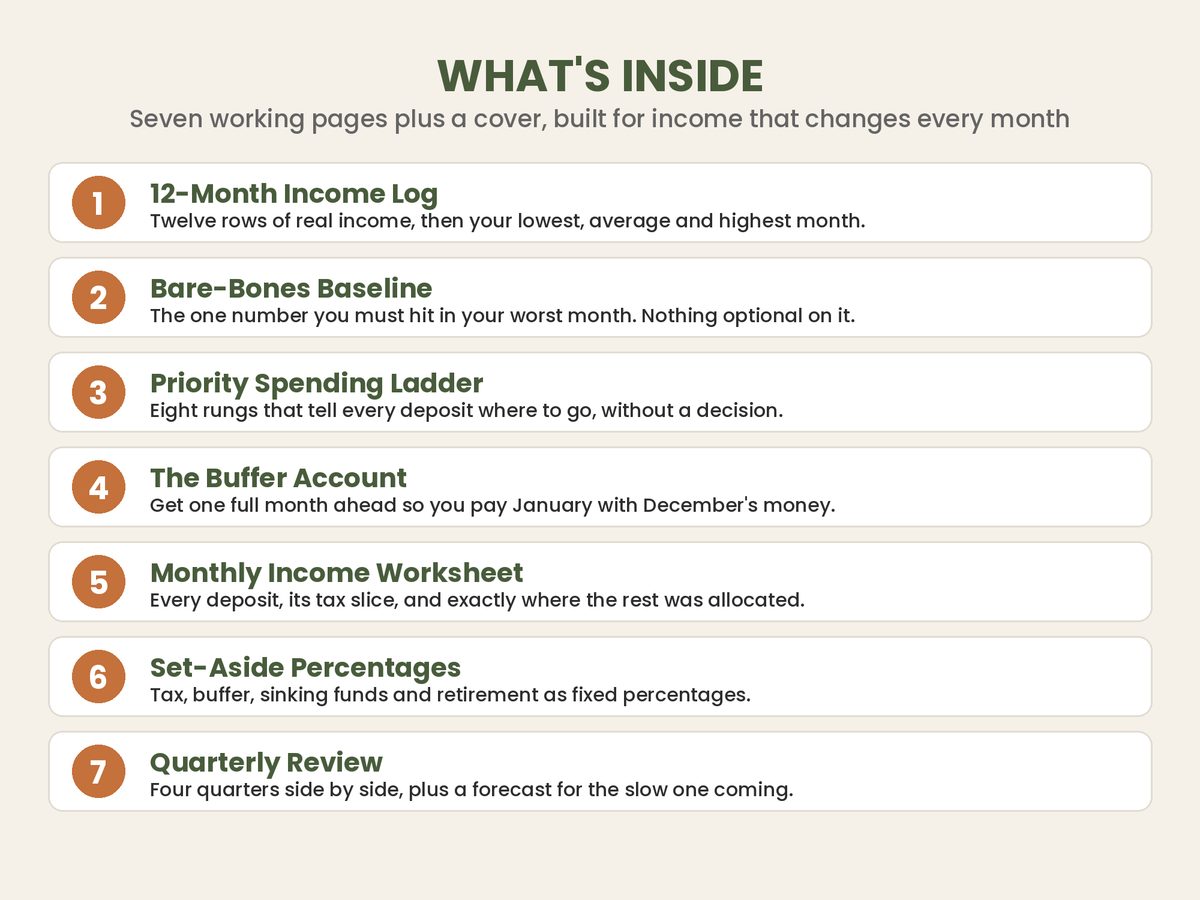
Step 2: Pay extra as a percentage, not a dollar amount
Here’s the core move. Instead of promising a fixed extra payment, you commit to a percentage of every dollar you earn above your baseline. Pick a rule — say 30% of the overage goes straight to your target debt.
Watch how it self-adjusts:
- Slow month — you earn $3,400. That’s $200 over baseline. 30% = $60 extra to debt. Small, but you paid every minimum and still made progress. No stress, no missed payment.
- Average month — you earn $4,800. That’s $1,600 over baseline. 30% = $480 extra to debt.
- Big month — you earn $7,500. That’s $4,300 over baseline. 30% = $1,290 extra to debt.
Across those three months you paid $1,830 extra — far more than a “safe” fixed pledge of $60/month ($180) would have, and you never once risked a payment. The percentage rule captures your big months automatically instead of letting the surplus leak into lifestyle creep, while protecting your slow months by design.
Step 3: Keep a bigger cushion than salaried folks
With variable income, your emergency fund does double duty — it covers true emergencies and smooths income droughts. So before you go all-in on aggressive payoff, build a fuller buffer than the standard starter fund: lean toward 3–6 months of essential expenses rather than one. That buffer is what lets you keep paying minimums through a dry season without reaching for a credit card and undoing your work. If you’re weighing how much to save versus how hard to attack the debt, work through should I pay off debt or save an emergency fund first.
Step 4: Automate minimums, decide extras by hand
Split your payments into two buckets. Minimums get automated against your baseline — set them to draft right after your most reliable income lands, so they’re never at the mercy of a slow week. Extra payments stay manual: after each chunk of income arrives, you calculate the percentage and send it yourself. This keeps the safe part on autopilot and the flexible part responsive to what you actually earned.
Step 5: When a windfall lands, use the lump-sum rule
Irregular earners often get uneven bursts — a big client invoice, a bonus, a strong season. Don’t let those dissolve into everyday spending. Treat each surge as a lump sum and concentrate it on one debt for maximum impact, exactly as in how to pay off debt with a lump sum like a tax refund or bonus.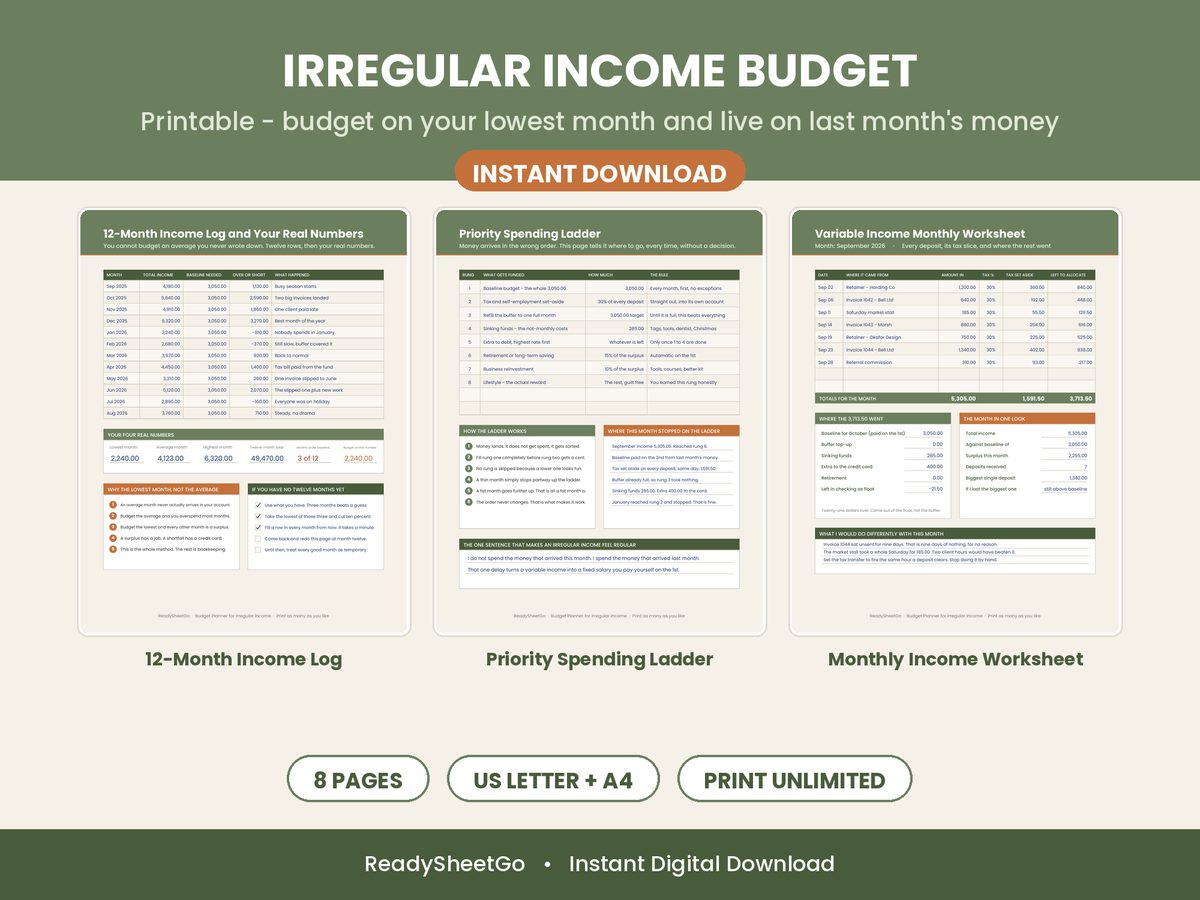
Smooth your income with a holding account
There’s an optional layer that makes all of this easier: a holding (or “buffer”) account that evens out your paychecks for you. Instead of spending directly from whatever lands, route all income into a separate account, then pay yourself a steady “salary” into checking each month equal to your baseline. Big months build up a surplus in the holding account; slow months draw it down. This does two things — it makes your day-to-day feel like a regular paycheck, and it lets you see your true monthly surplus clearly, which is the pool your percentage rule draws from. Once you’ve built a month or two ahead in the buffer, the stress of a slow season largely disappears, and your extra debt payments become far steadier.
Set the percentage you can actually sustain
Be honest about the percentage in Step 2. If 30% of your overage leaves you white-knuckling every slow month, drop it to 20% and raise it once your buffer is healthy. A sustainable rule you follow for two years beats an aggressive one you abandon after a rough quarter. The whole point of the percentage system is that it flexes — so tune it until it fits the real shape of your income.
Model your variable months before committing
The reason a spreadsheet beats a rigid app here is that you can test the swings. Plug in a slow month, an average month, and a big month, see the extra payment each one produces under your percentage rule, and watch how the mix changes your payoff date. That’s how you set a percentage you can actually sustain.
The Debt Free Blueprint makes this easy: enter your debts once and its What-If calculator lets you drop in different extra-payment amounts to see instantly how each changes your debt-free date and total interest — perfect for pressure-testing a $60 month against a $1,290 month. Build the surrounding plan with how to make a debt payoff plan that actually works.
Featured on ReadySheetGo
Debt Free Blueprint — $11.99
Enter up to 20 debts, then use the What-If calculator to test different extra-payment amounts month to month and see your payoff date shift in real time — ideal for irregular income. Includes snowball and avalanche tabs, a payment log, and a milestone dashboard. 420 formulas, works in Excel and Google Sheets. Get the Debt Free Blueprint on Etsy →
Frequently Asked Questions
How do I pay off debt when my income is different every month?
Cover all your minimum payments from a baseline you can hit even in a slow month, then send a fixed percentage of any income above that baseline to your target debt. This way a good month automatically accelerates payoff and a lean month never causes a missed payment.
How much should I pay toward debt on an irregular income?
Set a percentage rule rather than a dollar amount — for example, 30% of every dollar earned above your baseline expenses goes to debt. Percentages scale automatically with your income, so you pay more in strong months and protect yourself in weak ones without rewriting your plan each time.
Should I keep a bigger emergency fund with irregular income?
Yes. Because your income dips are predictable in frequency if not in timing, aim for a larger cushion — often 3–6 months of essentials rather than one — before going all-in on debt. That buffer lets you keep paying minimums through a dry spell without new borrowing.
How do I avoid missing debt payments in a slow month?
Automate only the minimums against a conservative baseline income you're confident you'll earn, and treat extra payments as a separate manual decision made after the money arrives. Minimums stay safe on autopilot; extra payments flex with your actual earnings.