Spot Rates at $3.64, Diesel Down 97 Cents: Why Owner-Operators Still Need Their Cost Per Mile
It is, by most measures, the best freight market owner-operators have seen in three years.
DAT Trendlines data reported by Overdrive showed spot loads posted in the last week of June up 12% week over week and 62% year over year, with more than 75,000 posted loads on DAT on a single Monday. FTR and Truckstop.com put the broad spot average at $3.64/mile — van at $2.99, reefer at $3.46, flatbed at $3.83.
And diesel went the other way. The national average dropped 16 cents in a week to $4.67/gallon, roughly 97 cents below the 2026 high set a couple of months earlier, as the conflict premium that had pushed it toward $5.64 in May drained out of crude.
Rates up. Fuel down. Brokers who, in Overdrive’s phrasing, “flat-out cannot find a truck.”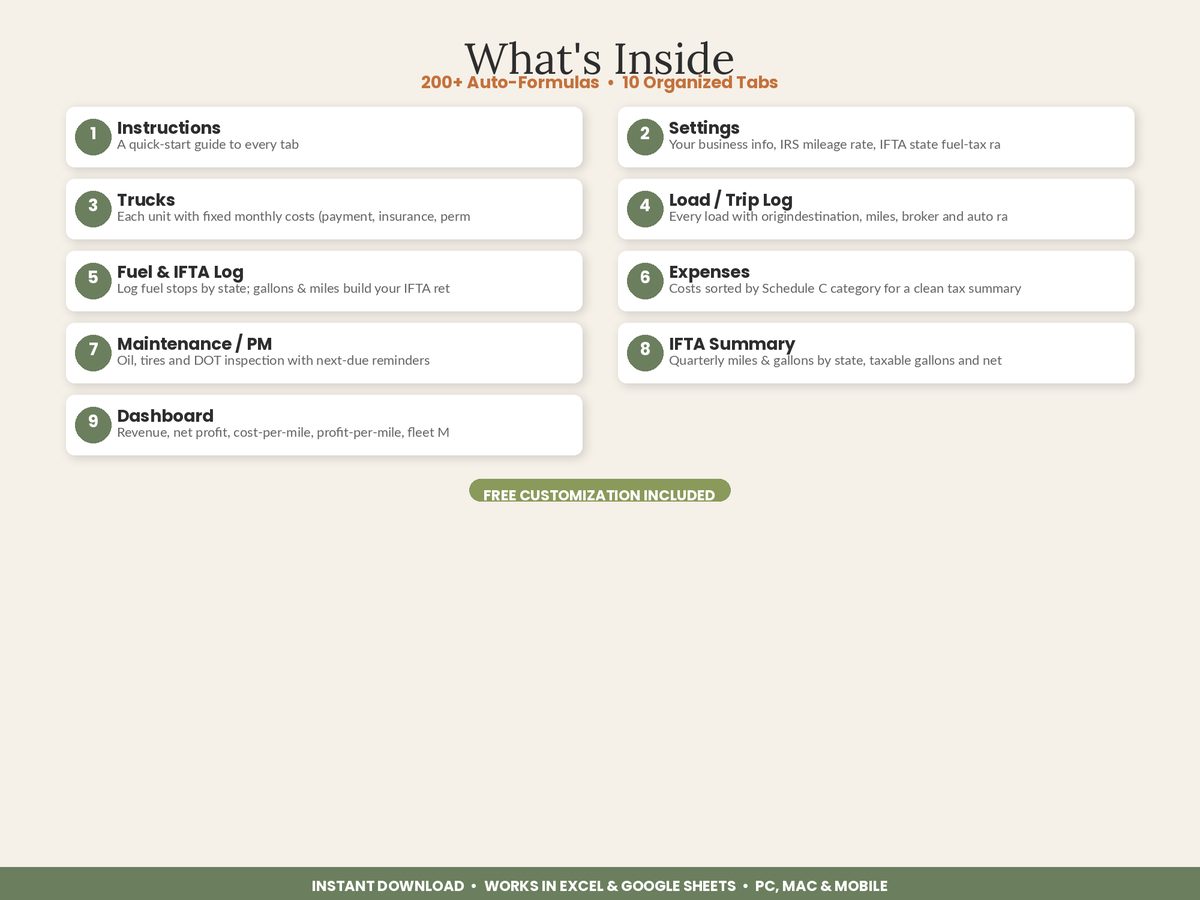
So why is this the moment to be more careful with your numbers, not less?
Because the Cost Floor Moved While Nobody Was Watching
Six days before that spot market report, ATRI released its 2026 Analysis of the Operational Costs of Trucking. The industry-average cost to operate a truck in 2025 hit $2.336 per mile — the highest in the report’s history, up 3.4%. Excluding fuel, up 4.2% to $1.854 per mile.
Tolls rose 13.2%. Repair and maintenance, 8.6%. Tires, 6.4%. And ATRI noted first-quarter 2026 data show most of those trends continuing.
That’s the part the rate headlines don’t capture. The reason rates recovered is that capacity left — carriers cut truck counts 2.4% in 2025, the largest reduction since the freight recession began in 2022, and left another 10% of trucks unseated. The market is tight because the industry got smaller under cost pressure that hasn’t gone away.
You’re being paid more per mile against a mile that costs more to run.
The Way a Good Market Gets Wasted
Nobody goes broke in a $3.64 market. But plenty of operators come out of one with less than they should have, and it happens the same three ways.
Booking on feel instead of math. When every load looks good, the difference between a good load and a great one stops feeling important. It isn’t. With 75,000 loads posted, the cost of taking a mediocre run isn’t the thin margin — it’s the better load you couldn’t take because the truck was committed. That’s an opportunity cost that only exists in a strong market, and it’s invisible unless you’re comparing offers against a real cost-per-mile floor.
Letting the cost side drift. Good months are when deferred maintenance gets deferred again because the truck is making money and can’t afford downtime. Maintenance costs rose 8.6% and average truck age went up industry-wide — that’s a bill accumulating, not one avoided.
Not banking the difference. Rates are cyclical. The operators who survived 2023 through 2025 were the ones who came into it with reserves. The ones who used the last strong market to upgrade the truck went into the downturn with a bigger payment.
The Contract-Versus-Spot Split
There’s a real disagreement among experienced operators about what to do right now, and it’s worth seeing both sides.
One camp is naming their price. Owner-operator Ilya Denisenko, quoted in Overdrive’s report: “I just booked up most of next week, will have it booked up today/tomorrow and it’s absolutely insane for next week.” On rates: “Extremely good… you get better rates and way more selection booking in advance.”
The other camp is holding steady. Joe Bielucki, an owner-operator Overdrive describes as famously disciplined, isn’t raising his rates: “I think the market should be careful of chasing rates. Stability always wins. Take the steady thing.” His reasoning played out in his favor — as spot-market chasers abandoned their contracts for better spot money, loads went to internal spot bid and, as he put it, “I get to name my price.” His warehouse manager raised his contract rate unprompted.
Both approaches are defensible. Both require the same input: knowing what a mile costs you. Denisenko can push rates because he knows what he’s pushing above. Bielucki said it directly — “I know my operating costs, and being contract is good.”
The operators with no answer to that question are just taking whatever’s offered and hoping the market stays generous.
What to Actually Do With a Good Quarter
Four things, none of them complicated:
Recalculate your cost per mile now. Diesel moved nearly a dollar a gallon in two months. Whatever number you were using in May is wrong in both directions. Fixed costs plus variable costs, divided by total miles including deadhead.
Fund the maintenance reserve properly. A per-mile set-aside — many operators use 10 to 15 cents — turns the eventual $6,000 repair into a cost you already covered instead of a month that blows up your year.
Track which lanes and brokers actually pay. In a market this active you have selection, and selection is only useful with data. Average rate per mile grouped by broker over a quarter will surprise you.
Book against the number, not the vibe. Rate per loaded mile, minus cost per total mile including the deadhead to pickup. Four seconds if the inputs are current.
That’s what a load log and a live dashboard are for: revenue per mile, cost per mile, profit per mile, updating as you go. The Trucking Owner-Operator Bookkeeping & IFTA Tracker from ReadySheetGo is built around exactly those three outputs, with per-unit fixed costs, load and fuel logs, and Schedule C expense categories feeding them.
The Read
Freight rates turning a corner is genuinely good news, and after three years of a downturn that pushed flatbed carriers to an average operating loss, owner-operators have earned a good quarter.
But ATRI’s data and Overdrive’s rate report describe the same market from two directions: capacity left because costs went up, and rates rose because capacity left. The rates are cyclical. The cost base isn’t going back down.
The operators who come out of this stretch materially better off will be the ones who used it to find out what a mile actually costs them — and then booked accordingly. In a market this good, that’s the difference between a strong quarter and a strong year.
Featured on ReadySheetGo
Trucking Owner-Operator Bookkeeping & IFTA Tracker — 9 tabs built for one truck or a small fleet. Load/trip log with automatic rate-per-mile and separate deadhead tracking, per-unit fixed cost sheet, fuel & IFTA log by state with MPG, expense log mapped to Schedule C categories, preventive maintenance schedule with next-due odometer alerts, IFTA quarterly summary with taxable gallons and net tax owed by state, a dashboard with revenue/cost/profit per mile, and a tax summary with net taxable profit. Pre-filled with sample data. Works in Excel and Google Sheets, no macros. Instant digital download — $19.99.
Sources: Overdrive — Volumes boom, diesel fizzles: Fireworks hit the spot market before July 4 · ATRI — New ATRI Report Details Accelerating Costs and Low Profitability Despite Cuts · U.S. EIA — Gasoline and Diesel Fuel Update
Frequently Asked Questions
What are spot rates right now in July 2026?
FTR and Truckstop.com data reported by Overdrive in early July 2026 put the broad spot average at $3.64 per mile, with van at $2.99, reefer at $3.46, and flatbed at $3.83. Those figures were slightly below records set a few weeks earlier, but represented some of the strongest levels in years. DAT Trendlines showed posted loads in the final week of June up 12% week over week and 62% year over year.
How much have diesel prices dropped in 2026?
The U.S. on-highway diesel average was $4.67/gallon at the start of July 2026, a 16-cent drop on the week and roughly 97 cents below the 2026 high set a couple of months earlier. The May peak near $5.64/gallon reflected a conflict premium in crude that drained out quickly once shipping traffic through the Strait of Hormuz resumed.
Is this a carrier's market or a shipper's market?
As of July 2026 it is decisively a carrier's market. Capacity tightened after carriers cut truck counts 2.4% in 2025 — the largest reduction since the freight recession began in 2022 — and with load volumes surging, brokers have reported difficulty covering freight. Owner-operators have described being able to book a week out and select loads rather than take what's available.
Should I raise my rates when the spot market is hot?
It depends on whether your business runs on spot or contract freight, and opinions among experienced operators differ. Some are naming their price on the spot market; others, like the operator quoted in Overdrive's July report, deliberately hold contract rates steady on the view that stability outperforms chasing peaks. What both approaches require is knowing your cost per mile, so any rate decision is measured against a real floor rather than a guess.