Wedding Weekends Are the 2026 Norm — And They Make Your Guest List Three Lists
Zola released its 2026 First Look Report this year, drawn from a survey of more than 11,500 couples getting married in 2026, and one finding quietly rewrites the guest-list job. It’s not just about the wedding day anymore: 37% of these couples say they’re hosting at least one additional event, like a welcome party or a day-after brunch, and 18% are planning a full two-to-three-day wedding weekend. Zola also pegs the average guest count among its surveyed couples at 145 — a number it says has stayed consistent.
Put those together and a single truth emerges. If more than a third of couples are running multiple events, then more than a third of couples no longer have a guest list. They have several — overlapping, differently sized, each with its own headcount and its own set of RSVPs. And most are trying to manage that with a tool built for one yes-or-no question.
Full walkthrough of the template used in this guide.
One Wedding, Several Guest Lists
Here’s what a wedding weekend actually does to your planning. The Friday welcome party might be for out-of-town guests and the wedding party — say 40 people. Saturday’s ceremony and reception is the full list, maybe 145. Sunday’s farewell brunch is a smaller, self-selecting group — perhaps 60. Those aren’t three copies of the same list. They’re three different invitations, three different counts, and three different RSVP tallies, all drawn from the same pool of people but never identical.
That’s a genuine data problem, and it’s exactly where a plain guest list breaks down. A list that only records “attending: yes” for the wedding can’t tell you who’s coming to the brunch. So couples end up with a separate document per event, and the moment someone’s plans change — a guest who can now make the welcome party, a family that has to skip the brunch — the lists drift apart, and you’re back to guessing at counts you need for catering and rentals at each event.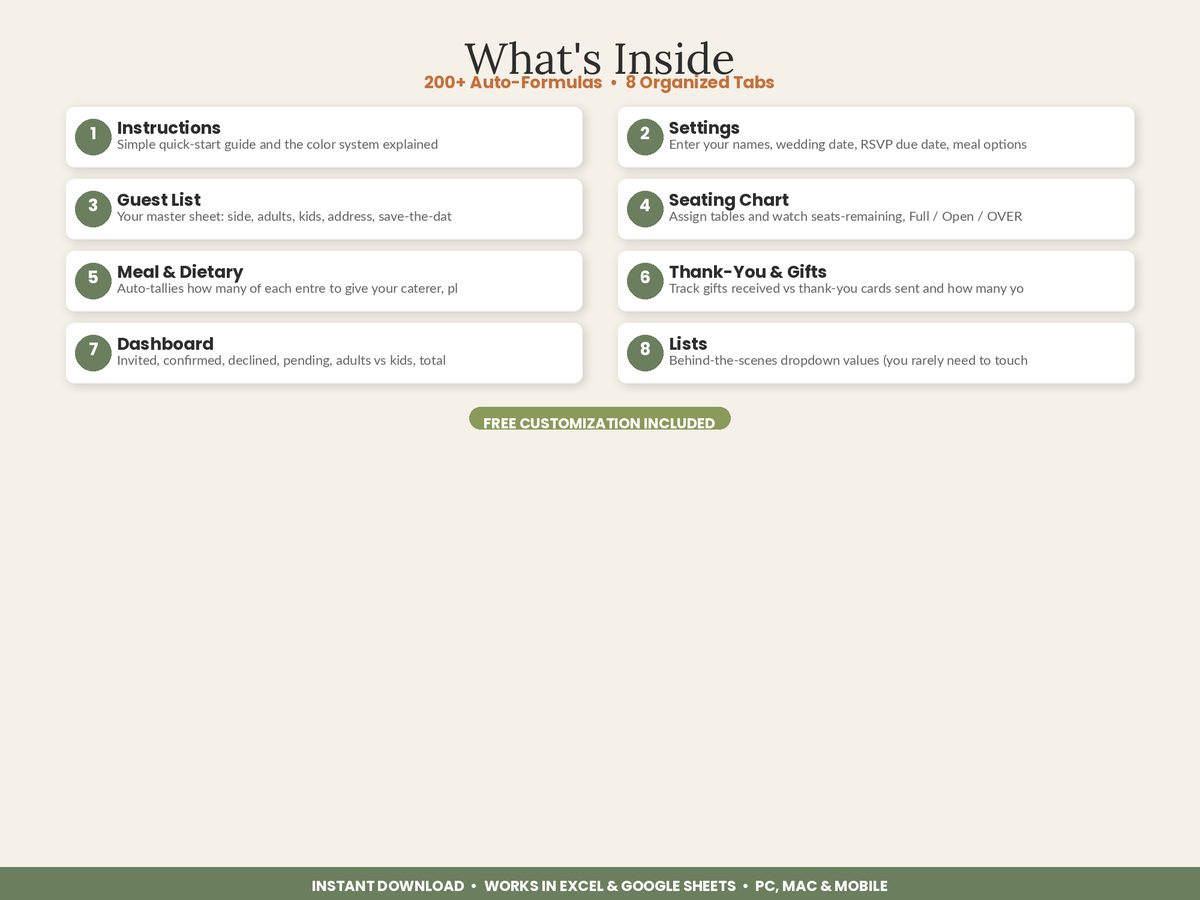
Why the “Second Event” Is the One That Trips People Up
The wedding day itself gets the attention and the tracking. It’s the extra events — the welcome party, the brunch, the morning-after send-off — where headcounts quietly go wrong, because they’re planned later, invited to a subset of guests, and often catered separately. A welcome party you thought was 40 turns out to be 55 once you actually count who said yes, and now you’re short on food and drink for a fifth of the room. The problem isn’t the event. It’s that the extra events rarely get the same disciplined headcount the main day does.
The couples who handle weekends smoothly do one thing differently: they keep every event’s guest list tied to the same master roster, so each person’s invitations and replies live in one place. Invite the Carters to the welcome party and the brunch but track their RSVP for each, and no event’s count is ever a mystery.
Keep the Weekend on One Master List
The fix isn’t a folder of separate spreadsheets — that’s how counts fall out of sync. It’s one master guest list where each household is marked for which events they’re invited to, with the headcount for each event totaling itself. Then getting the welcome-party count is a filter, not a recount, and a guest who changes plans is a one-cell edit that updates every affected number.
A connected guest manager like the Wedding Guest List, RSVP & Seating Chart Manager is built on exactly that one-master-list principle — every guest entered once, with RSVP status, party size, meals, and seating all reading from the same rows, so your headcount stays consistent no matter how many ways you slice it. For a couple running a welcome party, a wedding, and a brunch, keeping the whole weekend anchored to a single source of truth is what keeps three overlapping counts from becoming three separate headaches.
The Weekend Is Here — Track It Like One
Zola’s data makes the trend clear: for a large and growing share of 2026 couples, the celebration is a multi-event weekend, not a single afternoon. That’s more memories and more hosting — and more guest lists to keep straight. Treat the weekend as one connected system rather than a pile of separate lists, and each event’s headcount stays accurate right up to the day, so every welcome party, dinner, and brunch has exactly the food, drinks, and seats it needs.
Featured on ReadySheetGo
The Wedding Guest List, RSVP & Seating Chart Manager keeps your whole guest list on one connected 8-tab workbook — each household entered once, with RSVP status, party size, meal choices, seating, and thank-you notes all reading from the same master roster and rolling up into a live Dashboard. Enter a guest once and every headcount stays in sync. Works in Excel and Google Sheets, PC and Mac. One-time purchase — $16.99 instant download.
Frequently Asked Questions
How many couples are hosting multi-day wedding weekends in 2026?
In Zola's 2026 First Look Report, a survey of more than 11,500 couples getting married in 2026, 37% said they are hosting at least one additional event such as a welcome party or day-after brunch, and 18% are opting for a full two-to-three-day wedding weekend. Zola also reported an average guest count of 145 among its surveyed couples.
Why do wedding weekends make guest list tracking harder?
Because not every guest is invited to every event. The welcome party might be 40 people, the ceremony and reception 145, and the brunch 60. That's three overlapping guest lists with three headcounts and three sets of RSVPs. Tracking who's invited to what — and who has replied for each — is far more than a single yes-or-no list can handle.
What's the best way to manage RSVPs for multiple wedding events?
Keep one master guest list and mark, per household, which events they're invited to, then track RSVP and headcount for each. A single connected spreadsheet lets you filter to 'welcome party — attending' or 'brunch — attending' and get each event's count without maintaining separate files that fall out of sync.
How big is the average wedding guest list in 2026?
Zola's 2026 First Look Report put the average guest count at 145 among the more than 11,500 couples it surveyed who are marrying in 2026, and noted guest counts have stayed consistent. With many of those couples adding welcome parties, brunches, or full weekends, that headcount is now spread across multiple events that each need their own tracking.