How Much Does a Dog Really Cost Per Year? Track It in a Spreadsheet
Ask a dog owner what their dog costs per year and you’ll usually get a shrug and a guess: “I don’t know, maybe a thousand bucks?” Then they mention the food, and the vet, and oh right the dental last spring, and the emergency visit when he ate a sock, and the boarding over the holidays — and the guess quietly doubles. The problem isn’t that dogs are secretly expensive. It’s that dog costs arrive as forty small transactions a year that nobody ever adds up.
If you’ve never seen your real annual number, this is how to find it — and why the total is almost always higher than the guess.
Full walkthrough of the template used in this guide.
Why Owners Underestimate By Hundreds
The recurring costs feel manageable one bag of food at a time. What breaks the budget is the stuff that shows up unevenly: the once-a-year heartworm and flea/tick prevention billed in a lump, the dental cleaning that runs $300 to $800, the grooming appointments for a coated breed, the boarding bill when you travel, and the emergency that no calendar warns you about.
Industry estimates generally put the ongoing annual cost of a dog somewhere between $1,000 and $2,500, and that’s before anything goes wrong. A single unexpected illness or injury commonly adds $1,000 to $5,000 in a year — a swallowed object, a torn cruciate ligament, a skin condition that needs specialist care. Because none of these hit the same month, owners experience each as a one-off “bad month” instead of what it really is: a normal, predictable part of the annual cost of a dog.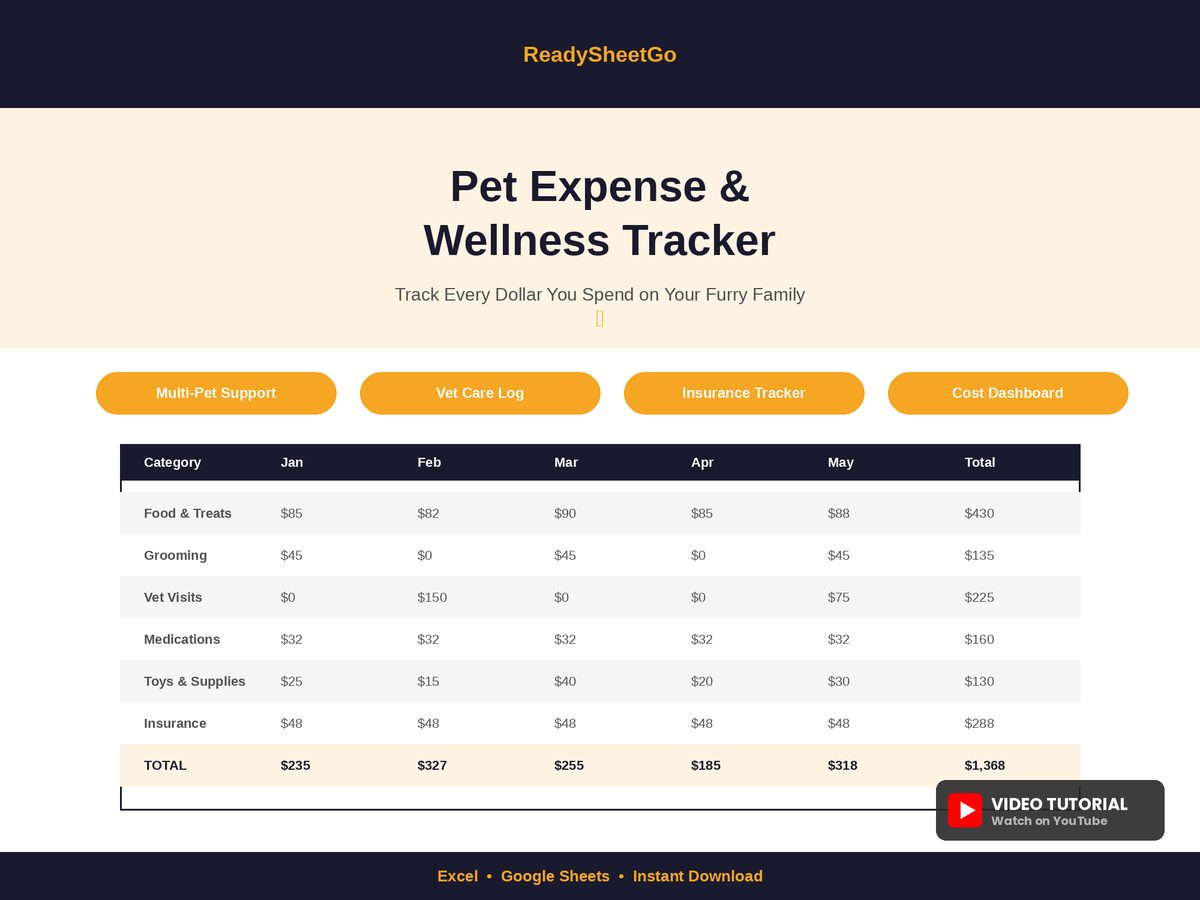
The Categories You Actually Need to Track
You can’t see your real number if everything lands in one “pet stuff” pile on your bank statement. Break dog spending into distinct categories so each one is visible:
- Food — the single biggest recurring line for most owners
- Vet care — annual exam, sick visits, dental, lab work
- Preventatives & medications — heartworm, flea/tick, any ongoing prescriptions
- Grooming — especially for poodles, doodles, and double-coated breeds
- Boarding & pet-sitting — the travel cost owners always forget
- Training — puppy classes, behavior work
- Supplies & gear — leashes, beds, crates, toys, replacements
- Insurance — premiums, if you carry a policy
- Emergency / other — the catch-all for the unexpected
When each category totals separately, two things happen. You finally see where the money actually goes (it’s rarely where people assume), and you can spot the categories worth optimizing — switching foods, shopping preventatives, or building an emergency fund so the next surprise isn’t a credit-card event.
Getting to Your True Annual Number
The mechanics are simple: log each expense once, tag it with a category and a date, and let the spreadsheet roll everything into monthly and annual totals. Ninety seconds a week, or a two-minute catch-up whenever you check your bank statement.
After one full month you’ll have a real monthly baseline. After a full year you’ll have something most owners never see — the actual, category-by-category cost of your dog, not a national average. That number is what you use to set a monthly pet budget that doesn’t get blown up by the “surprise” costs that were never really surprises.
This is exactly what the Pet Expense & Wellness Tracker from ReadySheetGo is built to do. Its Monthly Expenses tab tracks nine categories with automatic monthly and annual totals, so the moment you enter the boarding bill or the dental invoice, your real yearly figure updates itself.
From Annual Cost to Lifetime Cost
Once you know your true annual number, the more sobering figure is the lifetime one. Synchrony’s Lifetime of Care research estimated the lifetime cost of a dog at roughly $20,000 to $55,000, with large and health-prone breeds landing at the high end. A dog that costs you $1,800 a year and lives 13 years is a $23,000 commitment — and the senior years, when chronic conditions and more frequent vet visits appear, are usually the most expensive stretch of all.
A lifetime cost projector takes your real tracked annual spending and multiplies it across your dog’s expected remaining years, so you’re planning against your actual dog rather than a stranger’s average. Seeing that number early is what motivates owners to start an emergency fund now instead of discovering it the hard way at the animal ER.
Multiple Dogs, One File
If you have more than one pet, the guessing gets worse, because their costs blur together on the same card. Tracking each pet as its own profile — with its own expenses, vet history, and medications — lets you answer questions single-pet owners never can: which dog is more expensive, whether the older one’s costs are climbing, and what your whole household actually spends on animals in a year.
The goal isn’t to make you feel guilty about the money. It’s the opposite: when you can see the real number, dog ownership stops feeling like a series of financial ambushes and starts feeling like the planned, budgeted commitment it actually is.
Featured on ReadySheetGo
Pet Expense & Wellness Tracker — Know exactly what your pet costs with 8 tabs and 200+ auto-calculating formulas. Track up to 4 pets across 9 monthly expense categories with automatic annual totals, a vet care log, a medications tracker, a pet insurance ROI calculator, an emergency fund with progress tracking, and a lifetime cost projector that shows what your pet will cost over their whole life. Works in Excel and Google Sheets, no macros. Instant digital download — $12.99.
Frequently Asked Questions
How much does a dog cost per year on average?
Most industry estimates put the ongoing annual cost of a dog between roughly $1,000 and $2,500, depending on size, health, and where you live. Food, routine vet care, preventatives (flea, tick, heartworm), grooming, and supplies make up the recurring baseline, and a single unexpected illness or injury can add $1,000 to $5,000 in a year. The reason owners underestimate is that these costs are spread across dozens of small transactions no one adds up — which is exactly what a tracking spreadsheet fixes.
What is the lifetime cost of owning a dog?
Synchrony's Lifetime of Care study estimated the lifetime cost of a dog at roughly $20,000 to $55,000, and for some large or health-prone breeds it runs higher. Over a 12–15 year lifespan, recurring food and vet costs compound, and senior-year medical care is often the most expensive stretch. A spreadsheet with a lifetime cost projector multiplies your real tracked annual spending by your pet's expected remaining years so the number is based on your actual dog, not a national average.
What dog expenses do people forget to budget for?
The commonly forgotten ones are dental cleanings (often $300–$800), preventative medications billed annually, grooming for coated breeds, boarding or pet-sitting during travel, and the emergency vet fund. Owners tend to budget food and the annual checkup and treat everything else as a surprise. Tracking nine or more separate categories in a spreadsheet surfaces the costs that hide between the obvious ones.
Is it better to track pet expenses in a spreadsheet or an app?
A spreadsheet gives you a one-time cost, full control of your categories, no subscription, and the ability to see every pet and every year in one file you own. Most pet-budgeting apps charge monthly and lock your history behind a login. For a data set that only needs a few entries a month, a spreadsheet that auto-totals by category and projects lifetime cost is usually the simpler, cheaper long-term choice.