How Much Should a Booth Renter Set Aside for Taxes?
The first year of booth rental is the year everyone learns this the hard way. The chair goes well, the money feels good all year, and then a tax bill arrives that is large in a way an employee’s tax bill never is — because an employee’s was being taken out fifty-two times a year by someone else.
Booth rental removes that person. There is no withholding, no employer half of anything, and no automatic reserve. The number you need to set aside is calculable, though, and it is worth calculating rather than guessing, because the guesses run low.
Start With the Part That Is Fixed
Most tax questions have an “it depends” answer. This one has a fixed component you can compute exactly.
Self-employment tax is 15.3% — 12.4% for Social Security and 2.9% for Medicare — and it applies to 92.35% of your net earnings from self-employment (IRS Topic 554). The 92.35% is 100% minus 7.65%, which is the employer-equivalent half you are now paying yourself. You owe it if net earnings reach $400. The Social Security portion stops at an annual wage base the IRS sets each year; the Medicare portion does not stop at all.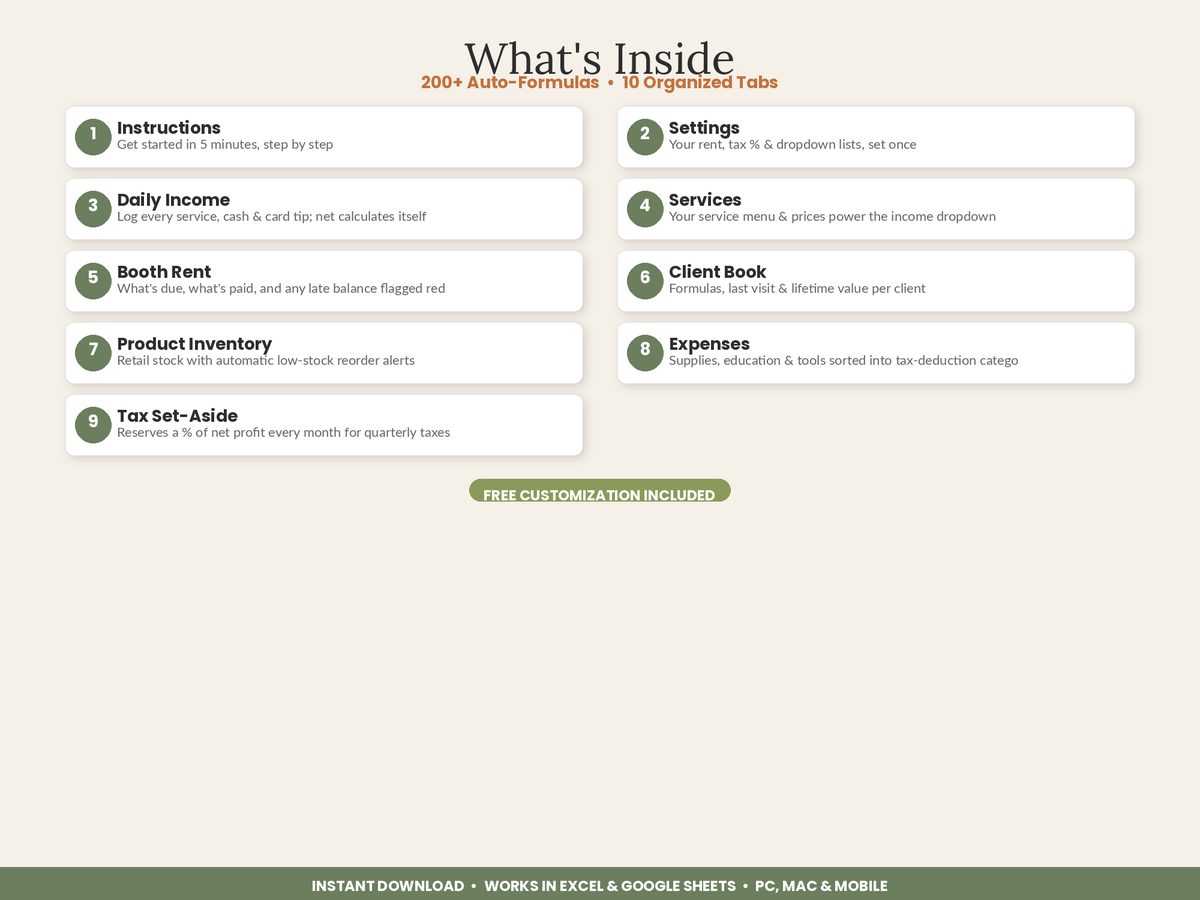
Take the worked month from the booth renter tracking guide — $5,072 of net profit — and run it for a year:
| Annual net profit | $60,864 |
| × 92.35% | $56,208 |
| × 15.3% self-employment tax | $8,600 |
$8,600 of self-employment tax on $60,864 of profit is 14.1% — and that is before one dollar of federal income tax, before state tax, and regardless of your deductions or filing status. It is the floor.
Half of it, about $4,300, is deductible in figuring your adjusted gross income. That deduction reduces your income tax; it does not reduce the self-employment tax itself.
Why the Rule of Thumb Is 25 to 30 Percent
Federal income tax is the part that genuinely depends — on your filing status, your standard or itemised deductions, your spouse’s income, and whether you qualify for the qualified business income deduction. Nobody can give you that number in an article, and anyone who does is guessing.
But you can see the shape of it. If self-employment tax is 14.1% of net profit and you reserve 25%, you have left about 11 percentage points for federal income tax and state tax. For a single filer in the low-to-mid brackets with a standard deduction, that is usually adequate. If you are in a state with meaningful income tax, or your household income is higher, 30% is the safer number.
Which is exactly why the rule of thumb exists in the range it does. It is not folklore. It is the fixed 14% plus a sensible allowance for the part that varies.
What 25 Percent Actually Looks Like
Annual figures are useless for a habit. Break the same reserve down until it becomes something you can do:
| Basis | Reserve at 25% |
|---|---|
| Per year | $15,216 |
| Per quarter | $3,804 |
| Per month | $1,268 |
| Per week | $293 |
| Per client through the chair | $16.26 |
That last row is the one that works. Seventy-eight clients a month at $16.26 each is the whole reserve. It is easier to think about sixteen dollars per head than fifteen thousand a year, and it scales automatically with how busy you are — a slow month reserves less, which is exactly correct.
An even simpler version, if you prefer a single percentage of takings rather than of profit: the $1,268 monthly reserve is 17.2% of the $7,355 that came through the chair that month. Move roughly 17 cents of every dollar you collect into a separate account and you land in the same place, without needing to know your net profit first.
Use a separate account. Not a mental note, not a sub-balance you intend to remember — a different account, transferred weekly. The reserve that lives in the same account as the rent money is not a reserve.
The Quarterly Dates, and the Rule That Protects You
Because nothing is withheld, booth renters generally pay estimated tax during the year rather than settling up in April. Payments are made with Form 1040-ES and are due:
- 15 April (for the first quarter)
- 15 June
- 15 September
- 15 January of the following year
If a date lands on a weekend or a legal holiday, the next business day counts as on time.
The underpayment penalty has a safe harbour worth knowing, because it turns an unknowable calculation into an arithmetic one. You generally avoid the penalty if you pay the smaller of 90% of the current year’s tax or 100% of the tax shown on last year’s return — 110% if your prior-year adjusted gross income was over $150,000 ($75,000 if married filing separately) (IRS — Estimated taxes).
That second option is the useful one. Once you have one full year of booth rental behind you, you do not need to forecast anything: take last year’s total tax, divide by four, pay that. Anything extra you owe is settled in April without penalty.
The Records That Make the Number Real
The reserve is a percentage of net profit, which means it is only as accurate as your profit figure — and booth rental has two places that figure quietly goes wrong.
Tips. IRS Publication 4902, which is written specifically for the cosmetology and barber industry, tells booth renters that tips received in the normal course of business belong in gross receipts. Card tips leave a trail. Cash tips leave nothing at all, which is precisely why they need to be written down the day they happen rather than estimated later. In the worked month, tips were $760 — 12.5% of service revenue and a real part of the tax base.
Expenses. The worked month carried $1,163 of costs beyond rent: colour and backbar, retail stock, card fees, education, supplies, tools, marketing, insurance and booking software. Add the $1,000 of rent and $2,163 came off the top. Every one of those dollars reduces the profit that the 15.3% is applied to — and every one you fail to log is a deduction you funded and then gave away. Nothing here is deducted at source. The log is the deduction.
Card processors also report card volume on Form 1099-K, and the reporting thresholds have changed in recent years, so check the current rule rather than assuming. Either way, a 1099-K reports gross card volume — it is not your income, it is a number you reconcile your own records against.
Set It Up Once, Then Forget It
The mechanics that actually stick, in order:
- Log every service the day it happens, tips included, cash tips especially.
- Log every expense with a category, so the total is a deduction schedule rather than a shoebox.
- Let net profit calculate itself — gross income minus rent minus expenses.
- Move your percentage out weekly to a separate account.
- Pay four times a year using the prior-year safe harbour once you have a prior year.
None of that is difficult. All of it collapses if step one is missing, because every later number is built on it.
Featured on ReadySheetGo
Hair Salon, Barber & Booth Renter Income Tracker — $15.99
The reserve calculates itself. A Settings tab holds your tax set-aside percentage — 25%, 30%, whatever you decide — and the Quarterly Tax Set-Aside tab applies it to each month’s net profit and totals the year, so the number to move is always on screen. The 200-row Daily Income Log captures service $, retail $, cash tips, card tips and tip-out per client, which is what makes the profit figure real and the cash tips recoverable. A 150-row Expense log categorises backbar and product, tools and equipment, education, supplies and marketing straight into a deductible total. The Booth Rent tracker logs every payment with an auto-flagged Paid / Partial / DUE status and a running balance owed. Also included: a Service Menu with prices and durations, a Client Book for up to 100 regulars, Retail Product Inventory with margins and reorder alerts, and a Dashboard returning gross income, net profit, average ticket, average tip per service, retail attach rate and rent balance.
Sample data pre-filled. Works in Excel and Google Sheets, no macros and no add-ons.
Get the Hair Salon, Barber & Booth Renter Income Tracker →
Part of the complete guide to tracking income, tips, rent and tax as a booth renter. This is general information, not tax advice — rates, thresholds and state rules change and personal circumstances differ, so confirm your own position with a tax professional or against current IRS guidance.
Sources: IRS Topic no. 554 — Self-employment tax · IRS — Self-employment tax (Social Security and Medicare taxes) · IRS — Estimated taxes · IRS Form 1040-ES · IRS Publication 4902 — Tax Tips for the Cosmetology and Barber Industry
Frequently Asked Questions
How much should a self-employed hair stylist set aside for taxes?
Twenty-five to thirty percent of net profit is the standard working range, and the reason is arithmetic rather than superstition. Self-employment tax is a fixed 15.3% applied to 92.35% of net earnings, which is about 14.1% of net profit on its own, before a dollar of income tax. Federal income tax and any state tax then sit on top. On $60,864 of annual net profit, a 25% reserve is $15,216 — of which roughly $8,600 is self-employment tax and the rest covers income tax.
Do booth renters have to pay quarterly taxes?
Generally yes, because nothing is withheld from a booth renter's income. Estimated payments are made with Form 1040-ES and are due 15 April, 15 June and 15 September of the tax year and 15 January of the following year, shifting to the next business day when the date falls on a weekend or holiday. You avoid the underpayment penalty by paying at least 90% of the current year's tax or 100% of the prior year's — 110% if your prior-year AGI was over $150,000 — whichever is smaller.
Are cash tips taxable for a booth renter?
Yes. IRS Publication 4902 is explicit that a booth renter operating their own business reports tips received in the normal course of business in gross receipts. Cash tips leave no trail — no 1099, no processor record, nothing in a bank statement if they never get deposited — so the only record that ever exists is the one you write down the day you receive it. That is the practical argument for logging tips per service rather than reconstructing them in April.
What can a booth renter deduct?
The ordinary and necessary costs of running the chair: booth or chair rent itself, colour and backbar, retail stock, tools and their maintenance, towels and supplies, liability insurance, licensing, continuing education, booking software, marketing and card-processing fees. In the worked month these came to $1,163 excluding rent, and every one of them reduces the profit that self-employment tax is calculated on. Because nothing is deducted at source in booth rental, an unlogged expense is simply a deduction you paid for and never claimed.