How to Price Salon Services as a Booth Renter (Work Backwards From the Goal)
Most price lists in booth rental are inherited. You brought them from the last salon, adjusted a couple of numbers to be slightly under the stylist across the room, and they have drifted upward by five dollars every eighteen months since.
That produces a menu that looks reasonable and pays unevenly, because pricing forwards — starting from what a service “should” cost and hoping the month works out — never checks the arithmetic that matters. A chair does not sell haircuts. It sells hours. And an hour spent on the wrong service pays a fraction of an hour spent on the right one, at prices that both look perfectly sensible on the wall.
Here is the backwards version, which takes about ten minutes and tends to change one or two lines on a menu quite sharply.
Step One: The Number Your Menu Has to Produce
Start at the end — what you need to keep — and work back up through everything that comes off the top.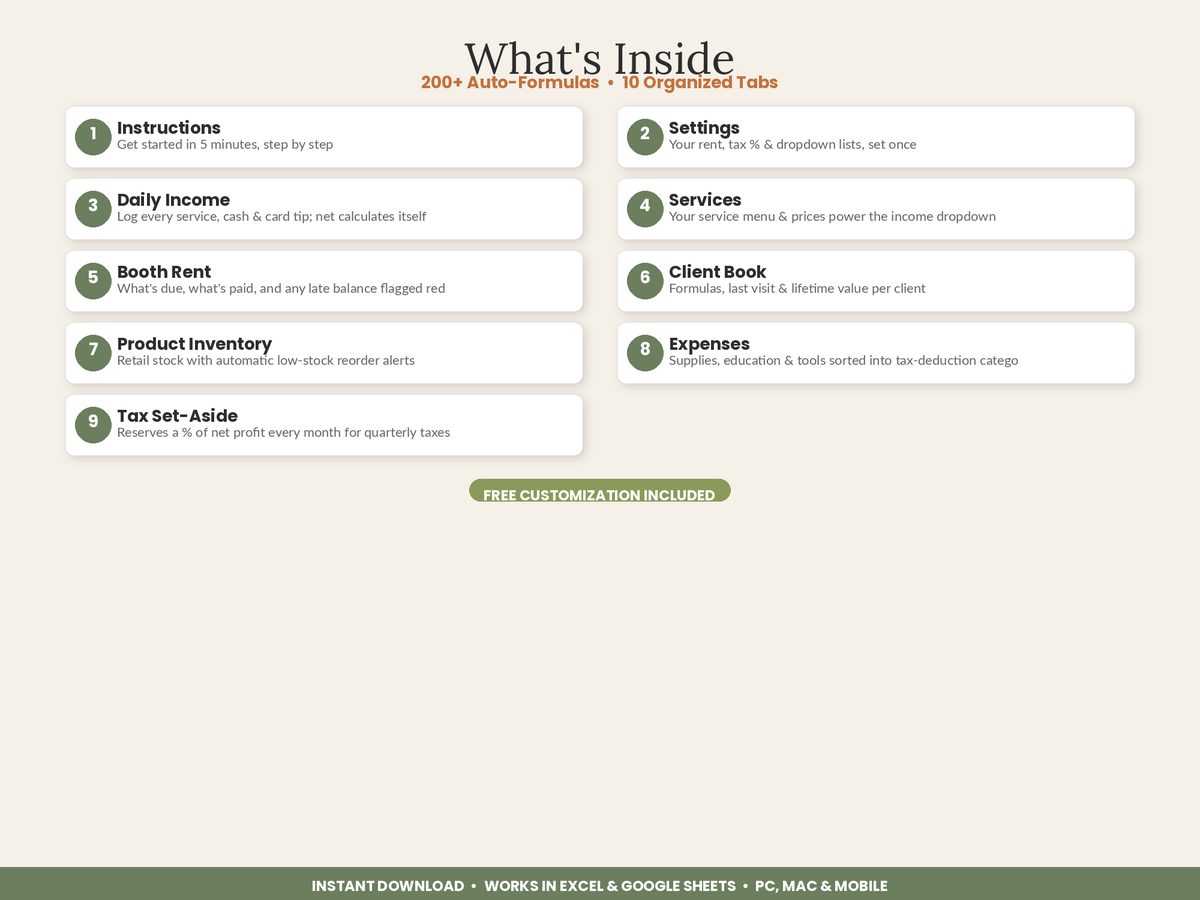
Say the goal is $3,600 a month in the bank, after setting money aside for tax.
Gross it up for the tax reserve. At a 25% set-aside, $3,600 is 75% of the profit you need: $3,600 ÷ 0.75 = $4,800 of monthly net profit. Why 25% is the working number.
Add back what leaves before profit. Booth rent at $250 a week is $1,000 on a four-week month. Fixed costs — insurance, booking software, education, tools, marketing — run about $338. Variable costs — colour and backbar, supplies, card processing — run about 11% of service revenue.
So with S as monthly service revenue:
0.89S − $1,000 − $338 = $4,800
0.89S = $6,138
S = $6,897 a month, or about $1,724 a week.
Divide by the hours you actually book. Four days a week at eight chair-hours is 32 hours, but nobody bills 32. At a 75% booking rate that is 24 billable hours a week, or 96 billable hours in the same four-week month.
$6,897 ÷ 96 = $72 per booked hour
That is the number. Not a price — a rate. Every line on your menu now has something to be measured against.
Step Two: Rank the Menu by Hourly Rate
Take a twelve-service menu and divide each price by its honest chair time. Not the time you wish it took — the time it takes including consultation, processing you cannot leave, and cleanup.
| Service | Price | Duration | $ per hour |
|---|---|---|---|
| Deep Conditioning | $40 | 0.5 hr | $80.00 |
| Beard Trim | $25 | 20 min | $75.00 |
| Women’s Cut | $55 | 45 min | $73.33 |
| Balayage | $220 | 3 hr | $73.33 |
| Blowout | $55 | 45 min | $73.33 |
| Cut & Color | $145 | 2 hr | $72.50 |
| Men’s Cut | $35 | 30 min | $70.00 |
| Highlights | $175 | 2.5 hr | $70.00 |
| Toner/Gloss | $50 | 45 min | $66.67 |
| Kids Cut | $22 | 20 min | $66.00 |
| Root Touch-Up | $90 | 1.5 hr | $60.00 |
| Perm | $120 | 2.5 hr | $48.00 |
Read that column and the menu tells you something the price column never could.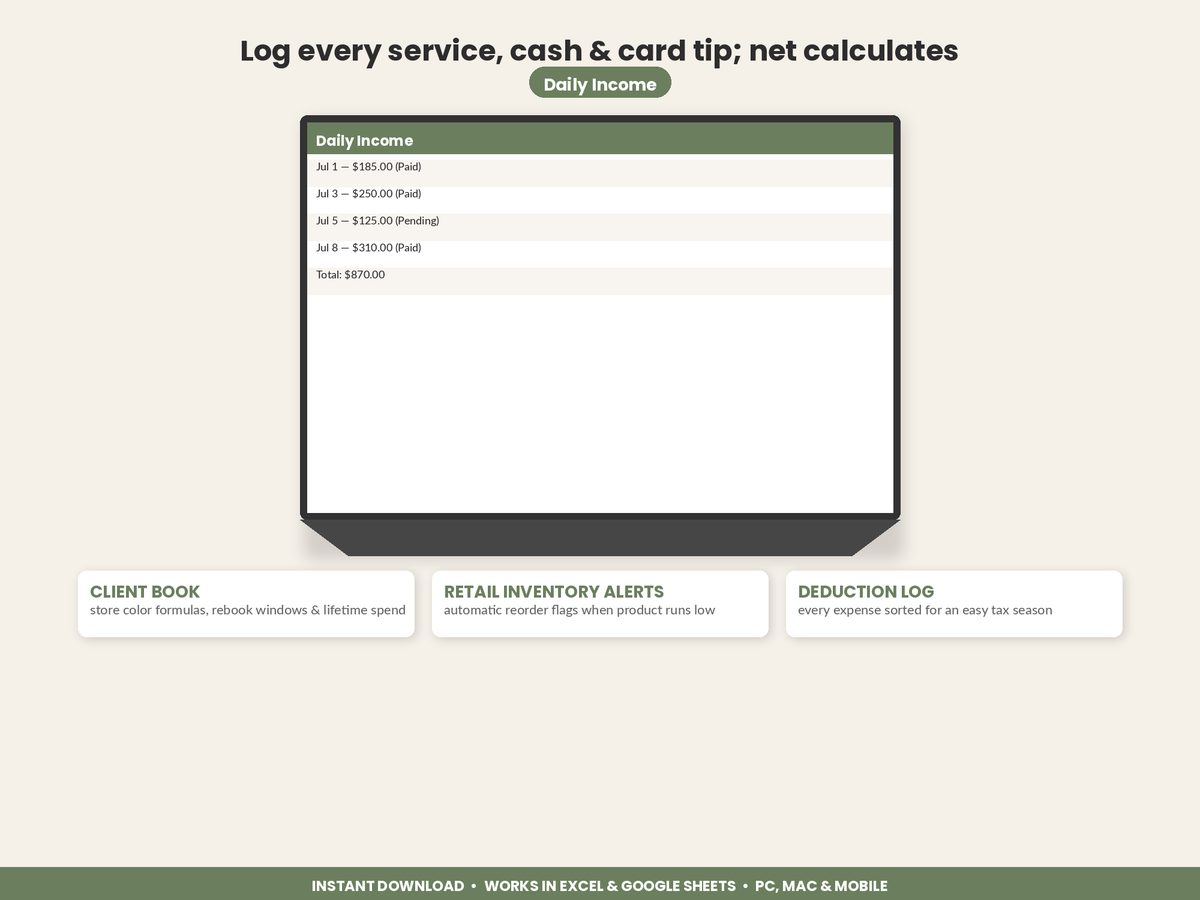
The most expensive service is not the best one. A $220 balayage and a $55 blowout earn identical hourly rates. The balayage is four times the ticket and four times the time, which means it is four times the risk for the same return.
The cheapest thing on the list is the best thing on the list. A $40 deep conditioning add-on is the highest-earning service on the menu at $80 an hour, and it is an add-on — it attaches to an appointment you already have, in a gap you are already standing in.
Six services are below target, but only two badly. Men’s Cut and Highlights at $70 are within 3% of the $72 the month requires. Kids Cut at $66 and Toner/Gloss at $66.67 are within 8%. Then the two real ones: a root touch-up at $60 is 17% under, and a perm at $48 is 33% under. That is what a menu looks like when it was set by feel — mostly close, with two lines quietly subsidised by the rest.
Step Three: Fix Only What Is Broken
The instinct after seeing that table is an across-the-board increase. Resist it. An across-the-board rise annoys every regular you have in order to fix two lines.
Bring the below-target services up to the rate instead:
| Service | Now | At $72/hr | Change |
|---|---|---|---|
| Perm (2.5 hr) | $120 | $180 | +$60 |
| Root Touch-Up (1.5 hr) | $90 | $108 | +$18 |
| Highlights (2.5 hr) | $175 | $180 | +$5 |
| Toner/Gloss (45 min) | $50 | $54 | +$4 |
| Kids Cut (20 min) | $22 | $24 | +$2 |
| Men’s Cut (30 min) | $35 | $36 | +$1 |
Six of the twelve move, and four of them move by five dollars or less — the kind of change nobody notices and nobody argues with. The two that move meaningfully are the two that were losing you money against your own goal, and both are chemical services where the price is easier to justify anyway: you are pricing product, processing and risk, not just time.
Or shorten instead of raising. A $90 root touch-up in 90 minutes earns $60 an hour. The same $90 in 75 minutes earns $72, and the client pays nothing extra. Better prep, tighter processing, or handing the shampoo to someone else all move the rate without touching the wall. This works well on services where the time is habit rather than chemistry, and badly on the ones where it is chemistry.
And price the add-on properly. The deep conditioning is the best-paying line you own. If it is not offered on every colour appointment, that is not a pricing problem, it is a menu problem — and the same logic applies to the shelf behind you, where the margin is even better. What retail actually adds to a chair.
The Booking Rate Nobody Calculates
One number in step one does more damage than any price on the menu: the 75% booking rate.
At 75%, 32 chair-hours became 96 billable hours a month and the target was $72. Drop to 60% booked and the same 32 hours yield 77 billable hours — and the same $6,897 now needs $90 an hour, a 25% increase in every price on your list. Rise to 85% and the target falls to $63.
Which means the cheapest way to raise your prices is often not to raise your prices. Rebooking a client before they leave the chair, filling cancellations from a waitlist, and knowing which regulars have quietly gone past their usual interval all move the booking rate — and every point of booking rate is a point you do not have to take out of a client’s wallet.
That is why a client book with a last-visit date and a rebook interval is a pricing tool. A client who books every six weeks and last came ten weeks ago is not loyal. They are a gap in next month’s schedule that you have not noticed yet.
Do It With Your Own Numbers
Three inputs: the take-home you want, your real costs, and your honest durations. Everything else is division.
The durations are where people cheat, so time three appointments properly before you build the table — start to finish, including the consultation and the sweep. Menus almost always understate chemical services and overstate cuts, which is exactly the direction that makes the expensive work look better than it is.
Then run the column. If nothing on your list is below target, you are priced correctly and the problem is volume. If the usual pattern holds — several lines just under, one or two badly under — you have found this month’s raise, and it involves annoying almost nobody.
Featured on ReadySheetGo
Hair Salon, Barber & Booth Renter Income Tracker — $15.99
The Service Menu tab holds every service with its base price and average duration — pre-loaded with the twelve services above, from a $22 kids cut to a $220 balayage — and feeds straight into the income log, so the durations you price against are the ones you actually work. The 200-row Daily Income Log captures service $, retail $, cash tip, card tip and tip-out per client and returns the net on the line, which is where your real average ticket comes from. The Client Book holds up to 100 regulars with usual service, last visit, rebook interval in weeks, visit count and lifetime spend — the raw material for the booking rate that sets your hourly target. Also included: a Booth Rent tracker with auto-flagged Paid / Partial / DUE status, a 150-row categorised Expense log, Retail Product Inventory with per-product margins and reorder alerts, a Quarterly Tax Set-Aside tab, and a Dashboard returning gross income, net profit, average ticket, average tip per service, retail attach rate, active clients and rent balance owed.
Sample data pre-filled. Works in Excel and Google Sheets, no macros and no add-ons.
Get the Hair Salon, Barber & Booth Renter Income Tracker →
Part of the complete guide to tracking income, tips, rent and tax as a booth renter. Figures here are worked examples with stated assumptions, not benchmarks — rents, costs and service durations vary widely, so run the arithmetic with your own.
Frequently Asked Questions
How do I know what to charge as a booth renter?
Work backwards rather than forwards. Start from the take-home you need, gross it up for your tax reserve, add back rent and costs to get the service revenue required, then divide by the billable hours you realistically book. In the worked example, a $3,600 monthly take-home requires $6,897 of monthly service revenue, which across 96 booked hours is $72 an hour. That single figure — dollars per booked hour — is what every price on your menu should be checked against.
Why is dollars per hour better than price for setting a menu?
Because your chair sells hours, not haircuts. A $220 balayage taking three hours earns $73 an hour. A $40 deep conditioning taking half an hour earns $80. The expensive service is the worse one, which is invisible if you rank by price. In a twelve-service sample menu the two lowest hourly rates were a perm at $48 and a root touch-up at $60 — both perfectly reasonable-looking prices until they were divided by their duration.
How much should I raise my prices?
Only enough to bring the underperforming services up to your target hourly rate, which is usually a smaller increase than an across-the-board rise and much easier to justify. Bringing a $120 perm that takes 2.5 hours up to a $72 target means charging $180; bringing a $90 root touch-up that takes 90 minutes up to target means $108. The services already at or above target do not need to move at all, which protects the regulars who fill your book.
Should I charge more for a longer appointment or shorten the appointment?
Either fixes the arithmetic, and shortening is often the easier sell. A $90 root touch-up at 90 minutes earns $60 an hour; the same $90 in 75 minutes earns $72. Faster processing, better prep, or moving a step to a technician all raise the rate without touching the price on the wall. Raising the price is the right move when the time genuinely cannot come down — which is usually true of chemical services and rarely true of blowouts.