Should I Refinance My Student Loans? The Break-Even Math
The offer says 4.89%. Your loans average something over six. The email has a number in it with a dollar sign and the word “save” next to it.
Before you compare that rate to anything, there are two questions the quote will not answer for you: what rate does it actually have to beat, and what happens to the money the lower payment frees up. The second one decides whether the refinance is worth anything at all.
Full walkthrough of the template used in this guide.
The Portfolio and the Offer
| Loan | Balance | Rate | Minimum |
|---|---|---|---|
| Loan A — Undergrad 1 | $4,180.44 | 4.53% | $58 |
| Loan B — Undergrad 2 | $5,624.19 | 4.53% | $68 |
| Loan C — Undergrad 3 | $6,912.05 | 4.99% | $80 |
| Loan D — Grad 1 | $17,640.88 | 6.08% | $206 |
| Loan E — Grad 2 | $18,011.32 | 7.54% | $219 |
| Loan F — Private | $9,884.61 | 9.25% | $156 |
| Total | $62,253.49 | 6.6406% blended | $787 |
Federal share: 84.12% — $52,368.88. Only Loan F is private.
The offer: the whole balance at 4.89% fixed over 10 years, a required payment of $656.95. That is 1.75 points under the blended rate and $130.05 a month less than the current minimums. It looks like an easy yes.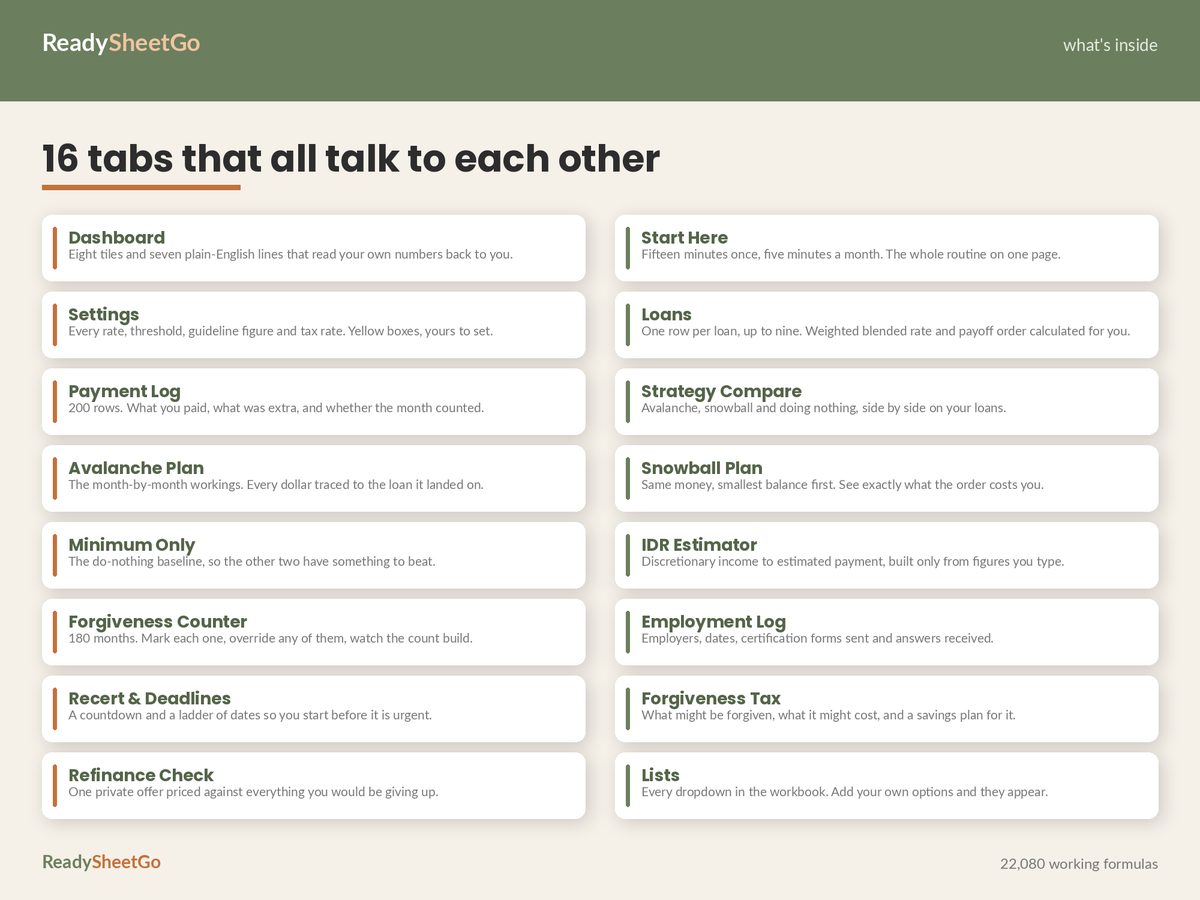
The Number the Quote Is Really Comparing Against
A refinance offer implicitly competes with your weighted blended rate, not your worst loan. Multiply each balance by its rate, sum, divide by total balance: 6.6406%. Any quote above that is worse than doing nothing, however much better it looks than the 9.25% loan you have been staring at.
But 6.6406% is not the bar either. It is slightly too generous to the refinance.
Consolidating six loans into one removes something valuable: the ability to point every extra dollar at the 9.25% loan first. A targeted avalanche is already earning you a rate somewhere above your blended average, because it kills the expensive debt earliest. Once everything is one loan at one rate, that advantage is gone.
Solving for the rate at which refinancing draws exactly level, at an identical monthly payment:
Break-even refinance rate: 6.249%
Roughly 0.39 points below the blended rate. A 6.5% offer on this portfolio looks like a saving and is actually a small loss.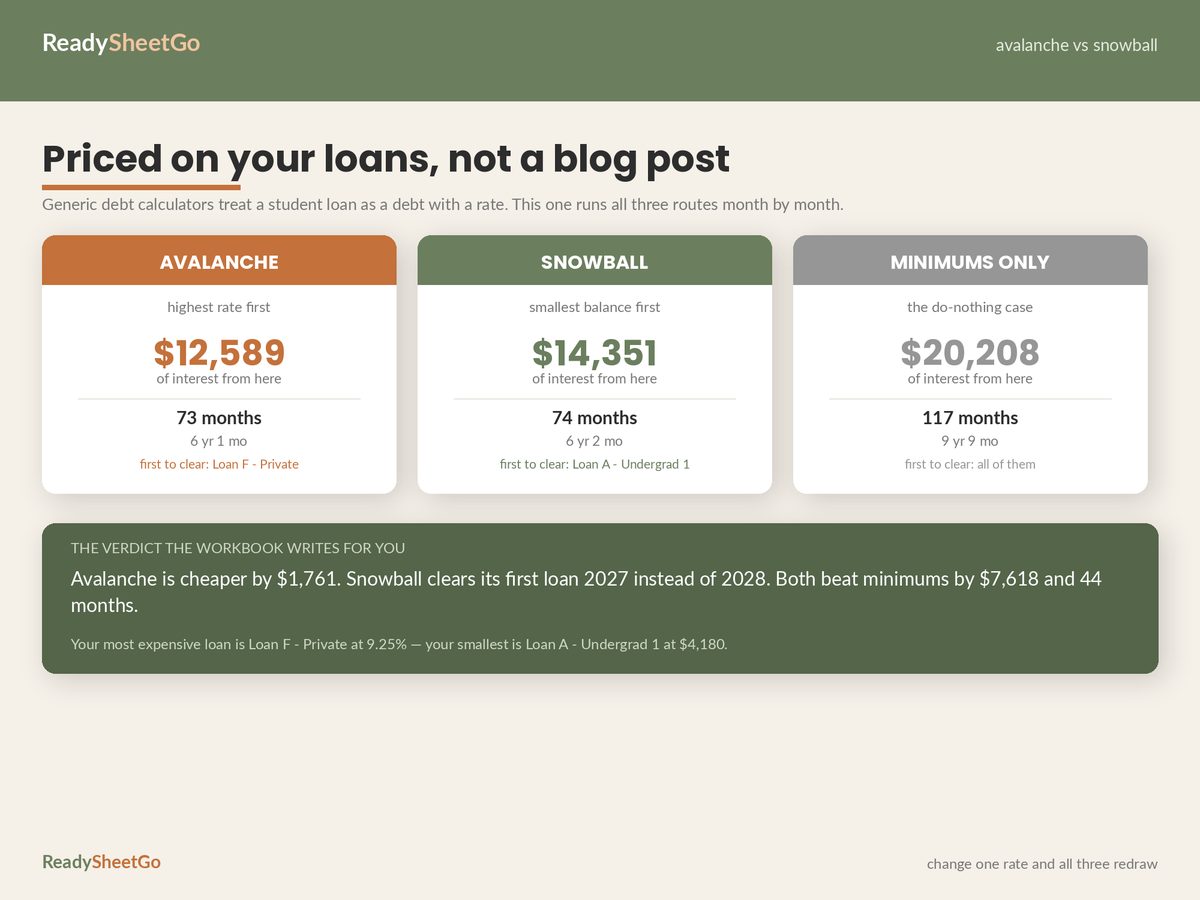
What the Refinance Is Worth — Both Ways
Everything below assumes the avalanche method with a $250 monthly extra, so the total outflow is $1,037.
Scenario 1 — you keep paying $1,037 a month.
| Months | Debt-free | Total interest | vs keeping | |
|---|---|---|---|---|
| Keep all six loans | 73 | Sep 2032 | $12,589.42 | — |
| Refinance everything @ 4.89% | 69 | May 2032 | $9,285.78 | saves $3,303.64, 4 months |
| Refinance private loan only @ 4.89% | 71 | Jul 2032 | $11,066.91 | saves $1,522.51, 2 months |
Scenario 2 — you pay the new required minimum instead.
| Monthly | Months | Debt-free | Total interest | |
|---|---|---|---|---|
| Keep all six, minimums only | $787 | 117 | May 2036 | $20,207.65 |
| Refinance everything, pay $656.95 | $656.95 | 121 | Sep 2036 | $16,580.93 |
There it is. Take the lower payment the refinance offers and you finish four months later than doing nothing at all. The interest bill falls, because 4.89% is genuinely cheaper than 6.6406% — but you are in debt longer, and you have moved $52,368.88 of federal balance into a private contract to get there.
This is the mechanism behind most refinance marketing. A meaningful share of any advertised “saving” comes from the term, not the rate. The rate creates the opportunity; holding your payment constant is the thing that converts it into money. If you cannot commit to that in writing to yourself, the refinance is worth much less than the quote implies.
The Half of the Decision That Is Not Arithmetic
$3,303.64 is the entire prize for refinancing everything. To collect it, 84.12% of this portfolio leaves the federal system permanently.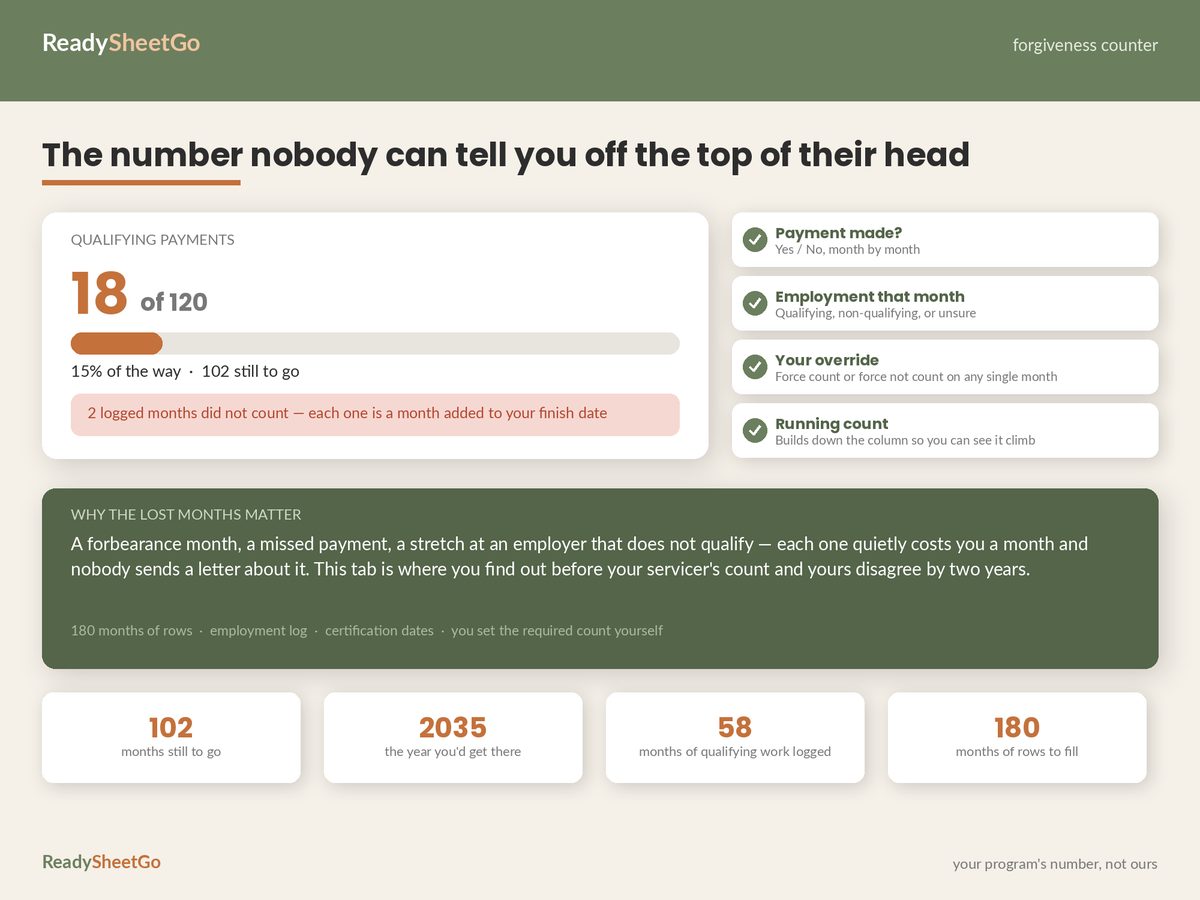
Federal loans carry features private loans do not: payments that can be tied to your income rather than your balance, eligibility for forgiveness routes, deferment and forbearance provisions, and discharge protections in certain circumstances. Which of those apply to you depends on your loan types and on current rules, so establish the list from studentaid.gov and your servicer rather than from any article — including this one. What is not in dispute is the direction of travel: the move is one-way. There is no mechanism to refinance back.
So the honest version of the question is not “is 4.89% better than 6.64%”. It is:
Is $3,303.64 worth more to me than everything my federal loans currently carry?
For a borrower with a large emergency fund, stable high income and no interest in forgiveness, that can be a reasonable yes. For a borrower whose income might fall, who works in a sector with a forgiveness route, or who has any qualifying payments already counted, it is a clear no — and the qualifying count you have already accumulated is worth vastly more than three thousand dollars.
The Move Most People Should Consider First
Refinance only the private loan.
Loan F is $9,884.61 at 9.25%. It carries no federal protections, because it never had any. Moving it from 9.25% to 4.89% is purely a rate decision with nothing to weigh against it — and it captures $1,522.51 of the $3,303.64, about 46% of the total benefit, at zero cost in optionality.
That is the trade to make first, and for many borrowers it is the only one worth making. The remaining $1,781.13 is what you are being asked to hand over $52,368.88 of federal balance to obtain.
A Four-Step Check Before You Sign
- Calculate your blended rate, then subtract roughly 0.4 points for the targeting you give up. That is your real bar. Any offer above it is a loss dressed as a saving.
- Price the offer twice — once at the new required payment, once at your current total outflow. The gap between those two answers is the whole game, and only the second one is a saving.
- Split federal from private. Price a private-only refinance separately. It is frequently most of the benefit with none of the trade-off.
- Write down what you are giving up, from your servicer and studentaid.gov, before you look at a single rate. If that list is short and irrelevant to your life, proceed. If it is not, the number on the quote is not the number that matters.
For the full method behind these figures — the six columns per loan, the blended rate calculation and the three payoff routes — see the complete guide to tracking every loan and your real payoff date. And if the appeal of refinancing was really just finishing sooner, an extra $100 a month does 28 months of it without signing anything away.
Featured on ReadySheetGo
Student Loan Payoff, IDR & Forgiveness Progress Tracker — $14.99
The Refinance Check tab prices one private offer against everything you would be giving up. Enter the quoted rate, term and payment, and it sets the new schedule against your current loans, shows the federal share of your balance that would leave the system, and lists the protections attached to it — so the decision is framed as a trade rather than a rate comparison.
It reads from the Loans tab, which takes one row per loan, up to nine, federal and private together, and returns your weighted blended rate, total minimum and interest per month and per day — the actual number any offer has to beat. Strategy Compare then runs avalanche, snowball and minimum-only as full month-by-month simulations so you can see what your existing loans do before you replace them, which is the comparison most refinance quotes quietly skip.
Sixteen tabs and 22,080 formulas in total, including a 200-row Payment Log, an IDR Estimator that walks from counted income to an estimated payment and tells you whether it covers your interest, a 180-row Forgiveness Counter with an override on every month, a recertification countdown with warnings at 90, 60, 30 and 7 days, and a Forgiveness Tax projection.
Every programme figure is a yellow input box you fill in from your own servicer’s current numbers. Nothing is baked in. Sample data pre-filled across six loans. Works in Excel and Google Sheets, no macros and no add-ons.
Get the Student Loan Payoff, IDR & Forgiveness Tracker →
Frequently Asked Questions
What rate does a student loan refinance need to beat?
Not your highest rate and not quite your blended rate — a bit below it. On the portfolio worked through here the blended rate is 6.6406%, but the break-even refinance rate at an identical monthly payment is 6.249%. The difference exists because consolidating six loans into one removes your ability to attack the 9.25% loan first, so the refinance has to beat the blended rate by roughly 0.4 points just to draw level with what a targeted payoff was already doing.
Is refinancing student loans actually worth it?
It depends entirely on whether you keep paying the old amount. Refinancing $62,253.49 from a 6.6406% blend to 4.89% saves $3,303.64 and four months if the total monthly payment stays at $1,037. Take the lower required payment of $656.95 instead and the same refinance finishes 121 months out — four months later than doing nothing. The rate creates the opportunity; holding the payment constant is what converts it into money.
Should I refinance federal student loans with a private lender?
Refinancing federal loans with a private lender replaces federal terms with that lender's terms, permanently and irreversibly. Whatever income-linked payment options, forgiveness eligibility, deferment provisions or discharge protections your loans currently carry do not survive the move. In the worked example, 84.12% of the balance is federal, so the whole $3,303.64 of savings requires moving $52,368.88 out of the federal system for good. Establish what you are giving up from studentaid.gov and your servicer before comparing rates.
Can I refinance only some of my student loans?
Usually yes, and it is often the better trade. In the worked portfolio, refinancing only the 9.25% private loan captures $1,522.51 of the $3,303.64 total benefit — about 46% — while leaving every federal loan and every federal protection untouched. Private loans carry no federal features to lose, so refinancing them is a rate decision rather than a rights decision.