The Cash Stuffing Method for Irregular Income
If your paycheck is different every time — freelance invoices, commission, tips, gig work, or a small business that has good weeks and lean ones — the standard “split your monthly pay into envelopes” advice falls apart. You can’t divide a paycheck you can’t predict. But the cash envelope system actually works beautifully on irregular income, as long as you flip the order of operations: instead of funding envelopes from a fixed plan, you fund them in priority order from whatever actually lands. Here’s exactly how.
The core shift: fund in priority order, not by a fixed plan
On a steady salary you can say “every payday, $600 to groceries, $200 to gas.” On irregular income you can’t, because some weeks $800 shows up and some weeks $180 does. So you don’t assign fixed amounts to a fixed schedule. Instead you build a priority ladder — a ranked list of envelopes from most essential to most optional — and every time money arrives, you pour it down the ladder from the top until it runs out.
Rent gets filled before groceries. Groceries before gas. Gas before eating out. Eating out before “fun money.” Fun money before extra savings. In a strong week you make it all the way down the ladder and overflow into savings. In a lean week you might only fill the top three rungs — and that’s fine, because the top three are the ones that keep the lights on.
Build your priority ladder
Rank every envelope. A typical ladder for a freelancer: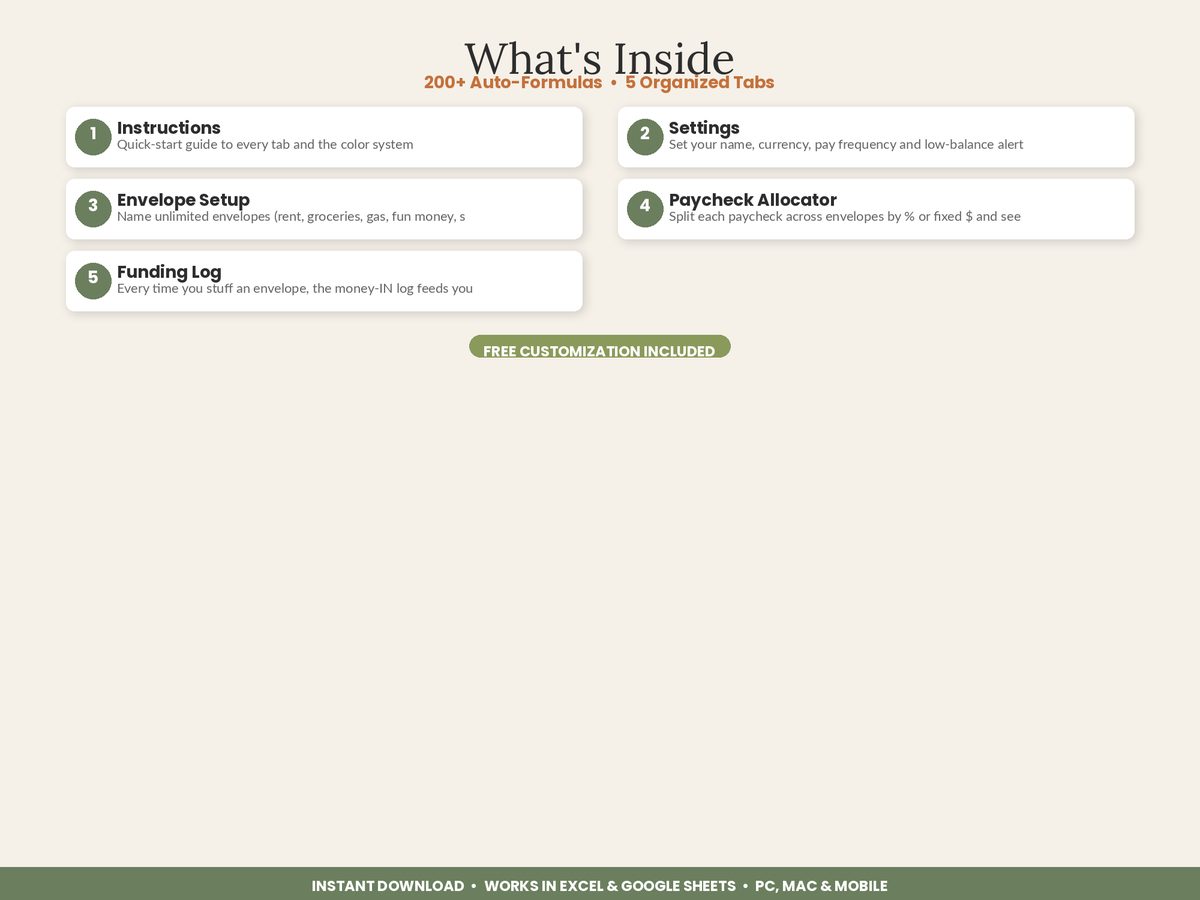
- Tax set-aside (pay yourself last means paying the IRS never — set aside taxes first)
- Rent / housing
- Groceries
- Utilities & minimum bills
- Transport / gas
- Buffer fund (until one month of expenses is built)
- Eating out
- Fun / personal
- Sinking funds (car, Christmas, annual software)
- Extra savings / debt paydown
The exact order is yours, but the rule is: anything that causes a real problem if unfunded goes near the top.
Anchor your essentials to a lean month
Here’s the second key move. Look back over the last 6–12 months and find your lowest earning month. Set the targets for your essential envelopes (rungs 1–5) so that they’re fully coverable in that lean month. That’s your baseline. Now your must-pay categories are safe even in a bad stretch, and everything you earn above the baseline becomes surplus you consciously assign to buffer, sinking funds, and savings.
This is the opposite of what most people do, which is build their lifestyle around a good month and then panic in a slow one.
A worked example
Say you’re a freelancer and your income over three recent weeks was $1,400, then $500, then $980. Your priority ladder targets (monthly) are: Tax 20% of income, Rent $1,000, Groceries $500, Utilities $180, Gas $150, then buffer/fun/savings below.
Watch how funding works week by week:
Week 1 — $1,400 arrives:
- Tax set-aside (20%): $280 → done
- Rent envelope: fill toward $1,000 → put $700 in, $300 still needed
- Remaining $420 stops here — rent isn’t full yet, so nothing below gets funded
Week 2 — $500 arrives:
- Tax (20%): $100 → done
- Rent: needs $300 more → fill it → rent now fully funded
- Remaining $100 → Groceries envelope (needs $500) → now at $100
Week 3 — $980 arrives:
- Tax (20%): $196 → done
- Groceries: fill the remaining $400 → groceries fully funded
- Utilities $180 → funded
- Gas $150 → funded
- Remaining $54 → into the buffer fund
By the end of three uneven weeks, every essential is funded and $54 started your buffer — even though no single paycheck could have covered the month. The ladder did the work.
The step-by-step for your own irregular income
- [ ] List every envelope and rank them from most to least essential
- [ ] Find your lowest-income month in the last year
- [ ] Set essential envelope targets to fit that lean month
- [ ] Each time income arrives, set aside taxes first (if self-employed)
- [ ] Pour the rest down the ladder, filling each envelope before moving down
- [ ] Never fund an envelope from money you haven’t received yet
- [ ] Send any overflow past the bottom rung to your buffer, then savings
- [ ] Once the buffer holds one month of expenses, start each month pre-funded
Why a digital tracker matters more here
With irregular income, the math gets fiddly — partial fills, “how much does this envelope still need,” percentage tax set-asides on every deposit, and a buffer that grows in uneven chunks. Doing that by hand invites mistakes exactly when you can least afford them.
The Cash Stuffing & Cash Envelope Budget Tracker handles the variable-income case directly. The Paycheck Allocator lets you split each deposit — however big or small — across envelopes by percentage or fixed dollars, with a “left to allocate” check so you always know what’s still unassigned. The dashboard shows funded, spent, and remaining per envelope so you can see at a glance which rungs are still short, and unspent balances roll over automatically so a strong week’s overflow carries into the next. Because it works in Excel and Google Sheets on your phone, you can allocate a deposit the moment it clears.
This guide is one piece of the bigger picture — for the full digital envelope workflow, start with the main guide on how to do cash stuffing digitally without carrying cash.
The bottom line
Irregular income doesn’t break the cash envelope system — it just changes the order. Rank your envelopes, anchor your essentials to a lean month, and fund down the ladder from whatever actually arrives. Fund only real money, build a one-month buffer, and a bumpy income slowly becomes a steady one.
Featured on ReadySheetGo
The Cash Stuffing & Cash Envelope Budget Tracker makes priority-ladder funding effortless: split any paycheck by % or fixed $, track funded-vs-remaining on a live colour-coded dashboard, and let unspent cash roll over automatically. 9 tabs, unlimited envelopes, Excel + Google Sheets, pre-filled samples. Instant digital download — $13.99.
Frequently Asked Questions
How do you do cash stuffing when your income changes every month?
Fund your envelopes in priority order from whatever actually arrives, rather than from a fixed monthly plan. Rank your envelopes from most essential (rent, groceries, minimum bills) to least (fun money, extra savings). When money comes in, fill the top envelopes first and only move down the list if cash remains. In a lean week the bottom envelopes get little or nothing; in a strong week you fill them and overflow into savings.
Should I budget my irregular income based on my lowest month?
Yes — that's the safest baseline. Set your essential envelope targets to what you can cover in a low-earning month so your must-pay categories are always funded. Treat income above that baseline as a bonus you allocate to sinking funds, debt, and savings when it arrives, instead of building fixed spending around your best months.
How can I stop overspending an envelope in a bad income week?
Fund envelopes only from money you've already received, never from money you expect. If the cash isn't in your account, the envelope doesn't get stuffed. A digital tracker that shows each envelope's live balance and turns it red when empty makes this automatic — you check the balance before spending and simply stop when it's gone.
What's a good buffer to smooth out irregular income?
Aim to build one month of essential expenses in a 'buffer' or 'income holding' envelope. You pay this month's bills from last month's income, which turns a bumpy income into a steady one. Until the buffer is built, fund essentials first from each deposit and route any surplus toward growing that buffer.