Digital Cash Envelopes vs the Paper Envelope System
Maybe you tried paper cash stuffing — the labelled envelopes, the ATM run, the satisfying thunk of cash into sleeves — and it worked for a few weeks before the friction wore you down. Or maybe you’re deciding which version to start with. Either way, the real question isn’t “which is trendier,” it’s “which one will you actually keep doing?” Here’s an honest, side-by-side comparison of digital versus paper cash envelopes, and how to switch to digital without losing the discipline that made the method work in the first place.
Both versions share the same engine
Before the differences, be clear on what’s identical. Paper and digital cash envelopes both deliver the three things that make the method work: every dollar gets assigned a job, each category has a hard limit, and you can always see what’s left. That engine is the same. So this isn’t a debate about whether one “really counts” — both are genuine cash stuffing. The difference is purely in the mechanics of tracking, and that’s where one clearly pulls ahead for most people.
Side by side
| Paper envelopes | Digital cash envelopes | |
|---|---|---|
| The math | You do it in your head | Calculated automatically |
| Getting the money | ATM trip every payday | No withdrawal — money stays in bank |
| Overspend alert | You notice the envelope is thin | Envelope turns red instantly |
| Online & card shopping | Awkward — cash only | Works normally, just log it |
| Splitting a paycheck | Manual counting | Allocator splits by % or $ |
| Rollover of unspent cash | Manual, easy to lose track | Automatic |
| Record of spending | None, unless you jot it | Full logged history |
| Risk of loss/theft | Real — it’s physical cash | None — money’s in the bank |
| Interest on savings | $0 (cash earns nothing) | Money can sit in savings and earn |
| The tactile feeling | Strong — you handle real money | Absent (the one real trade-off) |
Where paper genuinely wins
Let’s be fair. Paper has one real advantage: the physical feeling. Handling actual cash, seeing an envelope empty, and having to hand over bills creates a visceral “this is my last $20” moment that a screen doesn’t fully replicate. For some people — especially early on, when building the habit — that tactile friction is genuinely motivating. If that’s what makes you stick, paper is doing its job.
Where digital wins — usually decisively
For most people, though, the friction of paper is exactly what kills the habit: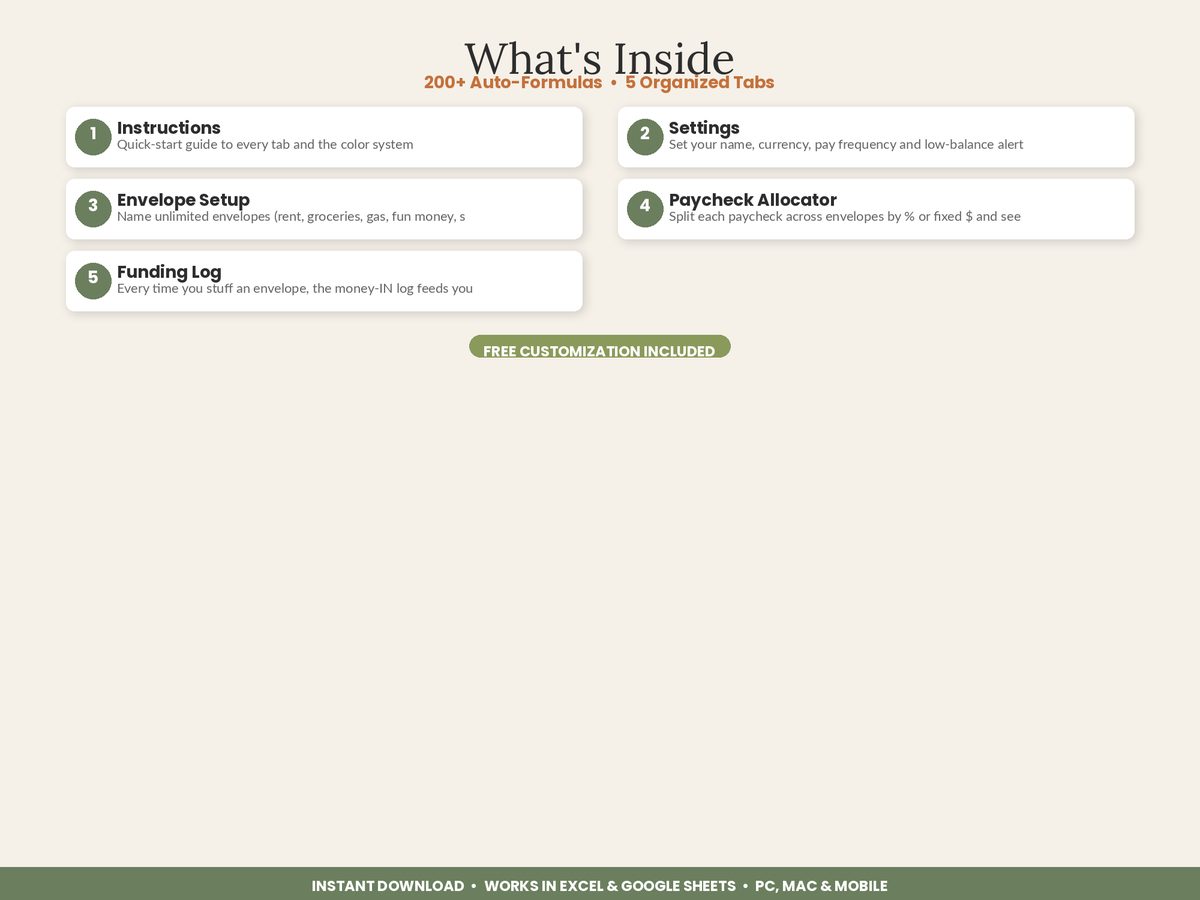
- No ATM runs. The single biggest reason people quit is the recurring chore of withdrawing exact cash every payday. Digital removes it entirely.
- You can shop online and use your card. Modern life is mostly cashless. Paper envelopes fight that; digital works with it — spend normally, just log it against the envelope.
- The math is done for you. No mental subtraction, no re-counting envelopes. Balances update the instant you log a purchase.
- Nothing gets lost or stolen. Your money never leaves the bank. A misplaced envelope is a bad afternoon; misplaced cash is gone.
- Your savings can actually earn. Cash in a drawer earns nothing. Sinking-fund money tracked digitally can sit in a savings account earning interest.
- You get a record. Paper leaves no history. Digital logs every purchase, so month-end reviews are real.
How to switch from paper to digital without losing the discipline
The mistake people fear is that going digital means going back to a vague banking-app budget they’ll ignore. It doesn’t — as long as you keep the envelopes. Here’s the clean switch:
- [ ] List your existing paper envelopes and their monthly targets
- [ ] Recreate each one as a digital envelope with the same name and target
- [ ] Deposit any physical cash you’re holding back into your bank
- [ ] On your next payday, allocate income across the digital envelopes instead of withdrawing
- [ ] Spend from your debit card or bank balance as normal
- [ ] Log every purchase against its envelope, right at the checkout on your phone
- [ ] Check the envelope balance before you spend — same habit, new medium
- [ ] At month-end, review, roll over sinking funds, and adjust
You keep every category and every limit. The only thing that changes is that the tracking moves from paper sleeves to a file — so there’s zero learning curve on the actual method.
The tool that makes digital feel like envelopes
The reason a plain banking app fails is it shows one big balance, not per-category limits. A proper envelope tracker restores the exact feeling of separate envelopes on screen. The Cash Stuffing & Cash Envelope Budget Tracker recreates the paper experience digitally: unlimited named envelopes each with their own target, a Paycheck Allocator that “stuffs” each envelope by percentage or fixed dollars, and a dashboard where every envelope shows funded, spent, and remaining — colour-coded green, yellow, and red so an overspend hits you as hard as an empty paper sleeve would. Unspent cash rolls over automatically, and because it runs in Excel and Google Sheets on your phone, you log spending at the register just like counting out bills — minus the ATM trip. It’s the discipline of paper with none of the friction that makes people quit.
To see the full step-by-step system this fits into, read the main guide on how to do cash stuffing digitally without carrying cash.
The bottom line
Paper and digital cash envelopes run the same engine — assign every dollar, cap every category, always know what’s left. Paper’s only real edge is the tactile feeling; digital wins on ATM-free convenience, automatic math, instant alerts, online shopping, rollover, safety, and a real spending record. If paper didn’t stick, it probably wasn’t the method that failed — it was the friction. Move the envelopes to a screen and keep going.
Featured on ReadySheetGo
The Cash Stuffing & Cash Envelope Budget Tracker gives you the paper-envelope discipline in digital form: unlimited envelopes, a paycheck allocator, a live colour-coded dashboard, automatic rollover, and an annual savings scoreboard — no ATM trips, no lost cash, no monthly fees. Excel + Google Sheets, pre-filled samples. Instant digital download — $13.99.
Frequently Asked Questions
Are digital cash envelopes as effective as physical ones?
For most people digital is at least as effective and often more so. Both deliver the core discipline — a hard limit per category and live visibility of what's left. Digital adds automatic math, instant overspend alerts, paycheck splitting, and rollover, and removes the risk of lost or stolen cash. The one edge paper has is the physical, tactile feeling of handling money, which some people find more motivating.
Why do people quit the paper cash envelope system?
The most common reasons are practical friction: needing to visit an ATM regularly, awkwardness paying with cash or making change, not being able to shop online from an envelope, the risk of losing cash, and no easy record of what you spent. Digital cash stuffing keeps the discipline while removing every one of those friction points, which is why many people switch after trying paper.
How do I switch from paper envelopes to a digital system?
Recreate each paper envelope as a digital envelope with the same monthly target, deposit any physical cash you're holding back into your bank, and start logging spending against the matching digital envelope. You keep the exact same categories and limits — only the tracking moves from paper sleeves to a spreadsheet or app, so there's no learning curve on the method itself.
Can you do the cash envelope system without going to the ATM?
Yes — that's the main appeal of digital cash envelopes. You never withdraw cash. You allocate your income across envelopes on a tracker, spend from your normal debit card or bank account, and log each purchase against the right envelope. The money stays in your bank the whole time, so there are no ATM trips, no change to carry, and no cash to lose.