Farmers Market vs Custom Orders: Which Makes a Home Bakery More Money?
Both channels feel productive. A market day ends with an empty table and a full cash box; a custom order ends with a happy customer and a bank transfer. The question nobody runs the numbers on is which one actually pays better for the hours it takes — and the gap is far bigger than most home bakers expect.
Here is the comparison, run on the same costs, with every assumption on the table.
The Setup
Both scenarios use the same costing: brownies at $0.568 of ingredients and $0.35 of packaging each, cookies at $0.377 and $0.20, and a $20/hour labor rate on 2 minutes per item. Where hours are estimated, they are labelled.
Scenario A: A Saturday Farmers Market
A real market day from a home bakery’s log: 62 items sold at $4.00 = $248 gross, booth fee $35.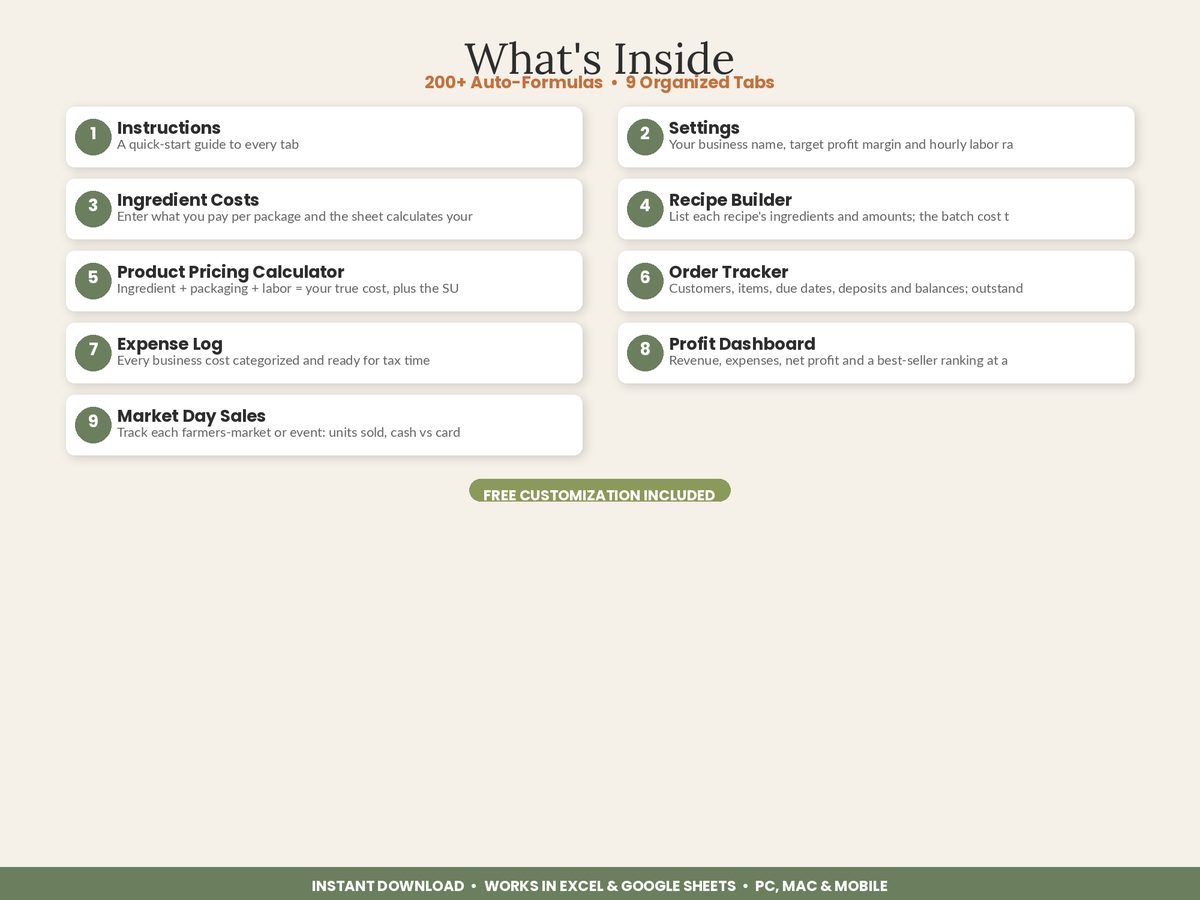
| Line | Amount |
|---|---|
| Gross sales | $248.00 |
| Ingredients + packaging (62 × $0.918) | −$56.92 |
| Booth fee | −$35.00 |
| Left to pay for your time | $156.08 |
Now the hours. Baking 62 items at 2 minutes each is 2.1 hours. Packing, loading and the drive there and back is roughly 1.5 hours. And the booth itself — arrive to set up, sell, tear down — is about 6 hours.
Total: 9.6 hours → $16.26 per hour.
That is below the $20/hour the items were costed at. The market day did not just fail to make a profit on top of wages — it did not fully cover the wages.
Scenario B: A 60-Cookie Custom Order
Same baker, an office-party order: 60 cookies at $3.00 = $180.
| Line | Amount |
|---|---|
| Order total | $180.00 |
| Ingredients + packaging (60 × $0.577) | −$34.62 |
| Left to pay for your time | $145.38 |
Hours: 60 cookies at 2 minutes is 2.0 hours, plus about 0.5 hours to drop it off.
Total: 2.5 hours → $58.15 per hour.
The Difference Is Not the Prices — It’s the Unpaid Hours
| Market day | Custom order | |
|---|---|---|
| Gross | $248 | $180 |
| Non-labor costs | $91.92 | $34.62 |
| Hours consumed | 9.6 | 2.5 |
| Effective hourly | $16.26 | $58.15 |
The market sold more product at a higher unit price and paid you roughly a quarter as well per hour. The cause is structural: six of those hours produced nothing. Standing at a booth is not baking. Your per-item labor costing captures the two minutes a brownie takes — it has no idea you spent a Saturday selling it.
Bigger events do not automatically fix this. A craft fair from the same log — 95 units, $410 gross, $60 booth fee — needs roughly 3.2 hours of baking plus about 8 hours at the booth and 2 hours of travel and setup. That is $262.79 over 13.2 hours: $19.91 an hour. Better, still under the rate you costed at.
What Markets Are Actually For
None of this means stop doing markets. It means stop mistaking them for your profit engine. What a market genuinely buys you:
- Customers who become custom orders. The hundred-cupcake wedding order that pays several times a booth hour usually met you at a booth first. Markets are a customer acquisition cost that occasionally pays for itself the same day.
- Cash today, no deposits to chase. Custom orders come with balances due and people who go quiet. Market money is in the box before you drive home.
- Live product testing. You find out what people pick up, what they put down and what price makes them hesitate — in one afternoon, for the cost of a booth fee.
Judge a market on those, and on whether it beats your alternative use of the Saturday. Just do not budget your year on it.
The Two Numbers That Fix a Bad Market Day
Units sold per booth hour. This is the whole game. At 62 units across 6 booth hours you are at about 10 an hour. Get to 20 — a busier market, a better pitch, a second pair of hands — and the same day pays roughly double, because the booth hours were fixed all along.
Units baked versus units sold. Everything you carry home is a total loss: ingredients, packaging and the baking time, all spent, none recovered. Bake 80 to sell 62 and you have quietly thrown away $16.52 in ingredients and packaging plus 36 minutes of labor — around $28 off a day that was only making $156 in the first place. Log both numbers for every event and the right quantity to bake reveals itself within a season.
The third lever is price. Market buyers compare you to the stall opposite, not the supermarket, and 50 cents on a $4 item is 12.5% more revenue at zero extra cost or time — worth more than any efficiency you will find in the kitchen. What you can charge starts from knowing what each item costs, which is the pricing formula this all rests on. And when the market does produce a big custom enquiry, what a boxed dozen should cost is the quote you want ready before they ask.
Featured on ReadySheetGo
The Home Bakery & Cottage Food Pricing Calculator tracks both channels side by side. The Market Day Sales tab logs each event with units sold, cash versus card, booth fee and net take-home per event. The Order Tracker logs custom orders with due dates, deposits and balances due, flagging anything still outstanding. Both feed a Profit Dashboard showing total revenue, expenses, net profit, margin and a best-seller ranking — so you can see which channel and which product is really carrying the business. Backed by the ingredient, recipe and pricing tabs that give you a true cost per item in the first place. 8 tabs, sample data included, works in Excel and Google Sheets. One-time purchase — $17.99 instant download.
Sales figures and booth fees are from a home bakery’s event log; hours for booth time, travel and setup are labelled estimates. Substitute your own.
Frequently Asked Questions
Is selling at a farmers market worth it for a home baker?
It depends almost entirely on how many hours the booth costs you. In the worked comparison here, a market day grossing $248 on 62 items returns about $16 an hour once baking, travel, setup and six hours of standing at the booth are counted — against roughly $58 an hour on a 60-cookie custom order. Markets earn their place through customer acquisition and cash flow, not hourly rate.
How do I work out my profit per hour at a market?
Take gross sales, subtract ingredient and packaging costs and the booth fee, then divide by every hour the event consumed — baking, packing, travel, setup, the booth itself and teardown. The booth hours are what people leave out, and they are usually the largest block.
Should I raise my prices at a farmers market?
Test it before you assume you cannot. Market buyers are comparing you to the stall opposite, not to a supermarket, and a 50-cent rise on a $4 item is a 12.5% revenue increase with no extra cost or time. Track average sale per unit per event and you will see within two or three markets whether it cost you volume.
What is the biggest hidden cost of selling at a market?
Unsold stock, followed by unpaid booth hours. Everything you bake and do not sell is 100% loss on ingredients, packaging and your baking time. Logging units sold against units baked for each event turns that from a vague feeling into a number you can plan against.