How to Price Baked Goods for Profit: The Home Bakery Pricing Formula
You have people asking for your cookies. Someone wants a hundred cupcakes for a wedding. And you have no idea whether the number you quoted last week made you money or quietly cost you money — because the honest answer is you have never worked out what a single cookie costs you to make.
This is the pricing method that fixes it: cost every ingredient down to the ounce, add packaging, pay yourself for your time, then set a price that hits a margin you chose on purpose. It takes an afternoon to set up once and it answers every quote you get asked for afterwards.
Why “Ingredients Times Three” Prices You Below Cost
The most repeated rule in home baking is to multiply your ingredient cost by three. It is fast, it feels safe, and in a lot of cases it prices you underwater.
Here is a real batch, costed out. These are the ingredient prices used throughout this guide, and every figure below is calculated from them: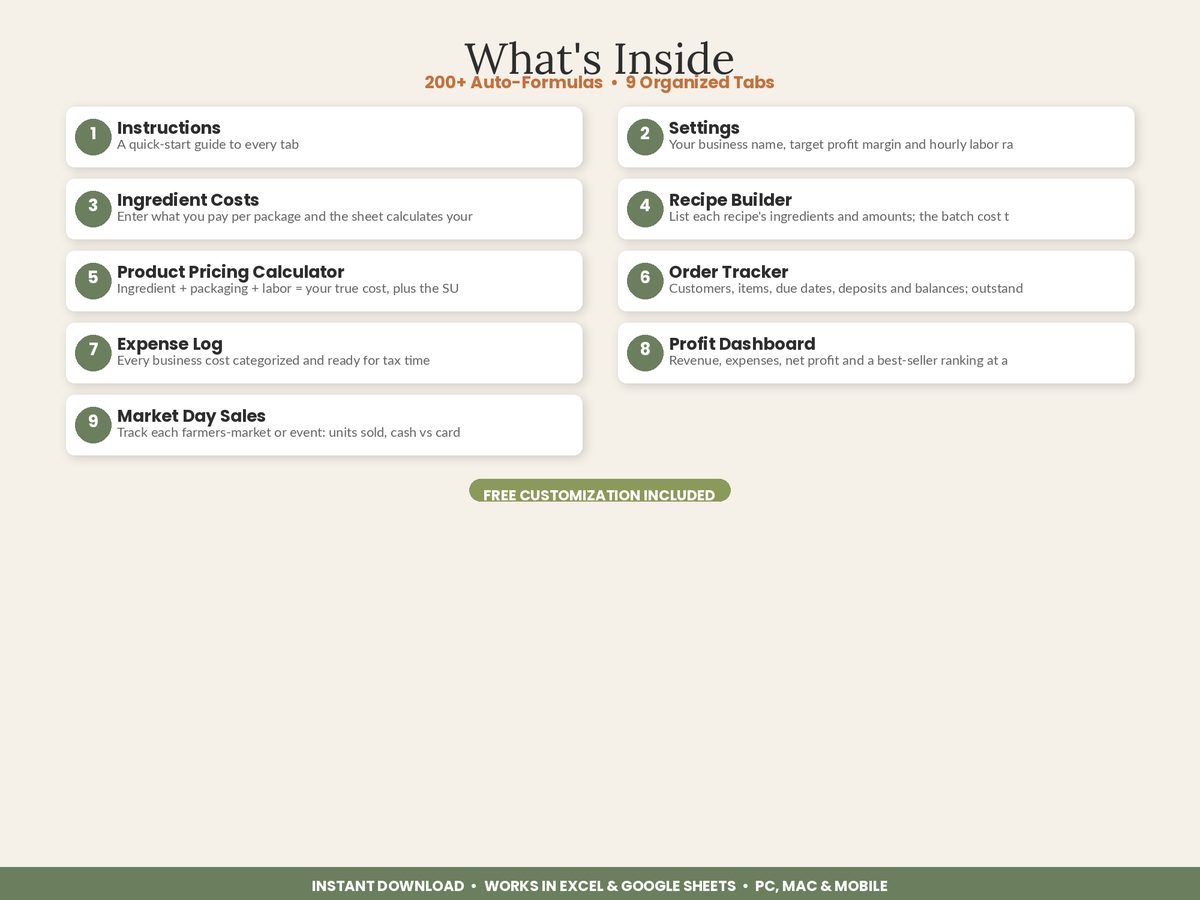
Chocolate chip cookies, batch of 24
| Ingredient | Amount | Cost per unit | Line cost |
|---|---|---|---|
| All-purpose flour ($4.50 / 5 lb) | 16 oz | $0.056/oz | $0.90 |
| Butter ($4.80 / lb) | 8 oz | $0.300/oz | $2.40 |
| Brown sugar ($2.40 / 2 lb) | 8 oz | $0.075/oz | $0.60 |
| Granulated sugar ($3.20 / 4 lb) | 4 oz | $0.050/oz | $0.20 |
| Eggs ($3.60 / dozen) | 2 each | $0.300 each | $0.60 |
| Vanilla extract ($7.50 / 4 oz) | 0.5 oz | $1.875/oz | $0.94 |
| Chocolate chips ($3.40 / 12 oz) | 12 oz | $0.283/oz | $3.40 |
| Batch total | $9.04 |
That is 37.7 cents of ingredients per cookie. Times three is $1.13.
Now add what the rule leaves out. A bakery box or bag and label runs about 20 cents per cookie. And the batch takes you time — mixing, chilling, baking, cooling, packing, washing up. Call it two minutes per cookie, and pay yourself $20 an hour, which is 66.7 cents.
True cost per cookie: $0.377 + $0.20 + $0.667 = $1.24.
The 3× rule said $1.13. Your cookie costs $1.24 before a cent of profit. Every cookie sold at the “safe” rule-of-thumb price loses you eleven cents and your entire afternoon.
It is not a fluke of cookies, either. A vanilla cupcake in the same costing comes to 44 cents of ingredients — 3× is $1.32 — against a true cost of $2.32 once you add a 55-cent liner-and-box and four minutes of decorating time. The rule fails hardest on exactly the items that take the longest, which are usually the ones you are proudest of.
The Formula That Actually Works
Four numbers per product, then one division.
1. Ingredient cost per item. Cost the whole batch, divide by the batch yield. This only works if you have first converted every package price into a cost per ounce, gram or each — the step-by-step for that conversion is here.
2. Packaging per item. Box, bag, liner, label, ribbon, insert, sticker. Buy in hundreds and divide.
3. Labor per item. (Minutes per item ÷ 60) × your hourly rate. Count everything — shopping, mixing, baking, decorating, packaging, delivery, cleanup. This is the number bakers leave out, and it deserves its own decision.
4. Add them up. That is your true cost per item.
Then price it:
Price = true cost ÷ (1 − target margin)
At a 70% target margin, the cookie prices at $1.243 ÷ 0.30 = $4.14.
Margin Is Not Markup — And the Difference Is Your Whole Profit
This is where most home bakeries lose money while believing they are making it. “Add 70%” and “keep a 70% margin” are completely different instructions.
| Method | Calculation on a $1.24 cookie | Price | What you actually keep |
|---|---|---|---|
| Add 70% on top (markup) | $1.243 × 1.70 | $2.11 | 41% margin |
| Divide by (1 − 0.70) (margin) | $1.243 ÷ 0.30 | $4.14 | 70% margin |
Same words, half the money. Margin is measured against the price; markup is measured against the cost. Pick margin, because margin is what tells you whether the business survives a bad month.
Run the same math across a product line and the picture gets clear fast. Every row below uses $20/hour labor and a 70% target margin:
| Product | Ingredients | Packaging | Labor | True cost | Price at 70% margin |
|---|---|---|---|---|---|
| Chocolate chip cookie (each) | $0.377 | $0.20 | $0.667 (2 min) | $1.24 | $4.14 |
| Vanilla cupcake (each, unfrosted) | $0.440 | $0.55 | $1.333 (4 min) | $2.32 | $7.74 |
| Cream cheese frosting (per cupcake) | $0.456 | — | $0.333 (1 min) | $0.79 | $2.63 |
| Fudge brownie (each) | $0.568 | $0.35 | $0.667 (2 min) | $1.59 | $5.28 |
| Dozen cookies, gift box | $4.519 | $1.50 | $2.667 (8 min) | $8.69 | $28.95 |
Two things jump out of that table.
Labor is the largest line in most items. On the cookie, your time is 54% of the cost. On the cupcake it is 57%. You are not selling flour and sugar — you are selling hours, and the ingredients are almost a rounding error next to them.
Frosting is a product. Cost the cupcake and the frosting as separate lines and a frosted cupcake costs $3.11, not $2.32. Sell that at $4.00 and you keep 89 cents — a 22% margin — while you may well believe you are running at 40%+.
When the Formula Says $7.74 and Your Market Pays $4.50
You will hit this. The formula will hand you a suggested price your customers will not pay, and the temptation is to shrug, charge $4.50 and stop looking. Do the opposite — treat it as information, and change one of the four inputs:
- Cut the minutes, not the quality. Four minutes a cupcake is a decorating decision. A simpler swirl at 90 seconds takes $0.83 out of the cost and moves the same cupcake toward your market’s price without touching an ingredient.
- Raise the batch size. Ingredient cost per item barely moves with volume, but the fixed part of your time — preheating, setup, cleanup — spreads across more units. Doubling a batch you were already making is the cheapest margin you will ever find.
- Change the unit you sell. Nobody blinks at a $28 gift box of a dozen and everybody blinks at a $4 single cookie, even though the box is better value per cookie. Pricing by the dozen is a different conversation entirely.
- Accept a lower margin knowingly. A 45% margin you chose is a business decision. A 22% margin you discovered in December is a year of unpaid weekends.
- Change where you sell it. The same cupcake earns differently at a market booth than in a custom order, and the two channels are worth comparing directly.
What you must not do is leave labor out to make the number work. That does not make the item profitable; it just moves the loss onto you.
The Ingredients That Quietly Set Your Price
When you cost a batch properly you find that a handful of ingredients carry almost all of it. In the cookie batch above, butter ($2.40), chocolate chips ($3.40) and vanilla ($0.94) are $6.74 of the $9.04 batch — 75%. Flour, sugar, eggs and salt are noise.
That matters for two reasons. When the price of butter jumps 30%, you now know exactly what it does to your cost per cookie and you can requote instead of guessing. And when you are hunting savings, you know to buy chocolate in bulk rather than switching flour brands to save fifteen cents a batch.
Vanilla is the usual surprise. At $7.50 for a 4-ounce bottle it is $1.875 an ounce — the most expensive thing in most home bakeries by a wide margin, and half an ounce of it is 10% of your cookie batch.
The Fourth Cost the Formula Doesn’t See: Overhead
Ingredients, packaging and labor cover the cost of making the item. They do not cover the cost of being a bakery. Every month you also pay for things that exist whether or not you bake: your cottage food permit or licence renewal, insurance if you carry it, equipment that wears out, card processing on every sale you take at a booth, mileage to the store and to deliveries, website or listing fees, and the mixer that will eventually need replacing.
None of those belong on a recipe line, which is exactly why they get forgotten. The clean way to handle them is a single overhead per item figure:
Overhead per item = total monthly fixed costs ÷ items you expect to sell that month
Say your fixed costs come to $150 a month and you sell about 400 items. That is 37.5 cents an item — almost as much as the ingredients in a cookie. Add it to your true cost and the cookie moves from $1.24 to $1.62, and the price at a 70% margin from $4.14 to $5.39.
Two practical notes. First, this number gets better with volume: the same $150 across 800 items is 19 cents. Second, if you would rather not carry overhead in every price, the alternative is to treat your target margin as the thing that absorbs it — but then you need the margin high enough to genuinely cover it, which means you still have to know the number. There is no version of this where not knowing helps.
A monthly expense log is what turns overhead from a guess into a figure. Categorise every business cost as it happens — ingredient restocks, packaging, permit and market fees, equipment, mileage, marketing — and the monthly total is sitting there waiting to be divided.
What to Track Once, and What to Track Forever
Set up once: your ingredient list with package price and package quantity, your recipes with quantities, and your labor rate. Those change a few times a year.
Track continuously: orders (customer, item, quantity, price, deposit taken, balance due), expenses (ingredient restocks, packaging, booth fees, equipment, mileage) and event days if you sell at markets. Those three feed the only two numbers that matter at month end — what came in, and what it cost you to make.
If your cost sheet is disconnected from your order log, you will end a good month with a full calendar and no idea whether it paid. Connected, the same data tells you which product earns the most per hour, which one you should stop offering, and how far you are from your monthly sales goal.
Featured on ReadySheetGo
The Home Bakery & Cottage Food Pricing Calculator runs this exact method for you across 8 tabs. Enter what you pay per package and it works out cost per ounce, gram or each automatically. Build each recipe once and the batch cost totals itself. The Product Pricing Calculator then adds packaging and labor and returns your true cost per item, the suggested price to hit your target margin, and your real profit and margin at whatever price you actually charge — so underpriced items flag themselves. Plus an order tracker with deposits and outstanding balances, an expense log ready for tax time, a market-day tab with booth fees and net take-home, and a profit dashboard that ranks your best sellers by margin. Sample data is filled in so you can see how it connects. Works in Excel and Google Sheets. One-time purchase — $17.99 instant download.
Cottage food rules — what you may sell, where, and how much — are set state by state. Check your own state’s cottage food program before you start selling.
Frequently Asked Questions
What is the formula for pricing baked goods?
True cost per item = ingredient cost per item + packaging per item + labor per item, where labor is (minutes per item ÷ 60) × your hourly rate. Then price = true cost ÷ (1 − target margin). At a 70% target margin, an item that costs $1.24 to make prices at $1.24 ÷ 0.30 = $4.14. Dividing by (1 − margin) is what produces a real margin; adding a percentage on top does not.
Is the rule of multiplying ingredient cost by 3 accurate?
Usually no, because it ignores your time. In the worked example on this page, a chocolate chip cookie costs 37.7 cents in ingredients — times three is $1.13. But packaging (20 cents) and two minutes of labor at $20/hour (66.7 cents) bring the true cost to $1.24. The 3× rule prices that cookie below what it actually costs to make.
Should I include my own labor in the price of baked goods?
Yes. Unpaid labor is the single biggest reason home bakeries look profitable and feel exhausting. Pick an hourly rate you would accept from a job, estimate the minutes each item takes including mixing, baking, decorating, packaging and cleanup, and cost it into every item. Profit is what is left after you have paid yourself, not instead of it.
What profit margin should a home bakery aim for?
There is no legal or universal number, but a common target once labor is already inside your cost is 50-70%. Anything below about 30% means a bad ingredient month, a dropped cake or a raised booth fee wipes out the job. If your market will not pay the price your target margin implies, change the product, the batch size or the decorating time rather than quietly working for free.