How Much to Charge for a Dozen Cookies (Costed Out, Not Guessed)
Someone asks what you’d charge for a dozen for their office party, and you have about four seconds to produce a number. Say $12 and you will spend Saturday afternoon working for roughly nothing. Say $30 and you might be leaving money on the table, or you might be the only person in town charging what the box is actually worth.
The way out of that four-second panic is to have costed one dozen, once, properly. Here is that costing.
What a Dozen Actually Costs You
Start with the batch. Using typical grocery prices — flour at $4.50 for 5 lb, butter at $4.80 a pound, chocolate chips at $3.40 for 12 oz, eggs at $3.60 a dozen, vanilla at $7.50 for 4 oz — a batch of 24 chocolate chip cookies costs $9.04 in ingredients. That is $4.52 for a dozen.
Now the two lines everyone forgets.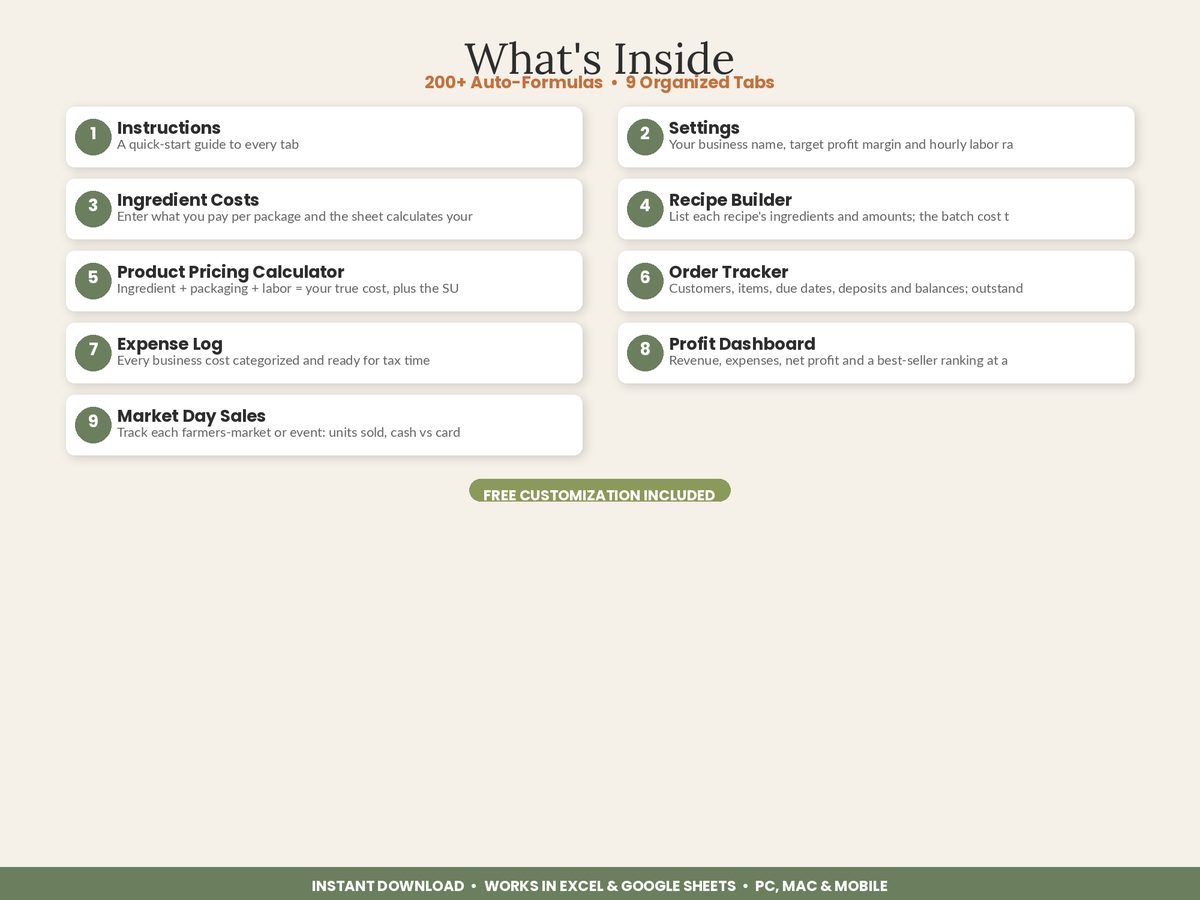
Packaging. A single cookie in a bag runs about 20 cents. A gift box with a label and a ribbon is closer to $1.50 — more than seven times as much, and it is the reason a gift box is a different product from twelve loose cookies.
Your time. Mixing, portioning, baking in batches, cooling, boxing, tying, labelling. Call it eight minutes of your hands on that specific box. At $20 an hour, that is $2.67.
| Line | Cost |
|---|---|
| Ingredients (12 cookies) | $4.52 |
| Gift box, label, ribbon | $1.50 |
| Labor — 8 min at $20/hr | $2.67 |
| True cost per dozen | $8.69 |
So the floor is $8.69 — and that already includes paying yourself $20 an hour. Anything above it is profit on top of wages. Anything below it and you are subsidising a stranger’s office party.
What the Margin Math Says
Once you have a true cost, the price follows from the margin you want:
Price = true cost ÷ (1 − target margin)
| Target margin | Price for a dozen | Profit per box |
|---|---|---|
| 40% | $14.48 | $5.79 |
| 50% | $17.37 | $8.69 |
| 60% | $21.72 | $13.03 |
| 70% | $28.95 | $20.26 |
Note what $18 — the price a lot of home bakers land on by instinct — actually delivers: $9.31 of profit and a 51.7% margin. That instinct is not bad. It is a genuinely healthy price at these costs, sitting just above a 50% margin, and it is defensible if a customer pushes back.
Note also how fast the number moves. A 70% margin, which is a perfectly normal target in a business where labor is the main input, implies $28.95. If that feels impossible for your market, that is real information about your market — not a reason to abandon the margin quietly.
Why a Dozen Should Not Cost Twelve Singles
The single cookie in the full pricing guide costs $1.24 and prices at $4.14 at a 70% margin. Twelve of those is $49.68. Nobody is paying that for a box of cookies, and they should not have to — because the dozen genuinely costs you less per cookie to produce:
- Packaging drops. Twelve individual bags at 20 cents is $2.40. One gift box is $1.50.
- Labor per cookie drops. Two minutes a cookie is 24 minutes for twelve; eight minutes for the boxed dozen. Setup, preheat and cleanup happen once regardless of how many cookies come out of them, so the more you box together, the less each one carries.
Per cookie, the boxed dozen costs 72 cents against $1.24 for a single. That is why a dozen at $18 — $1.50 a cookie — can feel like good value to the buyer and still be a better hourly rate for you than selling twelve singles at $3.
This is also the answer to bulk requests. When someone wants five dozen, do not discount off $18. Recost it: packaging per box may drop with volume, and the labor per box falls again because you are running one long session instead of five short ones. Quote from the new cost at the margin you want and you will often find you can offer a real discount and earn more per hour than the single-box price.
Setting the Price Your Market Will Pay
Three practical moves once you have the cost:
Price in tiers, not one number. A half dozen in a bag, a dozen in a gift box, and a two-dozen party tray are three products with three costs and three prices. Buyers self-select, and the tray usually earns you the best hourly rate of the three.
Let packaging carry the premium. The gap between a $12 bag and a $22 box is mostly perception, and perception costs you $1.30 in cardboard. Presentation is the cheapest margin available to a home baker.
Requote when butter moves. Butter and chocolate are 75% of that cookie batch’s ingredient cost. A 30% jump in butter is not a rounding error — it is a real change to your floor, and if your cost sheet is live you will see it the week it happens rather than the following January.
Featured on ReadySheetGo
The Home Bakery & Cottage Food Pricing Calculator is built for exactly this question. Enter what you pay per package and it converts to cost per ounce, gram or each; build the recipe once and the batch total fills itself; then the Product Pricing Calculator turns any batch into a per-item and per-box cost, gives you the suggested price for your target margin, and shows your real profit and margin at the price you actually charge — so a $12 dozen flags itself before you commit to it. Includes an order tracker with deposits and balances due, an expense log, a market-day tab, and a profit dashboard ranking products by margin. 8 tabs, sample data included, works in Excel and Google Sheets. One-time purchase — $17.99 instant download.
All figures above are worked from the stated ingredient prices, a $20/hour labor rate and the stated minutes per item. Cottage food rules vary by state — check your state’s program before selling.
Frequently Asked Questions
How much does a dozen homemade cookies cost to make?
In the worked example on this page, a dozen chocolate chip cookies costs $4.52 in ingredients, $1.50 in gift-box packaging and $2.67 in labor (8 minutes at $20/hour) — $8.69 total. Your number will differ with your ingredient prices and how long the box takes you, but the three lines are always the same three lines.
Is $18 a fair price for a dozen cookies?
At the costs in this example, $18 leaves $9.31 profit on an $8.69 cost — a 51.7% margin, on top of already paying yourself $20 an hour for the time. That is a healthy price. It is below the $28.95 a 70% target margin would imply, which is a deliberate trade rather than an accident.
Should a dozen cookies cost twelve times a single cookie?
No, and pricing it that way usually loses you the sale. Packaging one gift box is cheaper than packaging twelve singles, and the per-item labor drops because setup and cleanup spread across the batch. A dozen priced slightly below 12 singles reads as good value to the buyer and still earns you more per hour.
How do I price a dozen cookies for a wholesale or bulk order?
Recost it rather than discounting off retail. Bulk orders usually cut packaging per item and cut labor per item, so your true cost per dozen falls — quote from the new cost at the margin you want. Discounting a retail price by a flat percentage without recosting is how large orders end up being the least profitable work you do.