Buying your first home is really a series of budgets stacked on top of each other, and most first-time buyers only plan for one of them: the down payment. Then the other costs arrive in waves — the inspection, the closing disclosure, the movers, the empty second bedroom that needs furniture — and the “affordable” house suddenly feels tight. This first-time home buyer budget guide walks through every stage in the order you’ll actually hit them, so nothing catches you off guard between the offer and move-in day.
The core idea is simple: treat each stage as its own budget with its own numbers, and keep them in one place so you can see the whole picture. That’s exactly what the Home Buying Bundle is built to do — a set of four spreadsheets that map to the four money stages below. But the framework matters more than any tool, so let’s walk through it.
Stage 1: Figure Out What You Can Actually Afford
Before you look at a single listing, answer the math question: what price fits your income, your debts, and your down payment? The listing price is not the payment, and the payment is what you live with for years. Lenders start with the 28/36 rule — housing at or below 28% of gross monthly income, total debts at or below 36% — and then layer in taxes, insurance, and possibly PMI to get your true monthly cost.
The trap is shopping first and doing this math second. Reverse it. Our full walkthrough on how much house you can afford shows how to work backwards from a comfortable monthly payment to a realistic purchase price, and it’s worth doing before you get emotionally attached to anything.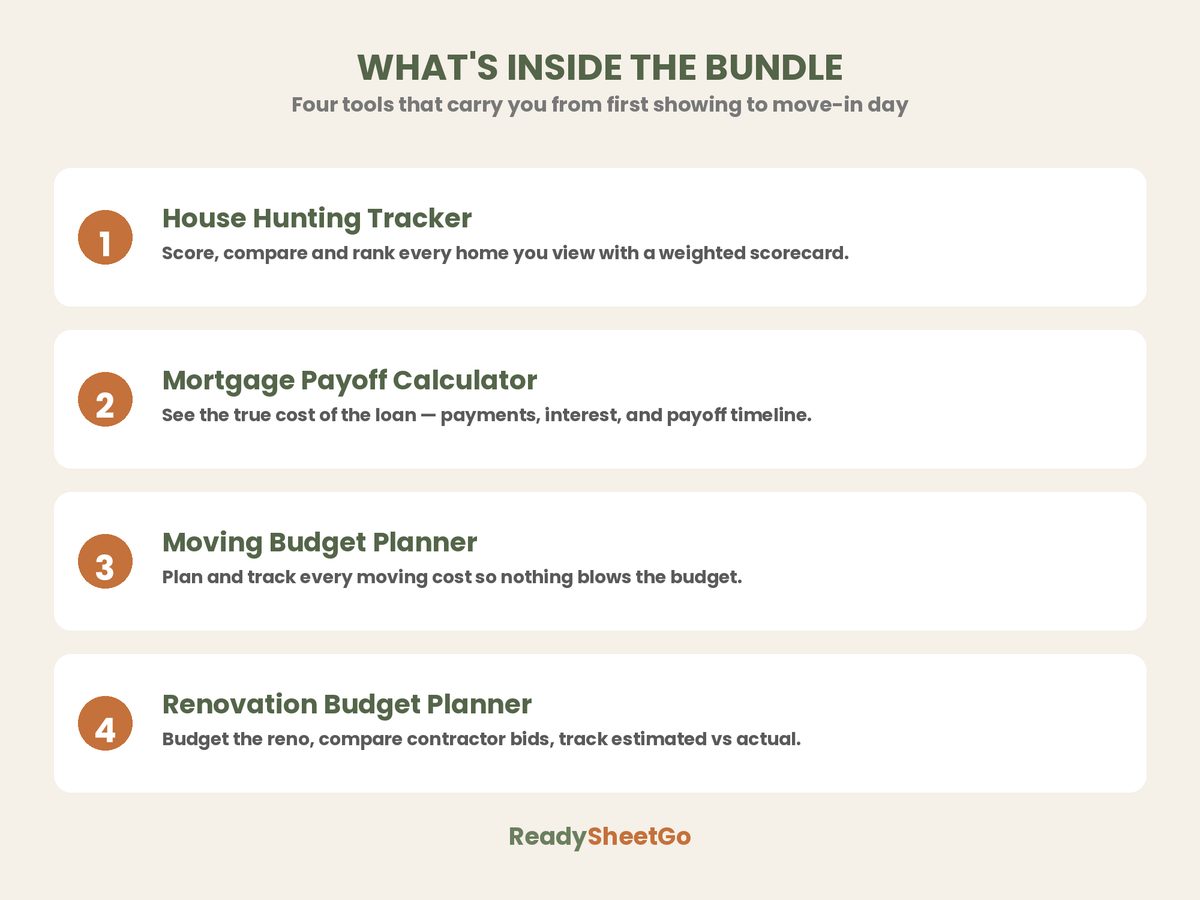
Stage 2: Tour, Track, and Compare Homes Objectively
Once you know your range, the house hunt begins — and this is where good decisions quietly fall apart. After the fourth or fifth showing, the homes blur together, and you start remembering how a place made you feel rather than what it actually offered for the money. Emotion is a terrible spreadsheet.
The fix is to score every home against the same criteria as you tour it. Decide what matters to you — location, layout, condition, commute, school zone, natural light — weight those factors, and rate each house on the spot. Our guide on how to compare houses with a scorecard explains the weighted method, and the companion piece on what to track when touring houses covers the specific details to write down before you forget them. A simple House Hunting Tracker turns a stack of half-remembered showings into a ranked shortlist.
Stage 3: Budget the Offer, Closing Costs, and the Mortgage
When you find the one, a new set of numbers appears. There’s the earnest money deposit to show you’re serious, the home inspection and appraisal fees, and then closing costs — which typically run about 2–5% of the loan amount and cover lender fees, title, escrow, and prepaid taxes and insurance. On a mid-sized loan that’s easily several thousand dollars, due at closing, on top of your down payment.
It’s also the moment to think past the purchase to the loan itself. A 30-year mortgage can more than double what you paid for the house once interest is included, which is why it’s worth understanding early how extra principal payments shorten the term. Our guide on how to pay off your mortgage faster with extra payments shows how even modest extra payments cut total interest — and a Mortgage Payoff Calculator lets you test scenarios before you commit to a loan.
Stage 4: Plan the Move
Closing isn’t the finish line — you still have to physically get there, and moving is the cost people most reliably underestimate. Professional movers, truck rental, deposits, travel, utility connection fees, and replacing what won’t fit all add up fast, and summer moves cost the most because that’s peak season. A cross-country move for a full household can run into the thousands, sometimes well over $5,000, depending on distance and how much you bring.
Two things keep this stage from blowing your cushion: a real estimate and a checklist of the costs you’d otherwise forget. Start with how much it costs to move to another state for the big-picture ranges, then use the first-time mover’s moving budget checklist to catch the deposits, fees, and setup costs that hide in the gaps.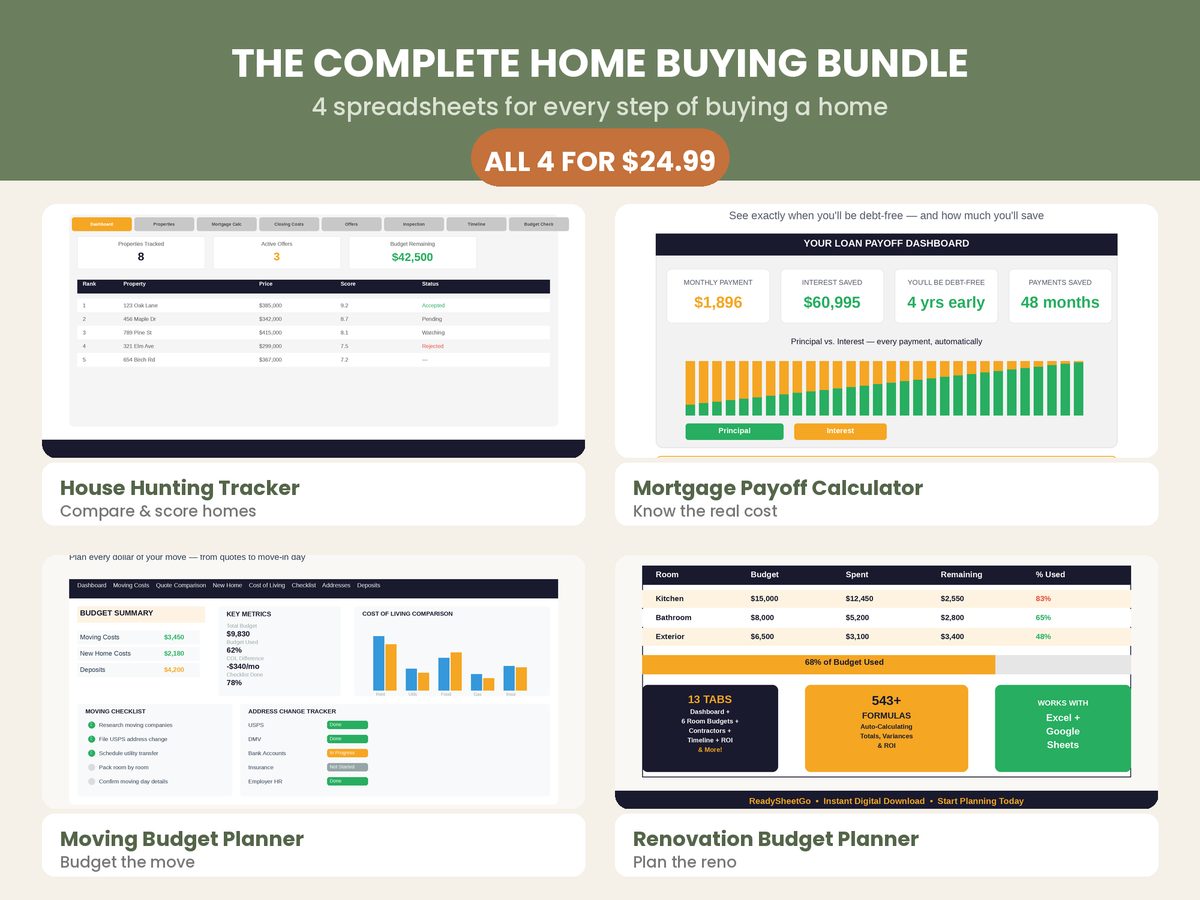
Stage 5: Budget the First-Year Repairs and Setup
Finally, the house is yours — and almost every home needs something in the first year, even the move-in-ready ones. There’s the repair the inspection flagged, the appliance that gives out, the empty rooms that need furniture, and the projects you’ve been picturing since the first showing. A common guideline is to keep about 1% of the home’s value available each year for maintenance, and to budget any planned renovations separately so they don’t quietly drain your emergency fund. If a remodel is on the horizon, our guide on how to budget for a home renovation without going over covers estimating costs and comparing contractor bids.
Put the Whole Picture in One Place
The reason buying a home feels overwhelming isn’t that any single stage is hard — it’s that they arrive back to back, each with its own numbers, and it’s easy to lose the thread. When you can see affordability, the shortlist, the closing costs, the move, and the setup in one connected view, the whole process gets calmer and the surprises get smaller.
Featured on ReadySheetGo
The Home Buying Bundle packages the four tools behind this guide into one purchase: a weighted House Hunting Tracker to score and rank homes, a Mortgage Payoff Calculator with amortization and extra-payment planning, a Moving Budget Planner with a checklist and address-change tracker, and a Renovation Budget Planner for the first-year projects. All four work in both Microsoft Excel and Google Sheets, with a video tutorial for each. Bought separately they run about $56 — the bundle is $24.99. It’s the simplest way to keep every stage of buying your first home in one place.
Frequently Asked Questions
What costs do first-time home buyers forget to budget for?
The most commonly forgotten costs are closing costs (often about 2–5% of the loan), the earnest money deposit, home inspection and appraisal fees, moving expenses, immediate repairs, and the cost of furnishing rooms you didn't have before. Property taxes and homeowners insurance also surprise buyers because they're bundled into the monthly payment through escrow. Budgeting each stage separately keeps these from becoming a shock.
How much money do I need saved to buy my first house?
Beyond the down payment, plan for closing costs of roughly 2–5% of the loan, plus a cash cushion for moving, immediate repairs, and a few months of payments. Many first-time buyers put down 3–5% rather than 20%, but that usually means paying PMI. A realistic total-cash-needed number is your down payment plus closing costs plus a move-in and emergency buffer.
What is the right order to budget for buying a home?
Start with affordability — how much house your income and debts support — before you tour anything. Then track and compare the homes you see, budget the offer and closing costs, plan the move, and finally budget any renovations or setup. Working in that order keeps you from falling for a house you can't comfortably afford.
Should first-time buyers budget for repairs and renovations right away?
Yes. Even move-in-ready homes usually need something in the first year — appliances, paint, a repair the inspection flagged, or basic furnishings. A common guideline is to keep 1% of the home's value available per year for maintenance, and to budget any planned renovations separately so they don't compete with your emergency fund.