The first house you tour gets your full attention. By the fifth or sixth, you are nodding politely while your brain quietly gives up trying to remember which kitchen had the island and which basement smelled a little damp. This is the central challenge of house hunting: homes blur together fast, and the details that should drive a six-figure decision slip away within hours. Knowing what to track when touring houses is what separates buyers who choose confidently from buyers who second-guess themselves for months.
As a first-time buyer, you are also learning what you even care about while you tour, which makes consistent notes doubly important. You cannot compare homes fairly if you recorded three things about one house and a dozen about another. The fix is to capture the same information, in the same order, at every single showing.
Capture the basics first
Before you get distracted by a gorgeous fireplace or a cramped hallway, log the identifying details. These are boring and easy to skip, and they are the first things you will wish you had:
- Full address
- List price
- Date and time of the tour
- Days on market, if you know it
- Square footage, bedrooms, and bathrooms
It sounds obvious, but after a weekend of showings, “the blue one near the park” is not enough to match your notes to a listing. Start every entry with the address so nothing gets orphaned.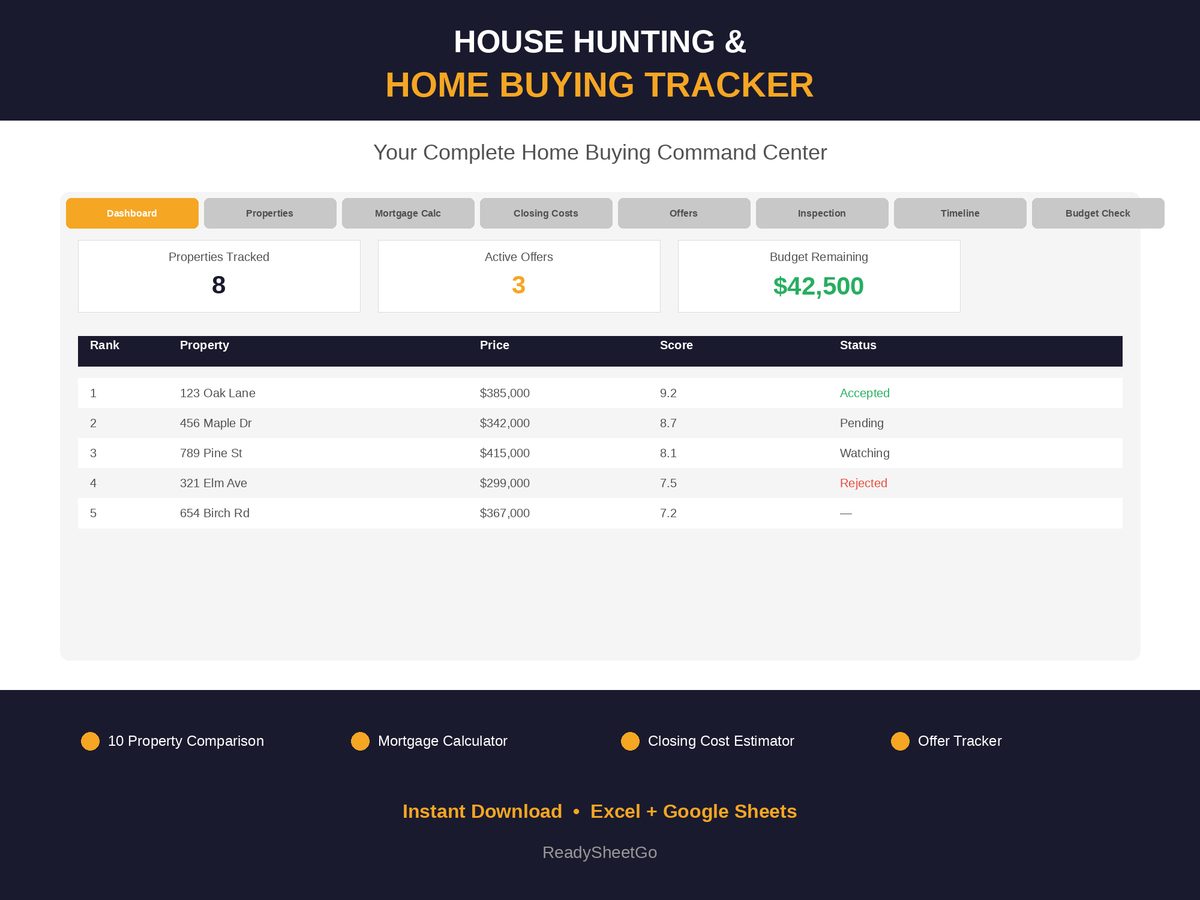
Track the things you will forget
Photos capture what a room looks like. They do not capture what a house feels like, sounds like, or smells like, and those are exactly the things memory drops first. Make a point of noting:
- Natural light. Which direction do the main rooms face, and how bright were they at the time you visited?
- Smells. Musty, smoky, pet odor, or a suspiciously strong air freshener all belong in your notes.
- Noise. Could you hear a busy road, train, flight path, or thin walls between units?
- Water pressure. Turn on a faucet. Weak pressure is annoying and can hint at plumbing issues.
- Cell signal. Check your bars in the basement and back bedrooms.
- Storage. Closets, pantry, garage, and attic. Staged homes hide how little there often is.
- Flow. Does the layout make sense, or do you walk through a bedroom to reach the laundry?
These sensory details are the ones that most influence whether you will actually enjoy living somewhere, and they are the first to vanish once you are back in the car.
Note the condition of the expensive stuff
Cosmetic issues are cheap to fix. The systems that quietly cost real money are the roof, the HVAC, the water heater, the electrical panel, and the foundation. When you tour, try to note the age and condition of each. Ask the agent, check for a sticker on the furnace or water heater, and look for obvious signs of trouble like water stains on ceilings, a patchwork of ceiling repairs, or fresh paint in just one corner.
You are not doing an inspection. You are flagging what to have inspected and what might turn into a negotiation later. A roof near the end of its life is not a dealbreaker, but it is worth thousands of dollars, and it belongs in your notes so it can factor into your offer. Remember too that your total move-in cost includes more than the price and repairs. Closing costs typically run about 2 to 5 percent of the loan amount, so a home that needs less immediate work can easily be the better financial choice even at a higher list price. Our first-time home buyer budget guide lays out those numbers from offer to move-in.
Watch for the quiet red flags
A few things are worth actively hunting for on every tour, because sellers and stagers are good at steering your eye away from them:
- Doors and windows that stick or will not close square, which can signal settling.
- Floors that slope or bounce.
- Fresh paint in a single isolated patch, a classic cover for a water stain.
- Musty smells or visible efflorescence in the basement.
- Overpowering air fresheners or a candle in every room.
None of these mean “walk away.” They mean “write it down and ask.” A pattern of small red flags across several rooms tells a bigger story than any single one.
Score before you leave the driveway
Here is the habit that makes everything else pay off: score the house while you are still there, or immediately after in the car. Rate your top priorities, things like location, layout, condition, and value, on a simple 1-to-5 scale. Waiting until that evening means you are scoring a memory, and memories favor whatever you saw last.
Doing this consistently is what turns a stack of scattered impressions into a real comparison. If you record the same fields and the same scores for every home, you can line up house number two against house number nine and actually see which one fits your life better. That is the entire point, and it is a lot easier with a structured tool than with the notes app and a fading memory. A purpose-built House Hunting Tracker spreadsheet gives you a consistent field for every detail above and totals your weighted scores automatically.
Once you have clean notes from several tours, the next step is comparing them the right way. Here is the companion method for how to compare houses with a scorecard, which turns your tracked details into a ranked shortlist.
A quick routine to make it stick
You do not need to track everything perfectly. You need to track the same things every time. Build a tiny routine: address and price first, then a slow video walk-through while you narrate what you notice, then the sensory checklist, then a quick score before you drive off. Ten disciplined minutes per house will save you weeks of second-guessing and, quite possibly, from buying the wrong home for the right reasons.
Featured on ReadySheetGo
The House Hunting Tracker is built to hold exactly the details above in one place. It gives you a consistent showing checklist, a weighted scorecard that automatically scores and ranks every home you tour, and dedicated space for offers, closing costs, inspection notes, and your shortlist, so no house ever blurs into another again. You can get the House Hunting Tracker here.
Prefer the full set of tools? The Home Buying Bundle ($24.99) bundles all four of our home-buying spreadsheets, covering everything from your first tour to the closing table in a single download.
Frequently Asked Questions
What should I write down when touring a house?
Capture the address, list price, and date first, then note the things you will forget: water pressure, cell signal, storage space, natural light, and any smells or sounds. Add the age and condition of the roof, HVAC, and water heater if you can find them. Finish with a quick 1-to-5 score on your top priorities while you are still standing in the house.
What are red flags to look for when viewing a house?
Watch for fresh paint in only one spot (it can hide water stains), doors that will not close square, sloping floors, musty basement smells, and mismatched patching on ceilings. Note strong air fresheners, which are sometimes used to mask odors. None of these are automatic dealbreakers, but each one is worth writing down and asking about.
How do I keep houses from blurring together after touring several?
Record the same details for every home in the same order, ideally in a single spreadsheet or checklist, and take a few labeled photos of each room. Consistency is what makes homes comparable later. If you only rely on memory, the most recent house always wins unfairly, so capture your notes before you leave the driveway.
Should I take photos or video when touring a home?
Both, if the seller allows it. Shoot a slow video walk-through for overall flow, then take still photos of anything specific you want to remember, like the electrical panel, the backyard, or a crack you noticed. Say the address out loud at the start of the video so your files stay organized across multiple showings.