You tour four houses on a Saturday, three more the next weekend, and by the time you get home they have all melted into a single blurry impression of granite counters and beige carpet. Was the one with the great backyard the same one with the tiny primary closet, or was that the other one? Figuring out how to compare houses when buying a home is one of the most underestimated parts of the process, because the moment you fall a little in love with a place, your brain quietly stops keeping score. Emotion is a terrible note-taker.
The good news is that comparing homes is a solvable problem. You do not need to be more disciplined or have a better memory. You need a system that does the remembering and the math for you, so that when it is time to write an offer you are choosing with your eyes open.
Why your brain sabotages house comparisons
Buying a home is an emotional purchase dressed up as a financial one. That is not a criticism, it is just how it works. The house with the dramatic entryway and the seller’s fresh-baked cookies will feel better than the slightly plain house with a superior floor plan and a shorter commute, even if the plain house is objectively the smarter buy.
The problem compounds because we compare homes sequentially, not side by side. You almost never stand in two kitchens at the same moment. Instead you remember the last house against your fuzzy memory of the one from nine days ago, and recency wins. The most recent house always feels a little more real than the ones before it.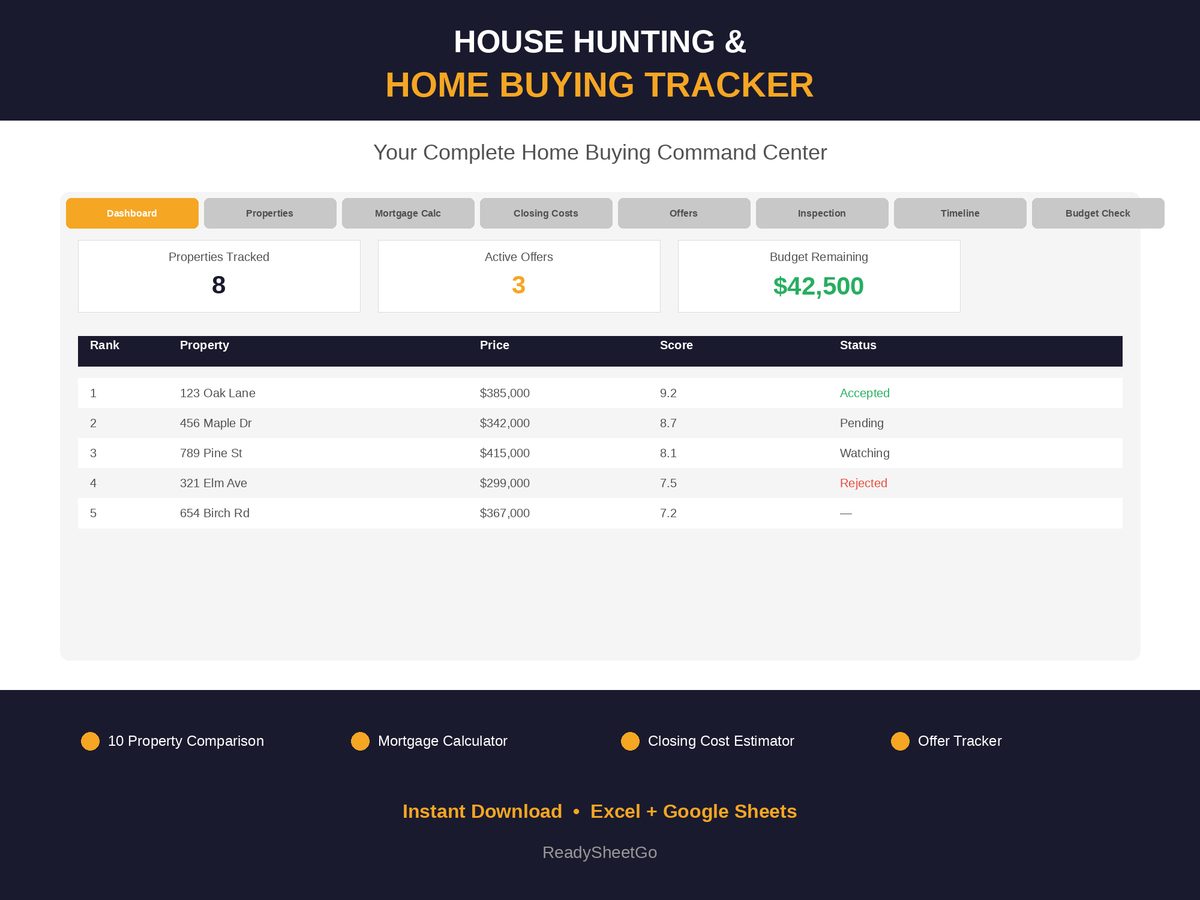
A scorecard fixes both problems at once. It forces you to evaluate every home against the same fixed criteria, and it captures those scores in the moment so the ninth house and the second house can be compared on equal footing.
Build a weighted scorecard
The core idea is simple: not every feature matters equally, so you should not score them equally. A weighted scorecard lets you say “location is three times more important to me than the kitchen” in actual numbers.
Start by listing the criteria that matter to you. A solid starting set looks like this:
- Location and neighborhood
- Commute and traffic
- Lot size and outdoor space
- Floor plan and flow
- Number and size of bedrooms
- Kitchen quality
- Storage and closets
- Condition of roof, HVAC, and major systems
- Natural light
- Price relative to comparable homes
Next, assign each criterion a weight from 1 to 5 based on how much it matters to your household. Location and commute might be a 5. A guest bathroom might be a 2. Then, at each showing, score the house on each criterion from 1 to 5. Multiply the score by the weight, add up the totals, and you get one number that represents how well that home fits your actual priorities.
The magic is in the weighting. Two houses can earn the same raw score, but once you weight for what you truly care about, a clear winner usually emerges. This is exactly the calculation a House Hunting Tracker spreadsheet is built to run automatically, so you can focus on touring instead of doing arithmetic on your phone in the driveway.
Weight what you cannot change
Here is the single most useful rule for weighting: give the most weight to the things you cannot change, and the least weight to the things you can.
You cannot move a house closer to your job. You cannot add a second story cheaply, shrink a busy road, or relocate to a better school zone. So location, lot, commute, and floor plan should carry heavy weight. These are the factors that determine whether you will still be happy in five years.
Cosmetic issues, by contrast, deserve almost no weight. Ugly paint, dated flooring, brass fixtures, and a wallpapered bathroom all look like dealbreakers on a tour and are among the cheapest things to change once you own the place. Do not let a hideous backsplash sink a home with a great bones-and-location profile, and do not let a beautifully staged home distract you from a bad layout.
Condition of the major systems sits in the middle. A roof, furnace, or electrical panel near the end of its life is expensive but fixable, and it is also negotiable. Which is a good reminder to keep track of what each home might cost you beyond the sticker price.
Track the numbers, not just the feelings
Comparison is not only about features. It is about total cost. A home listed $15,000 higher might actually be cheaper to own if it needs no immediate work, while the “deal” down the street needs a $12,000 roof and a new water heater.
For each home, jot down the list price, your estimated offer, and any obvious repair costs you can eyeball. Remember that your out-of-pocket cost at the finish line includes closing costs, which typically run about 2 to 5 percent of the loan amount, on top of your down payment. Building those numbers into your comparison keeps a slightly cheaper list price from fooling you. For a full walkthrough of the money side, from offer to move-in, our first-time home buyer budget guide breaks down every cost you will hit along the way.
While you are touring, it also pays to be systematic about the details you record on site, since those observations feed straight into your scores. If you want a checklist for the showing itself, here is a companion piece on what to track when touring houses.
When your gut and your scorecard disagree
Sometimes you will run the numbers and the winning house is not your favorite house. This is the most valuable moment the whole method produces, and it is worth slowing down for.
The disagreement is information. Maybe your gut is picking up on something real that you forgot to put on the scorecard, like how the light hits the living room in the afternoon or how safe the street feels. If so, add that criterion and re-score. Or maybe your gut is just chasing the cookies and the staging, and the spreadsheet is quietly saving you from an expensive mistake.
Either way, the point of comparing houses is not to let a spreadsheet overrule you. It is to make sure that when you write an offer, you are choosing with full information instead of a blurry memory and a rush of emotion. The buyers who stay happy years later are almost always the ones who compared clearly at the start.
Featured on ReadySheetGo
The House Hunting Tracker turns everything above into a tool you can actually use on tour day. It gives you a weighted scorecard that automatically scores, compares, and ranks every home you visit, plus space to log offers, closing costs, inspection notes, and your running shortlist so nothing blurs together. Score each house in the driveway and watch your true front-runner rise to the top. You can get the House Hunting Tracker here.
Want the complete toolkit? The Home Buying Bundle ($24.99) packages all four of our home-buying spreadsheets together, so you have every tool from first tour to closing table in one download.
Frequently Asked Questions
How do I compare two houses objectively?
Score each house on the same fixed set of criteria, using a 1-to-5 scale for things like location, layout, condition, and price. Weight the criteria by how much each one matters to you, then multiply and total the scores. The house with the highest weighted total is your objective front-runner, even if it wasn't your emotional favorite.
What factors should I weigh most when comparing homes?
Weight the things you cannot change most heavily: location, lot, commute, school zone, and the overall floor plan. Cosmetic issues like paint, flooring, and fixtures should carry low weight because they are cheap and easy to fix later. Structural, roof, and system condition sit in the middle since repairs are costly but possible.
How many houses should I tour before making an offer?
There is no magic number, but most buyers tour somewhere between 5 and 15 homes before they feel confident. What matters more than the count is tracking each one consistently so they do not blur together. A scorecard lets you compare house number two against house number twelve fairly.
Should I trust my gut or a scoring system when buying a house?
Use both. Your gut is good at catching things a spreadsheet misses, like how a space feels. A scoring system is good at catching things emotion hides, like a brutal commute or an overpriced kitchen. When your gut and your scorecard disagree, that gap is exactly the conversation worth having before you write an offer.