How Many Cleaning Clients Do You Need to Make $5,000 a Month?
It’s the question every cleaner asks at some point, usually while driving between two badly spaced jobs. The answer is not one number, because a client is not a unit of income — a visit is. And how many visits a client generates changes the answer by a factor of three.
Here is the maths, then the part nobody mentions: what $5,000 a month actually leaves you with.
What One Client Is Worth
A client’s monthly value is their rate per visit × their visits per month.
| Frequency | Visits/month | At $120/visit | At $150/visit | At $180/visit |
|---|---|---|---|---|
| Weekly | 4.33 | $519.60 | $649.50 | $779.40 |
| Biweekly | 2.17 | $260.40 | $325.50 | $390.60 |
| Monthly | 1.00 | $120.00 | $150.00 | $180.00 |
It’s 4.33 visits, not 4 — a year is 52 weeks, and 52 ÷ 12 = 4.33. Using 4 undercounts every weekly client by about 8%.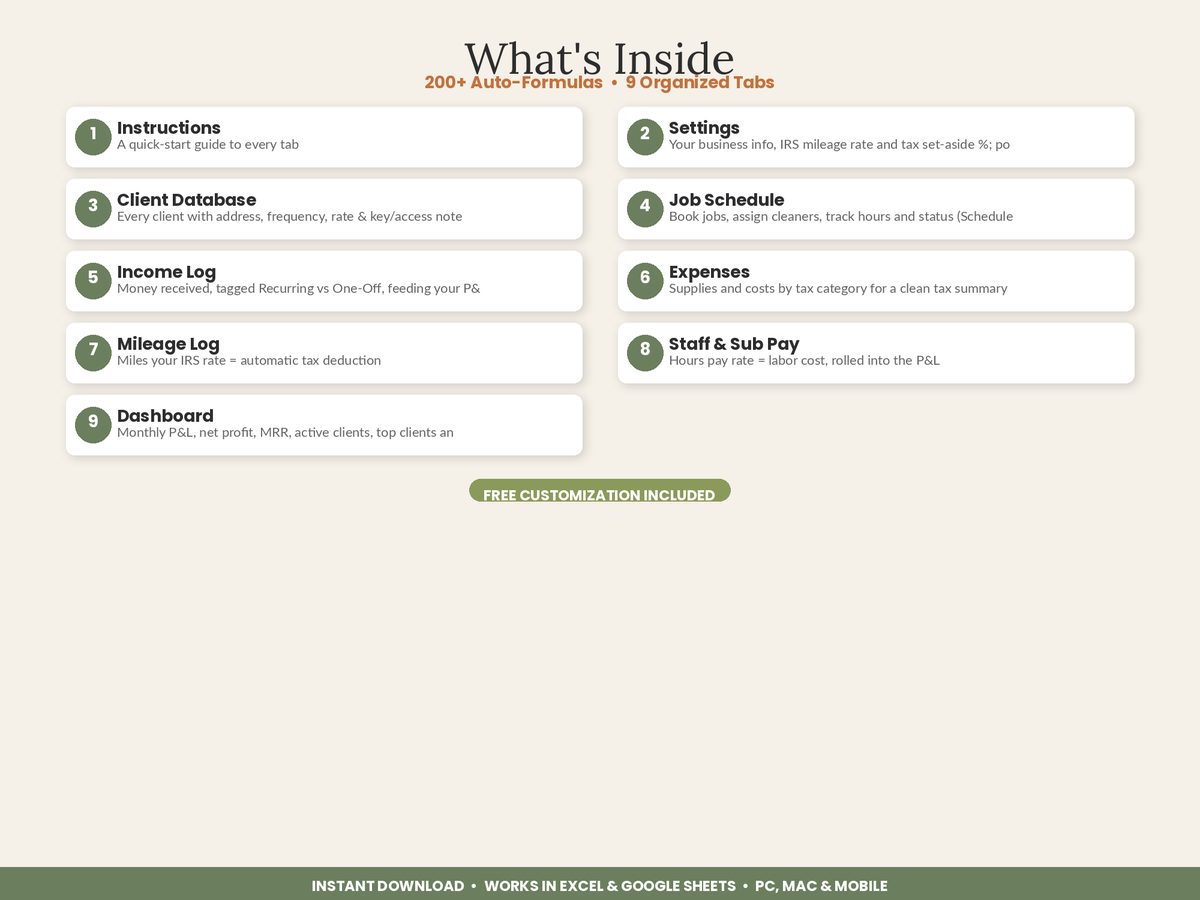
The headline: a weekly client is worth 4.33× a monthly client at the same price. Frequency, not headcount, is the lever.
The Client Count for $5,000
Revenue target ÷ monthly value per client:
| Book built on | Monthly value each | Clients needed |
|---|---|---|
| Weekly @ $120 | $519.60 | 10 |
| Weekly @ $200 (office) | $866.00 | 6 |
| Biweekly @ $150 | $325.50 | 16 |
| Monthly @ $180 | $180.00 | 28 |
Six commercial accounts or twenty-eight residential monthlies — for identical revenue. That spread is why “how many clients do you need” has no single answer, and why chasing client count instead of recurring revenue sends people in the wrong direction.
A realistic mixed book
Nobody has ten identical clients. A real $5,000 looks more like:
| Clients | Type | Each | Subtotal |
|---|---|---|---|
| 2 | Office, weekly @ $200 | $866.00 | $1,732.00 |
| 4 | Residential, weekly @ $120 | $519.60 | $2,078.40 |
| 3 | Residential, biweekly @ $150 | $325.50 | $976.50 |
| 1 | Residential, monthly @ $180 | $180.00 | $180.00 |
| 10 clients | $4,966.90 |
Ten clients, about $4,967 of recurring revenue — before a single one-off. One move-out clean in the month tips it comfortably past $5,000.
The Hours Behind It
Revenue you can’t deliver isn’t revenue. Assume 2 hours per residential clean, 2.5 per office, plus 0.75 hours of driving and admin per visit.
Ten weekly $120 clients:
- 10 × 4.33 = 43.3 visits a month
- Cleaning: 43.3 × 2 = 86.6 hours
- Drive and admin: 43.3 × 0.75 = 32.5 hours
- Total: 119.1 hours a month ≈ 27.5 hours a week
Twenty-eight monthly $180 clients (3.5 hrs each, as monthly visits run deeper):
- 28 visits a month
- Cleaning: 28 × 3.5 = 98 hours
- Drive and admin: 28 × 0.75 = 21 hours
- Total: 119 hours a month ≈ 27.5 hours a week
Identical hours. Identical revenue. But one book has 10 relationships and the other has 28 — nearly three times the scheduling, three times the reminders, three times the churn exposure, and three times the sales work to stay full. Weekly clients also cluster geographically over time, which quietly cuts the drive-time line that monthly books never get to optimise.
Same money, same hours, a third of the friction. That is the argument for frequency.
What $5,000 Actually Leaves You
This is where the target gets uncomfortable. Using the 72.5% margin from a solo worked month:
| Revenue | $5,000.00 |
| − Supplies, overhead, labour, mileage (27.5%) | $1,375.00 |
| Net profit | $3,625.00 |
| − Tax set-aside @ 25% | $906.25 |
| Yours to keep | $2,718.75 |
$5,000 a month in revenue is about $2,719 in your pocket. Self-employment tax alone is 15.3% before any income tax, so the set-aside is not optional — and 25% is a placeholder rather than advice, since your real rate depends on your whole situation.
To actually take home $5,000
Working backwards: you need $6,667 of net profit, which at a 72.5% margin means about $9,200 a month in revenue — roughly 18 weekly clients.
The hours: 18 × 4.33 = 77.9 visits, 155.9 cleaning hours plus 58.4 of drive and admin = 214 hours a month, about 49 hours a week.
That is the wall every solo cleaner hits. Somewhere around $6,000–7,000 of monthly revenue you run out of week, and the only routes past it are raising rates or hiring someone. Both work; doing neither means the ceiling holds.
The Faster Route Isn’t More Clients
Before adding an eleventh client, notice what a price rise does to the same book. Take the mixed book above and add 10%:
- $4,966.90 → $5,463.59
- Extra revenue: $496.69 a month, about $5,960 a year
- Extra hours: zero
- Extra drive time, supplies, scheduling: zero
Getting there by acquisition instead means finding one more weekly client — marketing, a quote visit, an onboarding clean, plus 8.7 hours a month of work forever. The 10% increase is the same money for none of it.
Which is why the sequence for most cleaners is: price correctly first, fill the calendar second, hire third. Reversing it produces a very busy business with a disappointing bank balance.
Working Out Your Own Number
- List every client with frequency and rate per visit.
- Multiply rate × visits per month (4.33 / 2.17 / 1) for each.
- Add them up — that’s your MRR, and it’s usually higher than people guess.
- Divide your target by your average client value to get the gap in clients.
- Check the hours before you commit to filling it.
Step 3 is the one worth doing today even if you skip the rest. Most cleaners have never seen their recurring monthly revenue as a single figure, and it reframes the whole question — the gap to $5,000 is nearly always smaller than it feels, and closable with a price review plus two or three clients rather than a heroic sales push.
Featured on ReadySheetGo
Cleaning Business Income & Client Tracker — $14.99
The Client Database does step 2 and 3 automatically — enter each client’s frequency and rate per visit and it returns their monthly value, with total MRR and active client count on the Dashboard alongside YTD revenue, net profit, margin % and your tax set-aside. Job Schedule logs hours so you can check capacity before you sell. Nine tabs, sample data pre-filled, works in Excel and Google Sheets.
Get the Cleaning Business Income & Client Tracker →
Part of the complete guide to tracking a cleaning business.
Frequently Asked Questions
How many cleaning clients do I need to make $5,000 a month?
Around 10 weekly clients at $120 a visit, because a weekly client is worth $519.60 a month once you use 4.33 visits rather than 4. The same $5,000 takes about 16 biweekly clients at $150, or 28 monthly clients at $180. Frequency does most of the work — a weekly client is worth roughly 2.9 times a monthly client at the same visit rate.
Is $5,000 a month in cleaning revenue the same as $5,000 income?
No. At the 72.5% margin from a solo worked month, $5,000 of revenue leaves about $3,625 of net profit, and after a 25% tax set-aside roughly $2,719 is actually yours. To take home $5,000 after setting tax aside you need closer to $9,200 a month in revenue — which is around 18 weekly clients and about 49 hours a week solo.
How many hours a week is a $5,000-a-month cleaning business?
About 27 hours a week solo, if it is built on 10 weekly two-hour clients. That counts roughly 87 hours of cleaning plus about 32 hours of driving and admin across 43 monthly visits. Notably, 28 monthly clients producing the same revenue also come to about 119 working hours — identical time, but 28 relationships to service instead of 10.
Are fewer high-frequency clients better than more occasional ones?
Generally yes. Ten weekly clients and twenty-eight monthly clients can produce the same revenue for the same hours, but the monthly book has nearly three times the relationships to maintain, three times the churn exposure and far more scheduling. High-frequency clients also cluster geographically over time, which cuts drive time — the single biggest hidden cost in cleaning.