Cleaning Business Mileage and Tax Deductions: What to Track
Cleaners drive more than almost any other service business — five houses a day, back and forth across town, supply runs on the way home. And mileage is the single most commonly abandoned deduction in the trade, because claiming it requires a log and a log requires a habit.
Here’s what’s deductible, the rule that catches most people, and a worked year showing what the habit is worth.
2026 Has Two Mileage Rates
Start here, because getting this wrong misstates the whole year. The IRS raised the business standard mileage rate mid-way through 2026:
| Period | Business rate |
|---|---|
| 1 Jan – 30 Jun 2026 | 72.5 cents/mile |
| 1 Jul – 31 Dec 2026 | 76 cents/mile |
Mid-year changes are uncommon — the last ones were 2022 and 2011 — and they catch people out because every mileage habit assumes one rate per year. Your first-half and second-half miles have to be totalled separately.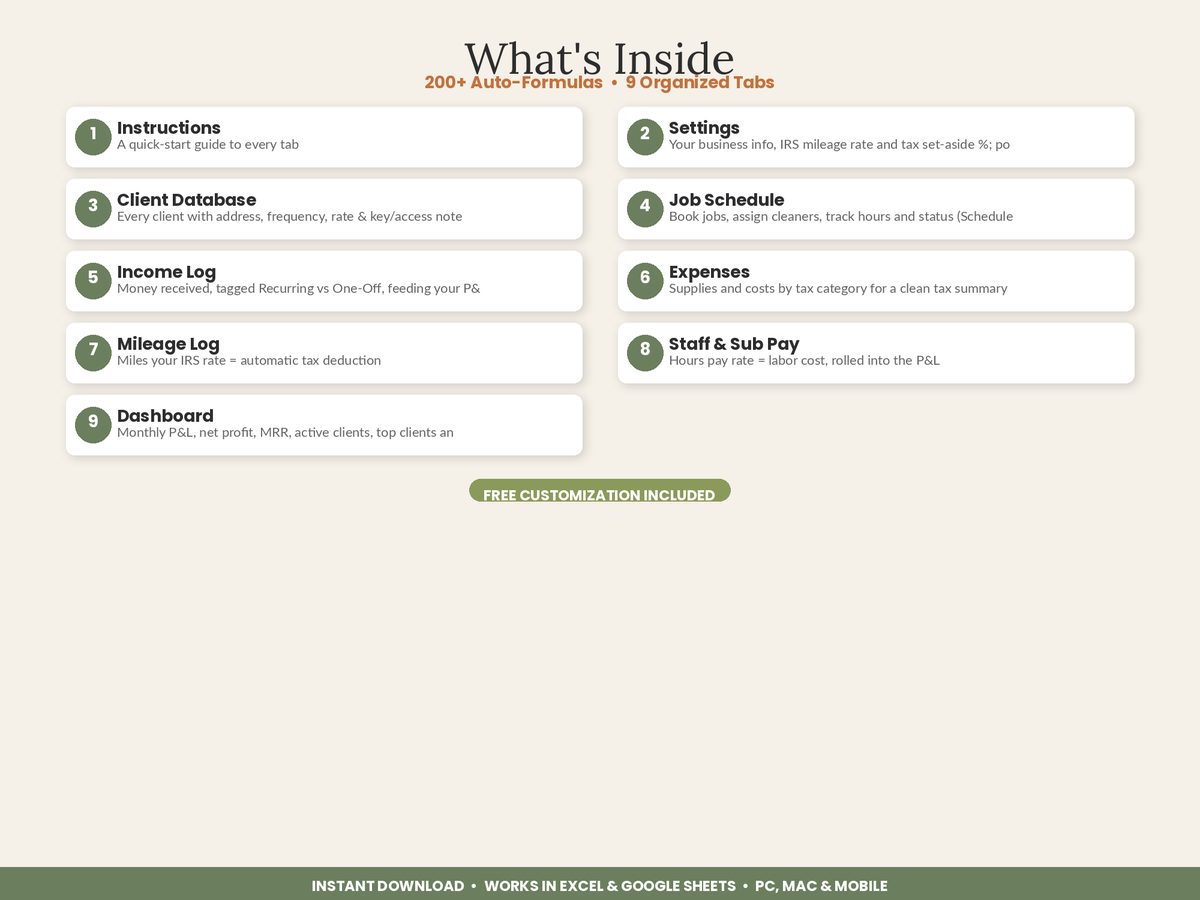
If you’re using a spreadsheet with a single mileage rate in its settings, that’s the field to check. Many templates still carry the 2025 rate of 70 cents, which would understate a second-half deduction by 6 cents on every mile.
A worked year
A cleaner running a normal route:
| Period | Miles | Rate | Deduction |
|---|---|---|---|
| Jan – Jun | 1,180 | $0.725 | $855.50 |
| Jul – Dec | 1,240 | $0.760 | $942.40 |
| Total | 2,420 | $1,797.90 |
Roughly $1,800 of deduction from a habit that costs about four seconds a trip. At a combined 15.3% self-employment tax plus a 12% income tax bracket, that’s meaningfully more than $400 of actual tax — for writing down numbers you already drove.
Use a single blended rate across the year and you’d be wrong in one direction or the other by a few hundred miles’ worth. Split them.
The Commuting Rule That Costs the Most
This is where cleaners lose money they were entitled to, or claim money they weren’t.
The general rule: home to a regular workplace is commuting, and commuting isn’t deductible. Travel between work locations during the day is.
So on a four-client day, the drives between clients one, two, three and four are business miles regardless. The contested legs are the first — home to client one — and the last — client four to home.
The exception that changes the answer: if your home is your principal place of business, trips from that home office to work locations are generally business travel. For many cleaners this is genuinely the case — the scheduling, invoicing, client records and supply storage all happen at home, and there’s no other office. But a qualifying home office has real requirements around regular and exclusive business use, and “I do the books at the kitchen table” may not clear them.
The difference is not small. Two extra trips a day at 8 miles each, five days a week, is around 4,000 miles a year — roughly $3,000 of deduction at 2026 rates. That’s worth twenty minutes with a tax preparer rather than a guess in either direction. The IRS covers the vehicle rules in Topic no. 510, Business use of car and Publication 463.
Either way: log every trip with its purpose. You can decide what qualifies at filing time, but only if the record exists.
Standard Rate or Actual Expenses
Two methods, and you pick one per vehicle.
Standard mileage — miles × rate. No fuel or repair receipts needed, just the log. Simple, and for most cleaners it wins.
Actual expenses — total your fuel, insurance, repairs, tyres, registration and depreciation, then deduct the business-use percentage. More paperwork, but better for expensive vehicles, heavy repair years, or low-mpg vans.
A practical note worth knowing before you choose: taking the standard rate in the first year a vehicle is used for business generally preserves your ability to switch methods in later years, whereas starting with actual expenses and depreciation can lock you out of the standard rate for that vehicle. If you’re unsure which suits you, starting with the standard rate keeps the door open. Confirm with your preparer — this interacts with depreciation rules that depend on how the vehicle was acquired.
Whichever you choose, you need the mileage log. Actual expenses still requires miles to calculate business-use percentage.
What Else a Cleaning Business Writes Off
Categorise as you spend, not in April. Sorting eleven months of receipts is how deductions get abandoned.
| Category | Typical items |
|---|---|
| Supplies | Chemicals, cloths, bags, gloves, paper goods |
| Equipment | Vacuums, steamers, mops, caddies, extension cords |
| Insurance | General liability, bonding |
| Licences & permits | Business licence, registration, renewals |
| Marketing | Ads, flyers, website, business cards, lead services |
| Software | Scheduling, invoicing, accounting, cloud storage |
| Vehicle | Mileage or actual expenses — not both |
| Labour | Employee wages, payroll taxes, subcontractor payments |
| Professional fees | Accountant, bookkeeper, legal |
| Bank & processing | Payment processing fees, business account fees |
| Uniforms | Branded clothing not suitable for everyday wear |
| Home office | If it qualifies |
The five most commonly missed
- Mileage. The big one. Covered above.
- Payment processing fees. Card and app fees skim 2–3% of every payment. Log the gross payment as income and the fee as an expense rather than banking the net — otherwise the deduction silently disappears.
- The home office. Frequently skipped as “not worth it”, but it can also convert commuting miles into business miles, which is often worth more than the office deduction itself.
- Equipment under a few hundred dollars. People assume small purchases must be depreciated over years and give up. Rules exist that allow many small items to be expensed immediately — ask your preparer rather than dropping them.
- Your phone. The business-use percentage of your bill is deductible, and for a cleaner running scheduling and client contact from it, that percentage is high.
Uniforms, and the Rule People Get Wrong
Uniforms are deductible when they’re required for work and not suitable for everyday wear. A polo with your logo embroidered on it qualifies. Plain black trousers you bought because they hide bleach marks do not, however genuinely you only wear them to work. Logo it, and it’s deductible.
Building the Habit
The whole thing rests on logging trips at the time. Three things make it stick:
- Log in the van, not at home. Odometer reading before you pull away, purpose in three words. Four seconds.
- Photograph receipts immediately and categorise the same week. Thermal paper fades to blank within a year — a faded receipt is a lost deduction.
- Reconcile monthly, not annually. Fifteen minutes a month beats a lost weekend in April, and it means your profit figures are right all year rather than only once.
The point isn’t only the tax saving. Logged mileage and categorised expenses are what make your monthly profit number true — and a true profit number is what tells you whether your pricing is working and whether you can afford to hire.
Set aside a percentage of profit for tax as you go, too. Self-employment tax alone is 15.3% before any income tax, and a quarter of net profit is a common working placeholder until your preparer gives you a real number.
Featured on ReadySheetGo
Cleaning Business Income & Client Tracker — $14.99
The Mileage Log converts every logged trip into a deduction at the rate you set in Settings — so when the rate changes mid-year, you update one cell. Expenses are categorised for tax, the Dashboard returns your YTD mileage deduction and estimated tax set-aside alongside revenue, net profit and margin, and the monthly P&L shows all of it month by month. Nine tabs, sample data pre-filled, works in Excel and Google Sheets.
Get the Cleaning Business Income & Client Tracker →
Part of the complete guide to tracking a cleaning business. This is general information, not tax advice — deduction eligibility depends on your circumstances, so confirm yours with a qualified tax professional.
Sources: IRS Standard mileage rates · IRS Topic no. 510, Business use of car
Frequently Asked Questions
What is the IRS mileage rate for 2026?
2026 has two rates. For business use it is 72.5 cents per mile from 1 January to 30 June, and 76 cents per mile from 1 July to 31 December, after the IRS raised the rate mid-year in response to fuel costs. Mid-year changes are unusual but not unprecedented — the same thing happened in 2022 and 2011 — so mileage driven in the first half of 2026 must be totalled separately from the second half.
Can a house cleaner deduct the drive from home to the first client?
Generally not — travel between your home and a regular workplace is commuting, which is not deductible. The significant exception is having your home as your principal place of business, in which case trips from that home office to work locations are generally business miles. Travel between client sites during the day is deductible either way, which is why route order can change your deduction.
What can a cleaning business write off?
Supplies and consumables, equipment such as vacuums and steamers, liability insurance, business licences and bonding, marketing and website costs, scheduling or invoicing software, uniforms with a business logo, bank and payment processing fees, mileage or actual vehicle costs, wages and subcontractor payments, and professional fees. The most commonly missed are mileage, payment processing fees and the home office if you have a qualifying space.
Do I need receipts if I use the standard mileage rate?
You do not need fuel receipts, but you do need a mileage log — the record must show the date, business purpose and miles for each trip, and you must be able to substantiate it. A contemporaneous log kept as you drive is far stronger than one reconstructed at year end. Choosing the standard rate in the first year a vehicle is used for business also preserves the option to switch methods later.