How Many Sinking Funds Should You Have?
You’ve discovered sinking funds, you’re fired up, and now you’ve got a list of fifteen things you want to save for — car repairs, Christmas, a vacation, new furniture, the dog’s vet bills, a laptop, your sister’s wedding gift, annual subscriptions, and on it goes. That enthusiasm is great. It’s also the exact thing that makes most people quit in month two, because fifteen funds split across a normal savings budget means every single one crawls forward too slowly to matter.
So here’s the honest answer to how many sinking funds you should have: start with three to five, and let your monthly savings budget — not your wish list — decide the limit. Let’s make that concrete.
The real constraint isn’t the count — it’s your budget
There’s no magic number of sinking funds. The only thing that actually limits you is how much you can move into savings each month, because every fund you add demands a slice of that same fixed pie.
Remember the core formula behind every fund: monthly amount = (target − already saved) ÷ months left. Each fund produces a monthly number, and those numbers add up. Watch what happens when you get greedy. Say you can save $500 a month, and you try to run these six funds all at once:
| Fund | Target | Months left | Monthly needed |
|---|---|---|---|
| Car Repairs | $1,200 | 10 | $120 |
| Christmas | $1,000 | 10 | $100 |
| Insurance | $900 | 9 | $100 |
| Vacation | $2,500 | 16 | $156 |
| New Laptop | $1,400 | 12 | $117 |
| Home Maintenance | $1,500 | 14 | $107 |
| Total | $700/mo |
Your funds want $700 a month. You have $500. That’s a $200 shortfall every month, which means all six funds run permanently behind and none reaches its target on time. You’d feel like you’re saving hard and still get caught short at every deadline. That’s the trap.
The fix: fund by priority, not all at once
Instead of feeding six starving funds, feed the three that matter most right now until they’re on track, then add the others. Prioritize by two questions:
- Which deadline is soonest? A November insurance bill beats a June vacation.
- Which expense is most likely and most painful if unfunded? Car repairs will happen; a nicer laptop can wait.
Fund the winners fully, and park the rest as “planned but not yet funded.” From the list above, the first three to fund are Insurance (soonest), Car Repairs (certain and painful), and Christmas (fixed deadline). That’s ~$320/month — comfortably under your $500 — leaving room to start trickling into the vacation. The laptop and home-maintenance funds wait in the wings until something graduates to “Funded.”
A starter priority checklist
If you’re not sure which funds deserve the first slots, work down this list and stop when you’ve filled your budget:
- Car / vehicle — repairs, tires, registration. Nearly everyone needs this; car trouble is a when, not an if.
- Insurance — only if you pay auto, home, or life premiums in lump sums rather than monthly.
- Holidays / Christmas — a fixed December deadline makes this easy to plan and painful to ignore.
- Home maintenance — if you own. Appliances and repairs are guaranteed over time.
- Medical / dental — deductibles, that one big dental bill, glasses.
- Then the “wants” — vacation, electronics, furniture — once the essentials are on track.
Three to five of these will cover most people’s genuinely predictable big costs. The rest can join the moment a current fund fills up and frees its monthly slice.
Separate funds beat one big “savings” pot
A tempting shortcut is to skip the whole question and just keep one big miscellaneous savings pile. Resist it. A single pot can’t answer the question that matters — “do I have enough for the specific bill that’s due next?” — because $2,000 sitting in one account looks like plenty until three separate $1,500 expenses all arrive in the same quarter.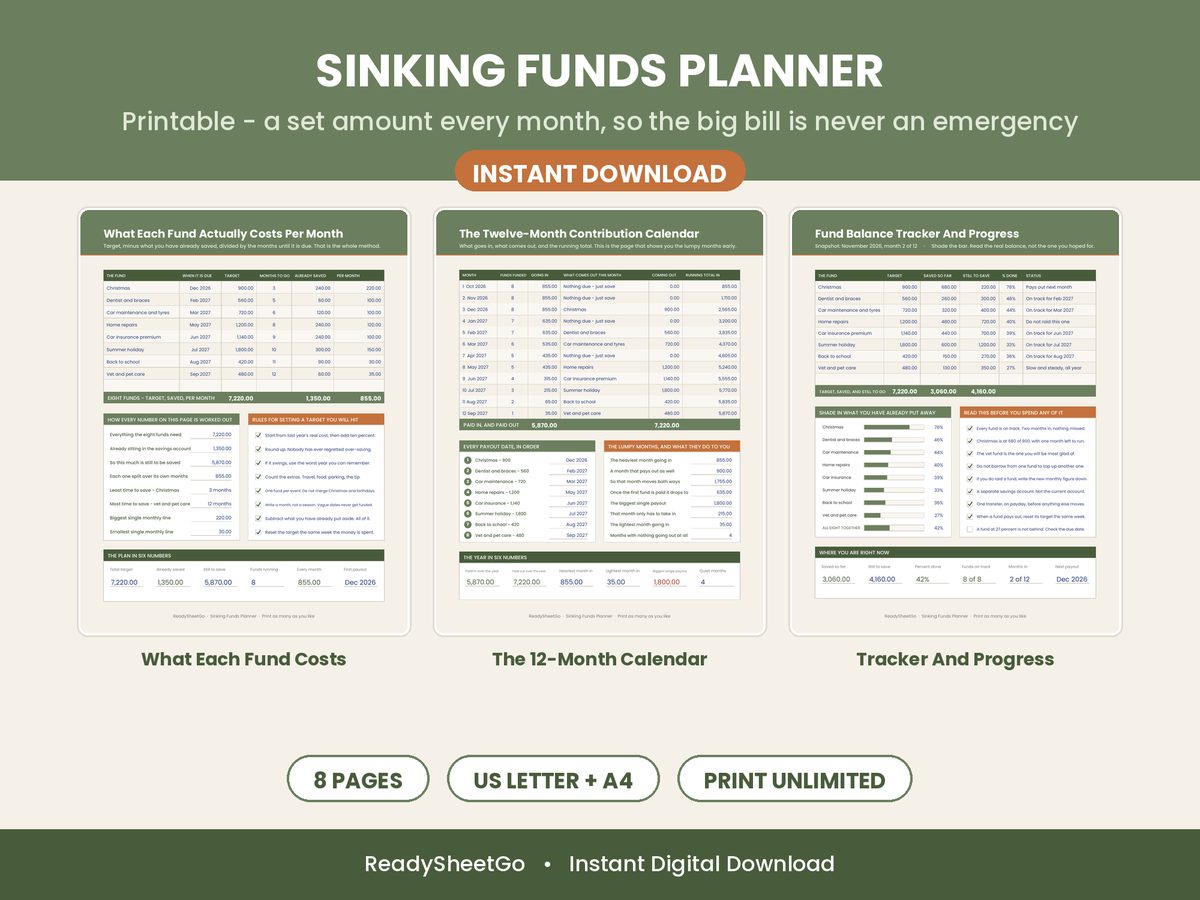
Named funds with their own targets and dates tell you the truth: this one’s funded, that one’s $300 short with six weeks to go. You keep the cash in a single savings account (no need for a dozen bank logins) and simply track the split. That’s the whole reason to run it in a spreadsheet — one balance at the bank, a clear breakdown of who owns what on screen.
When to add your next fund
The green light for a new sinking fund is simple: add one only when your existing funds are all on track and your total monthly need is still below your savings budget. When a fund hits “Funded,” its monthly amount is freed up — that’s the natural moment to promote the next goal off your waiting list. This way you’re always running the maximum number of funds you can actually keep on track, and never more.
This piece is part of the complete guide to setting up sinking funds in a spreadsheet, which walks through the full setup, the save-per-month formula, and how to split your budget across funds automatically.
Featured on ReadySheetGo
Sinking Funds Tracker — $9.99
Track up to 50 funds in one place, but only feed the ones that matter: the sheet calculates each fund’s monthly amount, flags which are on track versus behind, and its Monthly Plan tab splits your budget across funds by priority so you always know where this month’s savings should go. 7 tabs, works in Microsoft Excel and Google Sheets. Get the Sinking Funds Tracker on Etsy →
Frequently Asked Questions
How many sinking funds should a beginner start with?
Start with three to five. Fund the expenses that are the most predictable and have the soonest deadlines — usually car repairs, an insurance renewal, and Christmas. Trying to fund ten funds at once spreads your savings so thin that none of them fill up in time, which is the fastest way to give up.
Is it possible to have too many sinking funds?
Yes. The limit isn't a number of funds — it's your monthly savings budget. If the total 'save per month' across all your funds is more than you can actually set aside, every fund falls behind at once. Add a new fund only when your existing ones are on track and there's room in your budget.
What sinking funds does almost everyone need?
The near-universal ones are a car/vehicle fund (repairs and tires), an insurance fund if you pay premiums in lump sums, a holidays/Christmas fund, and a home-maintenance fund if you own. Beyond those, the right funds depend on your life — pets, medical, travel, or annual subscriptions.
Should I have separate sinking funds or one big one?
Separate funds with individual targets and dates, tracked in one place, beat one big 'misc savings' pot. A single pot hides whether you actually have enough for the specific bill that's due next, while named funds tell you exactly which goals are on track and which are behind.