How to Catch Up on Sinking Funds When You’ve Fallen Behind
Life happened. A couple of tight months, a payment you skipped “just this once,” and now you open your tracker and half your funds are glowing red. The temptation is to feel like the whole system failed and quietly walk away from it. Don’t. Being behind on sinking funds isn’t a moral failing or a sign the method doesn’t work — it’s an arithmetic problem, and arithmetic problems have clean solutions.
Here’s a calm, four-step routine to get back on track without wrecking your budget or reaching for a credit card.
First, understand what “behind” actually means
When you miss contributions, something mechanical happens: the fund’s required monthly amount goes up. That’s just the formula doing its job — monthly needed = (target − saved) ÷ months left — and every month that passes shrinks the denominator.
Say your car-repair fund needs $1,200 by December and you started with 10 months to go:
- On plan: ($1,200 − $200) ÷ 10 = $100/month.
- You skip two months. Now it’s 8 months out, still only $200 saved: ($1,200 − $200) ÷ 8 = $125/month.
- You skip two more. 6 months out, $200 saved: ($1,200 − $200) ÷ 6 = $167/month.
The target didn’t change, but your required payment jumped from $100 to $167 because you have less runway. Seeing this in numbers is the point — it tells you exactly how much catching up costs and which funds are getting expensive to save. Panic doesn’t help; the recalculated number does.
Step 1: Recalculate every fund
Before deciding anything, get the real picture. For each fund, recompute the monthly amount now required with today’s balance and today’s months-remaining. A tracker does this automatically the moment you open it, but the mental model matters: you’re not looking at what you were supposed to save, you’re looking at what you need from here. Total up the new required monthly amounts — that’s your true current commitment, and it’s almost certainly higher than your budget. Which brings us to triage.
Step 2: Triage by deadline and certainty
You probably can’t fully fund every behind fund at its new, higher rate. So decide the order deliberately, using the same two questions that govern the whole system:
- How soon is the deadline?
- How certain and unavoidable is the expense?
Fully fund the soonest, most certain expenses first. An insurance renewal due next month or a quarterly tax bill outranks a vacation that’s still eight months out. It is completely fine to let a distant, flexible goal stall while you protect a near, unavoidable one — that’s not failing, that’s prioritizing correctly.
Step 3: Rebalance targets and dates
Here’s where you get your power back. A shortfall gives you the same three levers you had at setup, and now’s the time to pull them:
- Extend a target date. If the vacation can move from June to September, its required monthly amount drops immediately. Deadlines you set yourself are negotiable.
- Lower a target. A $700 Christmas instead of $1,000 closes part of the gap with zero extra saving.
- Move money between funds — carefully. Shifting cash from a far-off, flexible goal to cover an urgent one is smart. Draining a fund whose own deadline is close just to feed another is not; you’d only move the crisis somewhere worse.
Most recoveries are a combination: push one date out, trim one target, and reassign a little from a distant goal to an urgent one. Do that and the scary red numbers usually become manageable again without you finding a single extra dollar.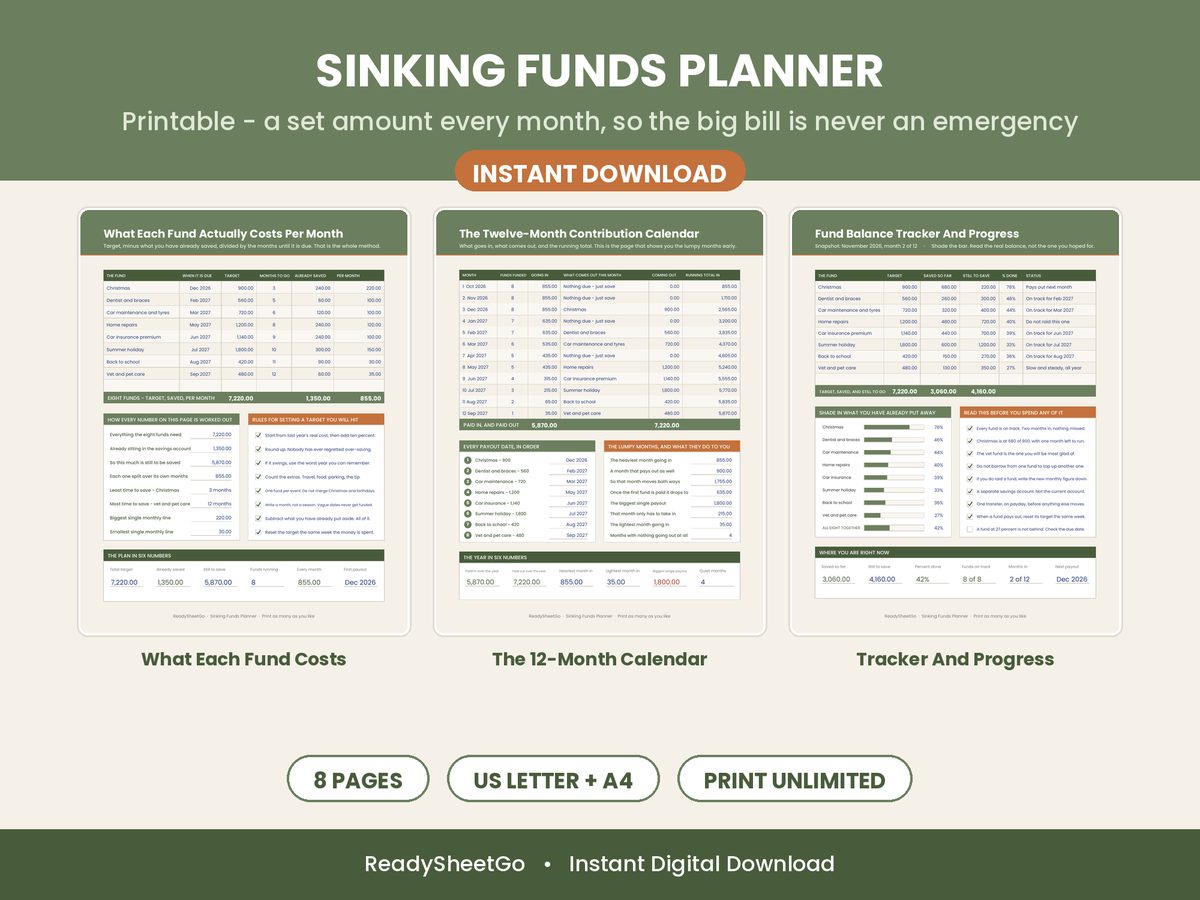
Step 4: Choose ONE catch-up lever for the gap that’s left
After triage and rebalancing there may still be a real gap. Close it with a single, deliberate move rather than vague hoping:
- A one-time injection — a tax refund, a bonus, a “sold stuff” weekend — dropped onto your most-behind, soonest-deadline fund.
- A temporary budget trim — pause one subscription or eating-out line for two months and route it straight to the shortfall.
- A brief pause on “want” funds — freeze the vacation and furniture contributions entirely for a month or two so every spare dollar catches up the essentials.
Pick one, apply it to the highest-priority behind fund, and let the milestone progress pull you forward.
A quick worked recovery
Say after a rough stretch you’re behind on three funds and the recalculated numbers are ugly: Insurance now wants $180/mo (due in 2 months), Car Repairs $150/mo (5 months), Vacation $200/mo (7 months) — $530 total, but you can only spare $350.
The fix: fully fund Insurance ($180) — soonest and unavoidable. Fund Car Repairs ($150) — certain. Push the vacation date out three months, which drops its requirement to ~$125, and fund it with the remaining $20 for now, catching up when the essentials are green. Your $350 now covers the two things that would’ve hurt, and the flexible goal simply waits. Crisis defused with arithmetic, not credit.
Stop it happening again
Repeat shortfalls almost always trace back to one cause: running more funds than your monthly savings can support. Once you’re caught up, right-size the count so your total required monthly amount sits comfortably under your budget — the discipline is covered in how many sinking funds you should have — and review your dashboard every payday so any slip is small and early. The whole system, including the formula and how to split your budget across funds, is laid out in how to set up sinking funds in a spreadsheet.
Featured on ReadySheetGo
Sinking Funds Tracker — $9.99
Falling behind is where a good tracker earns its keep: it recalculates every fund’s required monthly amount the instant you open it, flags each as on-track / behind / overdue, and lets you extend a date or trim a target and watch the numbers rebalance in real time. The dashboard shows your soonest deadline so you always know what to catch up first. 7 tabs, works in Microsoft Excel and Google Sheets. Get the Sinking Funds Tracker on Etsy →
Frequently Asked Questions
What should I do if I'm behind on my sinking funds?
Don't abandon the system — recalculate. When you miss contributions, each fund's required monthly amount rises because there are fewer months left to cover the same gap. Recompute (target − saved) ÷ months left for each fund, then decide which deadlines to protect and which targets or dates to adjust. A shortfall is a math problem, not a failure.
Which sinking fund should I catch up first?
Catch up the fund with the nearest deadline and the highest certainty first — an insurance renewal or tax bill due next month before a vacation months away. Protecting near-term, unavoidable expenses prevents a fund shortfall from turning into credit-card debt.
Is it okay to move money between sinking funds?
Yes, as long as you don't rob a fund whose deadline is close. Shifting money from a distant, flexible goal to cover an urgent one is a normal part of managing sinking funds. The risk is only when you drain a near-deadline fund to feed a far one — then you've just moved the problem to a worse spot.
How do I stop falling behind on sinking funds again?
Right-size the number of funds to your budget, fund your soonest deadlines first, and review your dashboard every payday so a fund slips by a little rather than a lot. Most repeat shortfalls come from running more funds than your monthly savings can actually support.