How Much Does a Missed Buy Now Pay Later Payment Actually Cost
A missed $35 installment doesn’t feel like a big deal in the moment — it’s a fraction of what a missed credit card minimum would be. That’s exactly why it’s easy to let one slide. But “cost of a missed BNPL payment” is rarely just the fee attached to that one installment. It’s the fee, plus whatever it triggers next, plus what happens to a plan you assumed was harmless the moment it stops being on-time.
Here’s what actually stacks up, and a worked example showing how a single missed payment can turn into a bigger number than it looked like at the start.
The direct cost: what the provider itself charges
Late payment consequences differ by provider and by the specific plan you’re in, and they’ve changed across the industry over time — so the only number that applies to you is the one printed in your own plan’s terms, not a general reputation for the company. Broadly, a missed BNPL payment can trigger one or more of the following, depending on the plan:
- A flat late fee, charged once or sometimes repeated if the payment stays unpaid
- A hold on the account, where the provider won’t approve new plans until the missed balance is settled
- A retry attempt, where the provider tries the charge again a few days later — which matters because of what it can trigger next
None of these is fixed across the industry; always check the terms screen for the specific plan, since it’s the only source you should treat as accurate for what a miss actually costs.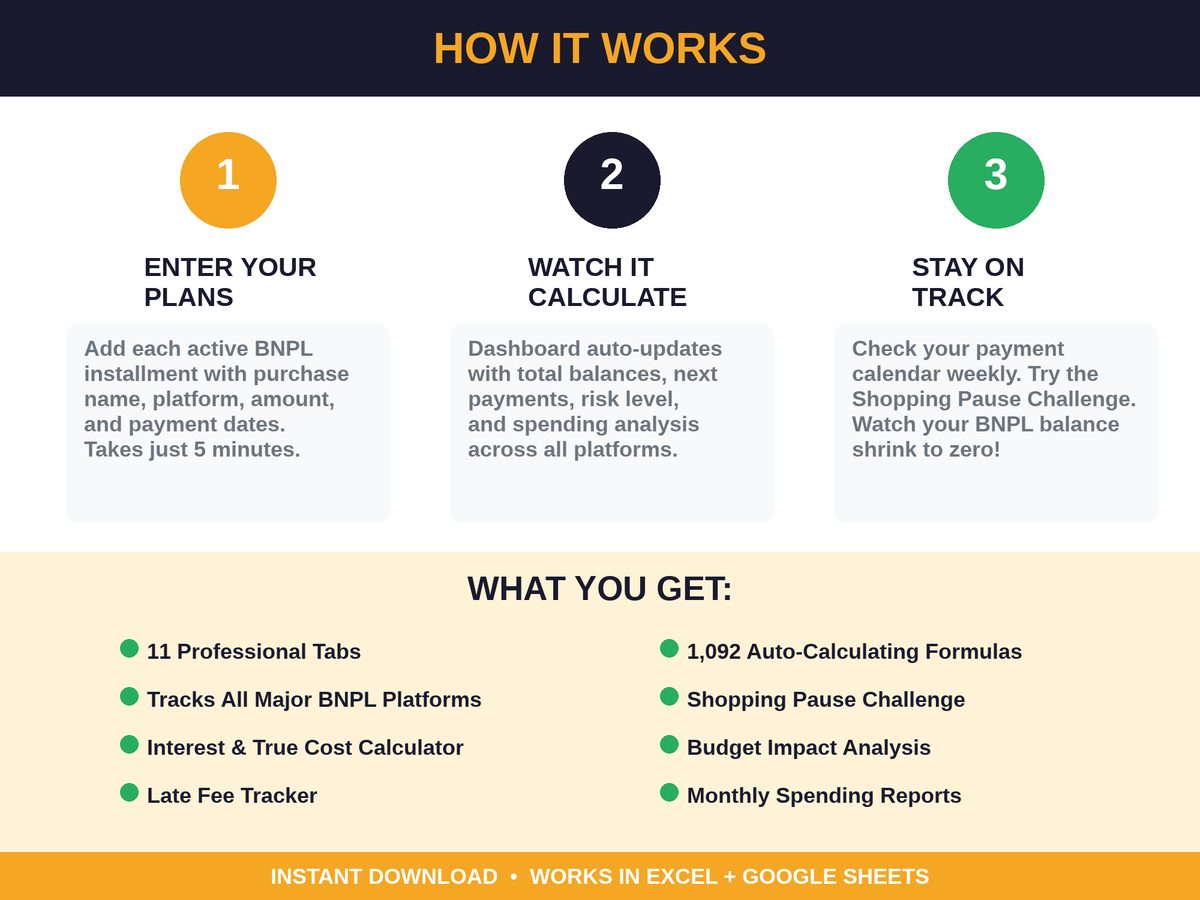
The indirect cost: what a missed payment can trigger elsewhere
This is the part that turns a small miss into a bigger one, and it has nothing to do with the BNPL provider’s own fee:
Bank overdraft or non-sufficient-funds fees. If a BNPL installment retries against a checking account that doesn’t have room for it — because two other bills or another BNPL payment already cleared that day — the bank’s own overdraft or declined-transaction fee can be several times larger than the BNPL late fee itself. This is the single biggest way a $35 miss becomes a $70+ event: not because the BNPL provider charged more, but because the bank did.
A card that’s since expired or been replaced. BNPL installments are usually billed automatically to the card used at checkout. If that card was replaced — lost, expired, reissued after a fraud alert — before all four installments finished, the charge can fail entirely, converting what should have been an automatic, forgettable payment into a manual one you now have to notice and fix yourself.
Lost access to future plans. Beyond any fee, a provider that sees an unresolved missed payment will typically decline to approve a new plan until the old one is settled — which matters if you were planning to use that same provider again soon.
Worked example: one missed payment, three possible outcomes
Take a hypothetical $35 Afterpay installment that gets missed. Below are three illustrative scenarios showing how differently this can play out, depending only on what else happens around it — the dollar figures are for illustration, not quoted terms from any provider.
| Scenario | What happens | Approximate added cost |
|---|---|---|
| Caught same day, paid manually | No retry needed, provider fee may still apply per plan terms | $0–$10 (provider-dependent) |
| Retried automatically 3 days later, succeeds | Standard late fee per plan terms | $0–$10 (provider-dependent) |
| Retried against an account with insufficient funds | Provider late fee (if any) plus bank overdraft/NSF fee | $10 provider fee + $35 bank fee ≈ $45 total, on a $35 purchase |
The third row is the one that actually costs real money, and it has almost nothing to do with the BNPL provider — it’s the bank’s overdraft fee doing the damage, triggered by a BNPL retry landing on the wrong day. That’s the scenario worth actively avoiding, and it’s avoidable: it only happens when a due date is a surprise.
The fix: know every due date before it’s due, not after
Every scenario above gets worse the later you find out about it. The version where you catch a payment coming and either fund the account or reschedule the plan ahead of time essentially never costs the bank-fee tier of damage. The version where you find out because a payment bounced always risks it.
That’s the entire case for tracking every BNPL plan’s due dates in one place instead of relying on each app’s own notification: a missed-payment scenario is really a missed-visibility problem. If you can see that four installments are landing in the same eight-day window before payday, you can move money, delay a plan, or contact the provider proactively — all of which cost nothing, compared to the overdraft-fee scenario above.
The Buy Now Pay Later Tracker Spreadsheet includes a Late Fee Tracker specifically for logging what a missed payment actually cost — provider fee, any bank fee, and the total — so the real cost of being late becomes a number you can see accumulating rather than a one-off you forget about. A Payment Calendar shows every upcoming due date across every platform on a single monthly view, which is what actually prevents the scenario in the first place.
Featured on ReadySheetGo
Buy Now Pay Later Tracker Spreadsheet — $9.99
11 tabs, 1,092 automatic formulas, including a Late Fee Tracker that logs the true cost of every missed payment and a Payment Calendar that lays every due date across every platform on one monthly view. Works in Excel and Google Sheets.
The bottom line
The advertised cost of missing a BNPL payment — a flat late fee, if any — is rarely the real cost. The real cost shows up when a missed installment retries against an account that can’t cover it, turning a $10 provider fee into a $45 event through a bank overdraft fee that has nothing to do with BNPL at all. The fix isn’t perfect willpower; it’s knowing every due date before it arrives, which is a tracking problem, not a discipline problem — and it’s the one you can actually solve.
Frequently Asked Questions
What happens if I miss a Buy Now, Pay Later payment?
The specific consequence depends on the plan and provider — some charge a late fee, some simply pause your ability to use that provider again until the balance is current, and terms have changed across the industry over time. Read the late-payment terms shown when you set up the specific plan, since that's the number that applies to you rather than a general assumption about the company.
Can a missed BNPL payment affect my credit score?
It depends on the provider and the plan. Many short-term Pay-in-4 plans are not reported to the major credit bureaus at all, so a missed payment on one of those may not touch your score directly — but that isn't a blanket rule across every BNPL provider or every plan type, and reporting practices have been shifting industry-wide. Missing a payment can still cost you in late fees and in losing access to that provider, independent of any credit impact.
Does missing one BNPL payment affect other plans I have open?
Not directly — each provider only sees your account with them, so a missed Klarna payment doesn't automatically appear inside your Afterpay or Affirm account. The real risk is indirect: if a missed payment retries against your card and triggers an overdraft or a declined-payment fee from your bank, that cost can ripple into whatever else was scheduled to hit that same account around the same time.
Is it better to miss a BNPL payment or a credit card minimum?
Generally the credit card minimum is the more serious miss, because a missed credit card payment is reported to credit bureaus and can trigger a penalty APR, while many BNPL late consequences are more contained to fees and losing access to that specific provider. That said, this isn't a reason to treat BNPL misses as harmless — check your own plan's terms before assuming either one is the 'safe' one to skip.