How Many Buy Now Pay Later Plans Is Too Many? A Ratio You Can Calculate
“How many BNPL plans is too many” doesn’t have a fixed answer, because two active plans totaling $600 a month is a very different situation for someone earning $3,000 a month than for someone earning $8,000. The plan count isn’t the useful number. The useful number is what those plans add up to as a share of what actually comes in — a BNPL-to-income ratio you can calculate for yourself in about two minutes, using numbers you already have.
Why counting plans is the wrong measurement
“I have four BNPL plans open” sounds concerning on its own, but it says nothing about whether that’s a problem. Four plans at $15/month each is $60 — a rounding error for most budgets. Two plans at $300/month each is $600 — a much bigger deal, even though it’s half as many plans. Counting plans measures how many apps you’re juggling, not how much financial pressure those apps are actually putting on your paycheck. The ratio below measures the thing that actually matters.
The calculation
BNPL-to-income ratio = (total monthly BNPL payments across every active plan) ÷ (monthly take-home pay) × 100
Two things go into this: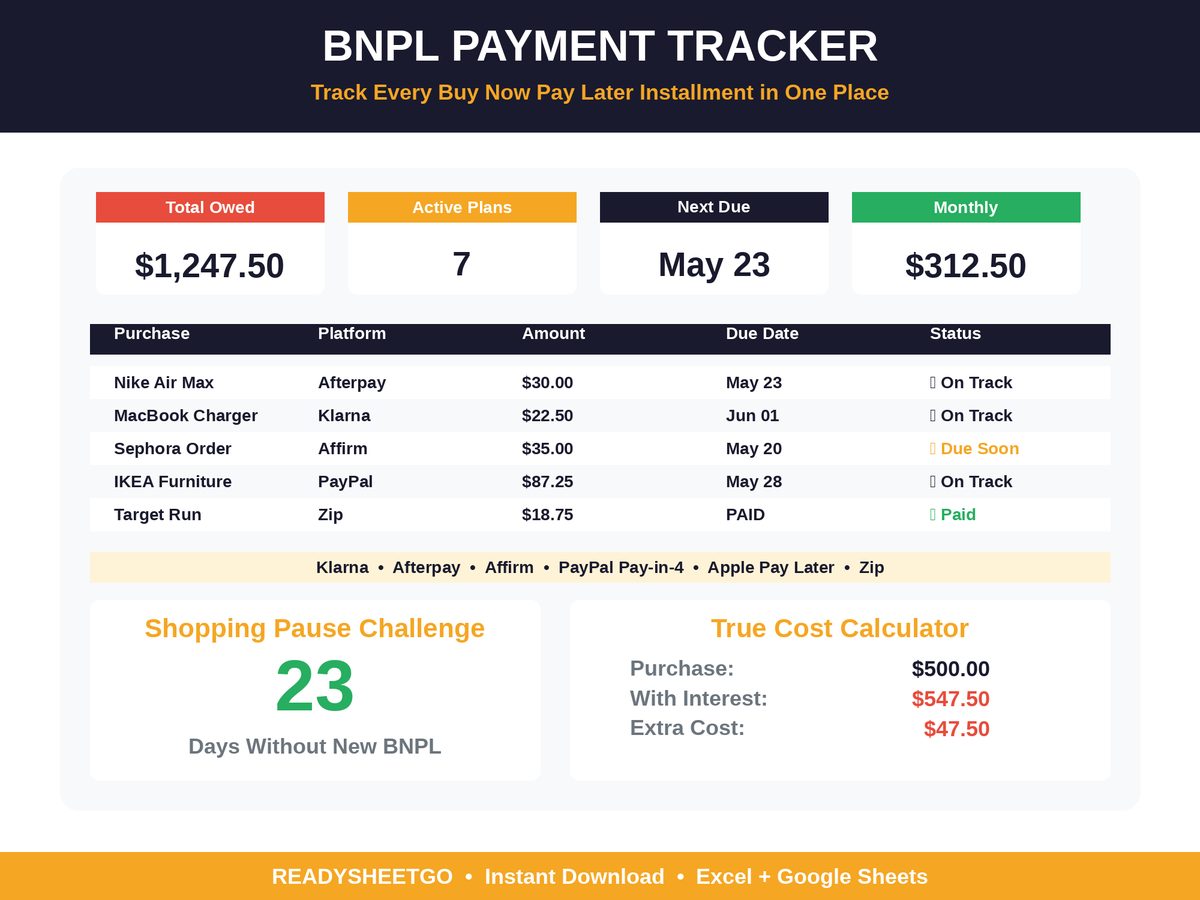
- Total monthly BNPL payments. Add up every installment coming due this month across every platform — Klarna, Afterpay, Affirm, PayPal Pay in 4, Zip, everything. This only works if every plan is actually listed somewhere; if any plan only lives inside its own app and never got written down, the total will be wrong.
- Monthly take-home pay. Use what actually lands in your account after taxes and deductions, not gross salary — the ratio is meant to reflect real spendable cash, not a number that overstates what you have available.
There’s no official, universally-cited cutoff the way there is for a mortgage debt-to-income ratio. The value of calculating it isn’t comparing it to some external rule — it’s having an actual number to watch move up or down over time, instead of a vague feeling that “it’s probably fine” or “it’s getting out of hand.”
Worked example
Take a hypothetical example: Priya brings home $3,400 a month after taxes. She currently has three active BNPL plans:
| Platform | Monthly payment |
|---|---|
| Klarna | $75 |
| Afterpay | $40 |
| Affirm (interest-bearing plan) | $95 |
| Total | $210 |
Her ratio: $210 ÷ $3,400 × 100 = 6.2%
On its own, 6.2% of take-home pay going to BNPL installments is a modest, easily-absorbed figure for most budgets — comparable to a single mid-size subscription bundle. Now say Priya opens two more plans over the next month, each at $85/month, without closing any of the existing ones:
New total: $210 + $170 = $380 → $380 ÷ $3,400 × 100 = 11.2%
The ratio nearly doubled without Priya making any single decision that felt dramatic — five separate “it’s just four easy payments” checkouts, spread across a few weeks, each reasonable in isolation. That’s the value of calculating the ratio rather than trusting a gut sense of “I don’t think I have that much BNPL”: the number moved from comfortable to worth watching closely, and the only way to see that shift is if every plan got added to the same running total in the first place.
What to do once you have your number
The ratio itself doesn’t come with a hard rule, but it’s useful as a trend line:
- If the ratio is climbing month over month even as older plans finish and roll off, that means new plans are being opened faster than old ones are closing — a pattern worth noticing before it compounds further, and one of the clearest signs BNPL has quietly become a bigger habit than it started as.
- If the ratio jumps because of one interest-bearing plan, check whether that specific plan is priced fairly against what the same purchase would have cost through a 0% alternative — the interest-bearing plan may be inflating the ratio more than the raw plan count suggests.
- If a payment is ever late enough to risk a bank fee, the true cost is higher than the ratio shows on paper — see what a single missed BNPL payment can actually end up costing once bank fees are factored in.
Recalculating as plans open and close
The ratio isn’t a one-time number — it changes every time a plan opens, closes, or an installment amount is misremembered. The only way to keep it accurate is recalculating it against a running list of every currently active plan, which means the ratio is really a byproduct of tracking every BNPL plan in one place to begin with, rather than something calculated separately from scratch each time.
The Buy Now Pay Later Tracker Spreadsheet automates exactly this: a Budget Impact tab maps every active plan’s monthly commitment against income to return the ratio automatically and flag a risk level, so the number above updates itself the moment a new plan is logged or an old one finishes — instead of requiring a fresh manual calculation every time.
Featured on ReadySheetGo
Buy Now Pay Later Tracker Spreadsheet — $9.99
11 tabs, 1,092 automatic formulas, including a Budget Impact tab that maps your BNPL obligations against income and returns a risk level automatically. Works in Excel and Google Sheets.
The bottom line
There’s no fixed number of BNPL plans that’s officially “too many” — the count of apps you’re using says nothing on its own. What matters is the total monthly commitment across every plan as a share of take-home pay, a number that can climb fast and quietly as each new “just four easy payments” checkout feels small in isolation. Calculate the ratio, watch it over time, and the vague worry turns into a specific number you actually control.
Frequently Asked Questions
How many Buy Now, Pay Later plans should someone have at once?
There's no universal number, since it depends entirely on income and what's being financed — two active plans can strain a tight budget while five can be comfortable for a higher income. Rather than counting plans, calculate your total monthly BNPL commitment as a percentage of take-home pay, which reflects the actual financial pressure regardless of how many separate apps it's spread across.
What percentage of income should go to Buy Now, Pay Later payments?
There's no official guideline specific to BNPL the way there is for mortgage debt-to-income ratios, but a useful reference point is to treat it like any other short-term installment debt: the smaller the percentage of take-home pay, the more room there is to absorb an unexpected expense without a payment being missed. Calculating your own percentage, even without an official cutoff, turns a vague worry into a specific number you can watch move up or down.
Is having multiple BNPL plans a sign of financial trouble?
Not automatically — multiple plans can simply reflect several one-time purchases financed interest-free around the same time. It becomes a more meaningful signal when a new plan is opened specifically to cover cash flow left short by an existing one, or when the total monthly commitment keeps climbing without any of the individual plans finishing and rolling off.
Should I stop using Buy Now, Pay Later entirely?
Not necessarily — a single, interest-free, on-time Pay-in-4 plan for a one-time purchase functions as a manageable, no-cost way to spread a cost. The point where it's worth pausing is when the combined monthly commitment across all active plans starts crowding out other budget categories, which is a specific, calculable threshold rather than a reason to avoid BNPL altogether.