How Much to Charge for House Cleaning: Hourly vs Flat Rate
You quoted $95 because the last person quoted $100 and you wanted the job. It took three hours, the drive was twenty minutes each way, and you went through half a bottle of degreaser. You got the client. You are not sure you wanted them.
The problem isn’t the number, it’s that the number came from a competitor instead of your own costs. Here is how to build a price from the bottom up, and why the hourly-versus-flat question matters more than most cleaners realise.
The Floor Price Formula
Your floor is the price below which a job costs you money to do. Everything above it is negotiation; everything below it is a hobby.
Floor price = (labour hours × target hourly rate)
            + supplies for the job
            + (round-trip miles × cost per mile)
            + overhead per job
Four inputs, all of which you can pin down in about ten minutes.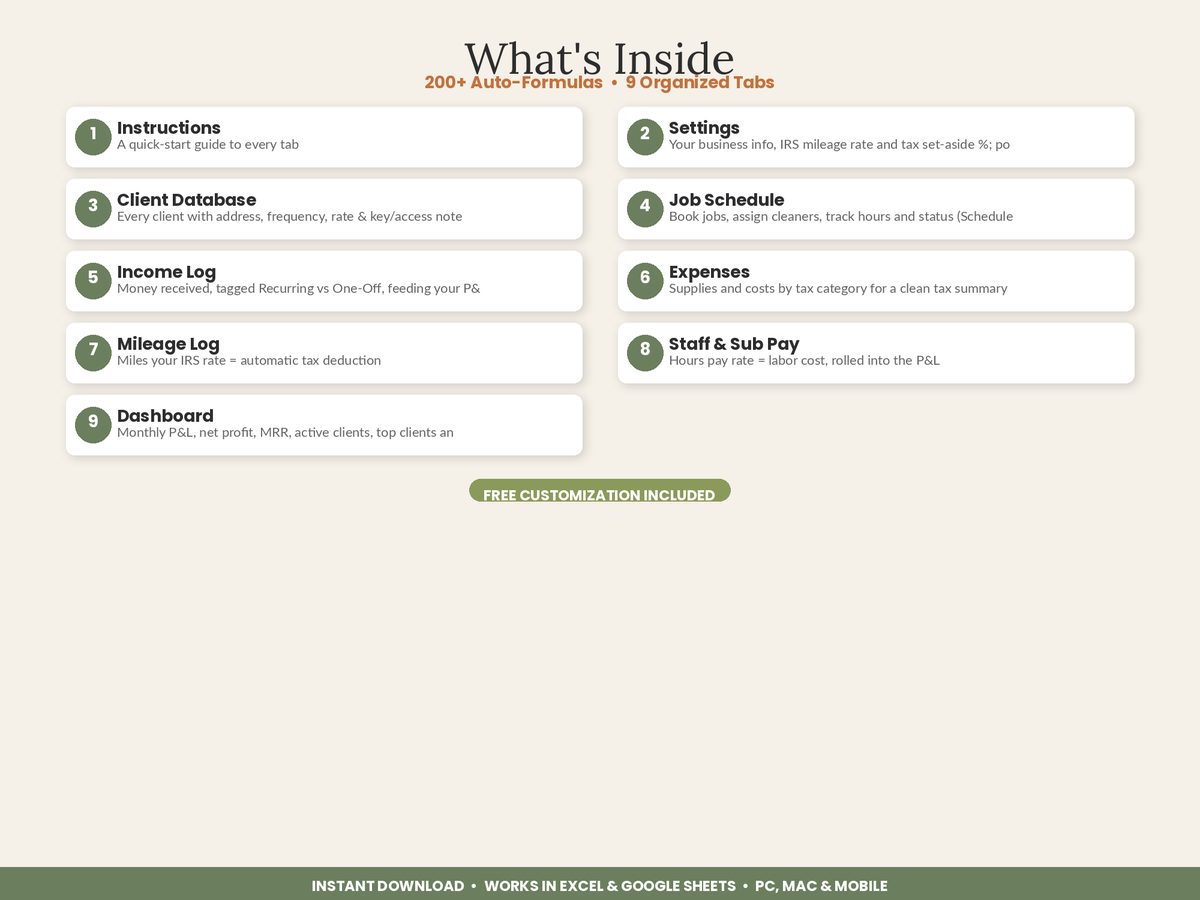
Labour hours — actual cleaning time, and if a second cleaner comes, count both. A 3-hour job with two people is 6 labour hours.
Target hourly rate — what you want an hour of your work to be worth. Not what you currently get. If you’re paying a cleaner, this must be above their pay rate or you’re subsidising the job.
Supplies per job — take last month’s supply spend and divide by jobs. Most residential cleans land between $3 and $6.
Cost per mile — the IRS standard rate is a fair proxy for what a mile actually costs a vehicle. For July through December 2026 that’s $0.76.
Overhead per job — monthly fixed costs ÷ jobs per month. Insurance $62 + software $20 + marketing $40 = $122, across 26 jobs, is $4.69. Call it $5.
Worked: a standard 2-hour clean
Assumptions: target $45/hour, 16 miles round trip, $4 supplies, $5 overhead.
| Component | Calculation | Amount |
|---|---|---|
| Labour | 2 hrs × $45 | $90.00 |
| Supplies | $4.00 | |
| Mileage | 16 × $0.76 | $12.16 |
| Overhead | $5.00 | |
| Floor price | $111.16 |
So $120 works. $95 does not — that job pays you about $34 an hour once everything is counted, and you’d have been better off with fewer, better-priced clients.
The same house, four ways
| Service | Hours | Price | Floor | Margin over floor |
|---|---|---|---|---|
| Standard clean | 2.0 | $120 | $111.16 | $8.84 |
| Deep clean | 3.5 | $180 | $178.66 | $1.34 |
| Move-out (2 cleaners) | 5.0 (10 labour hrs) | $350 | $471.16 | −$121.16 |
| Office clean | 2.5 | $200 | $133.66 | $66.34 |
Two things jump out. The deep clean is barely above floor — deep cleans routinely get underpriced because people anchor them to the standard rate and add a bit, rather than pricing the hours. And the move-out is losing money badly at two cleaners for five hours; either it’s a one-cleaner job at a longer duration, or it needs to be priced near $475.
Meanwhile the office clean is the quiet winner: same drive, same supplies, far better rate. Commercial work is frequently mispriced in the customer’s favour by cleaners who never compare it against residential on an hourly basis.
Why Hourly Quietly Punishes You
Here is the trap. You charge $45 an hour. You get better — the house that took 3 hours now takes 2.
Under hourly, your income on that house falls from $135 to $90. You got 33% better at your job and took a 33% pay cut. Under a flat $135, your effective rate went from $45 to $67.50 an hour, and the customer is equally happy because the house is equally clean.
Flat rate converts skill into money. Hourly converts skill into a discount for the client.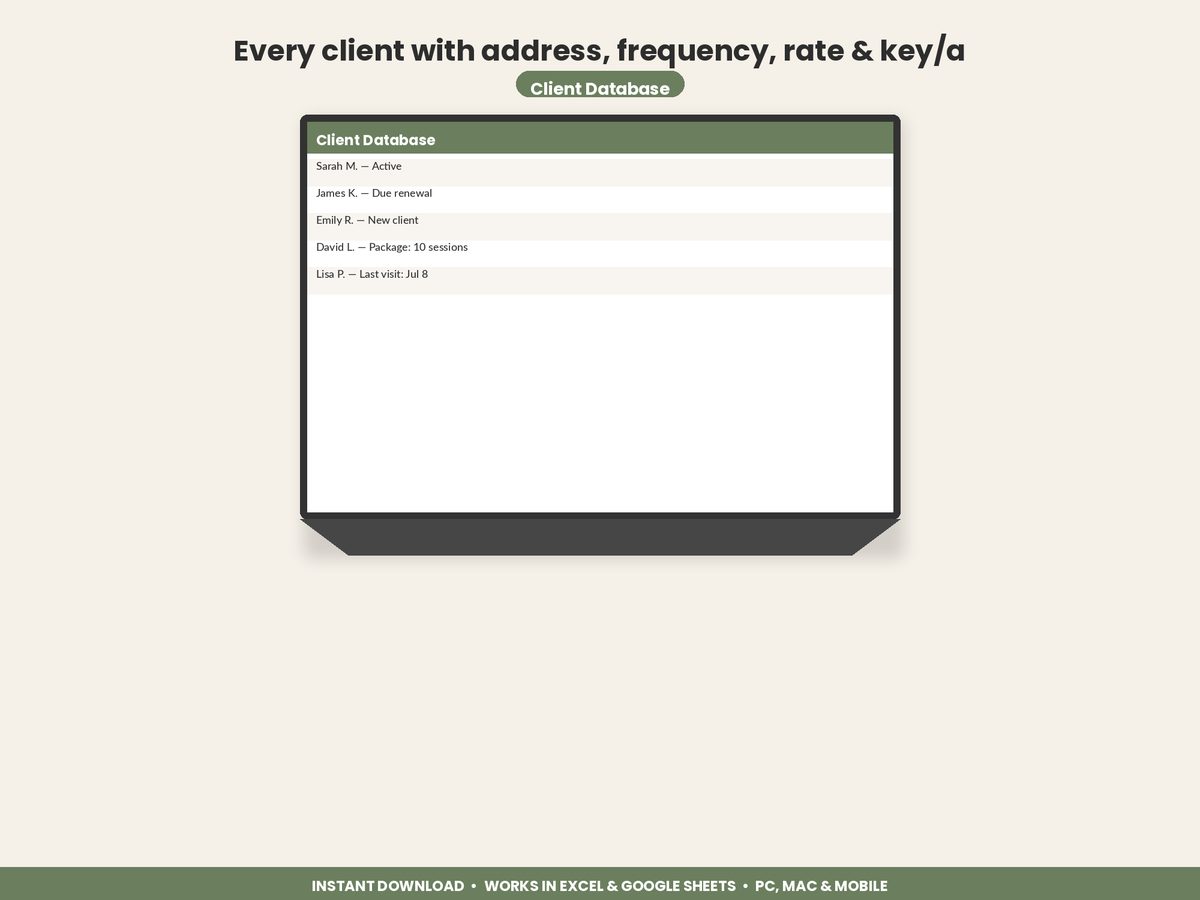
There’s a customer-side benefit too: a flat price is a decision, an hourly rate is an open-ended risk. “It’s $135” closes; “it’s $45 an hour, probably three hours” invites the customer to watch the clock and to feel cheated if you finish early.
Charge hourly only when you genuinely cannot scope the job — first-time deep cleans on a house you haven’t seen, post-construction, hoarding situations. Even then, quote “$45 an hour, minimum 4 hours” so the floor is protected.
The Hours You Don’t Bill
Effective hourly rate isn’t price ÷ cleaning hours. It’s price ÷ hours the job consumed.
| Standard clean | |
|---|---|
| Price | $120 |
| Cleaning time | 2.00 hrs |
| Drive time | 0.50 hrs |
| Scheduling, invoicing, chasing payment | 0.25 hrs |
| Total working hours | 2.75 hrs |
| Apparent rate | $60.00/hr |
| Real rate | $43.64/hr |
That 27% gap is the whole reason routing matters. Two clients on the same street share a single drive; two clients across town don’t. A $110 job five minutes away can beat a $120 job forty minutes away — and the only way to see that is to log hours and miles per job rather than trusting the sticker price. Your cleaning business tracker does that arithmetic if you record hours alongside price.
Raising Rates on Existing Clients
Held prices are falling prices — supplies, fuel and insurance all drift up.
Review once a year. Give existing clients 30 days’ written notice, keep it short, and don’t apologise or over-explain: state the new rate, the date it starts, and thank them. Quote new clients at current rates from the start. A modest annual increase is easier for everyone than freezing prices for four years and then needing a 25% correction.
The clients who leave over a small increase were usually the ones costing you the most anyway.
The Short Version
- Build the floor from labour + supplies + mileage + overhead. Never quote below it.
- Price flat wherever you can scope the work; hourly caps you at your current speed.
- Judge every job on effective hourly rate including drive and admin, not on price.
- Re-price deep cleans and move-outs by hours — they’re the two that get underquoted.
- Review annually.
Featured on ReadySheetGo
Cleaning Business Income & Client Tracker — $14.99
The Job Schedule tab logs hours next to price for every job, so your real hourly rate by service type stops being a guess. Settings holds your mileage rate and default labour rate; the Client Database converts each client’s frequency and rate into their monthly value; and the Dashboard rolls it into a monthly P&L with net profit and margin. Nine tabs, sample data pre-filled, works in Excel and Google Sheets.
Get the Cleaning Business Income & Client Tracker →
For the full system this pricing feeds into, see the complete guide to tracking a cleaning business.
Frequently Asked Questions
Should I charge hourly or a flat rate for house cleaning?
Flat rate, once you can estimate a home reliably. Hourly charging penalises you for getting faster — the better you get, the less you earn on the same house. A flat price means efficiency gains go to you. Charge hourly only for jobs you genuinely cannot scope in advance, such as first-time deep cleans or hoarding situations, and quote those as an hourly rate with a stated minimum.
How do I work out the minimum I can charge for a cleaning job?
Use a floor price: (labour hours × your target hourly rate) + supplies for the job + (round-trip miles × your cost per mile) + overhead per job. For a 2-hour clean at a $45 target, $4 of supplies, 16 miles and $5 of overhead, the floor is $111.16 — so a $120 flat price works and a $95 price does not. Overhead per job is your monthly fixed costs divided by jobs per month.
Why is my hourly rate lower than the price divided by cleaning hours?
Because you are paid for cleaning hours but you spend working hours. A $120 two-hour clean looks like $60 an hour, but adding 30 minutes of driving and 15 minutes of scheduling and invoicing makes it 2.75 working hours — $43.64 an hour. Drive time is the biggest hidden cost in cleaning, which is why tightly clustered clients are worth more than their price suggests.
How often should I raise my cleaning rates?
Review annually and raise on existing clients with 30 days' written notice. Supplies, fuel and insurance all rise, so a flat rate held for three years is a real pay cut. A common approach is a modest annual increase on existing clients while quoting new clients at current rates, which avoids the jump that comes from leaving prices untouched for years and then correcting all at once.