How to Do Cash Stuffing When You Get Paid Weekly
Most cash-stuffing advice assumes you get paid once or twice a month, then stuff all your envelopes in one go. But you’re paid weekly — four or five smaller checks a month — and stuffing a whole month of envelopes on week one leaves nothing for the paydays in between. So do you budget weekly? Monthly? What about the months with a fifth paycheck? Here’s how to run the envelope system cleanly on a weekly pay schedule.
The core rule: monthly targets, weekly funding
The trap is thinking weekly pay means a weekly budget. It doesn’t. Your rent, insurance, and most bills are monthly, so your envelope targets should stay monthly — that’s what matches your real costs. What changes is how you fill them: instead of one big monthly stuff, you fund each envelope in weekly slices as each paycheck lands.
Divide each monthly envelope target by the number of paydays in a normal month — four — and stuff that slice every week. Your envelopes fill up steadily, your cash flow stays smooth, and you never face the “I stuffed everything week one and now I’m broke” problem.
Step 1: Set monthly targets, then divide by four
Start with normal monthly envelope amounts, exactly as you would on any budget. Then divide each by four to get the weekly slice.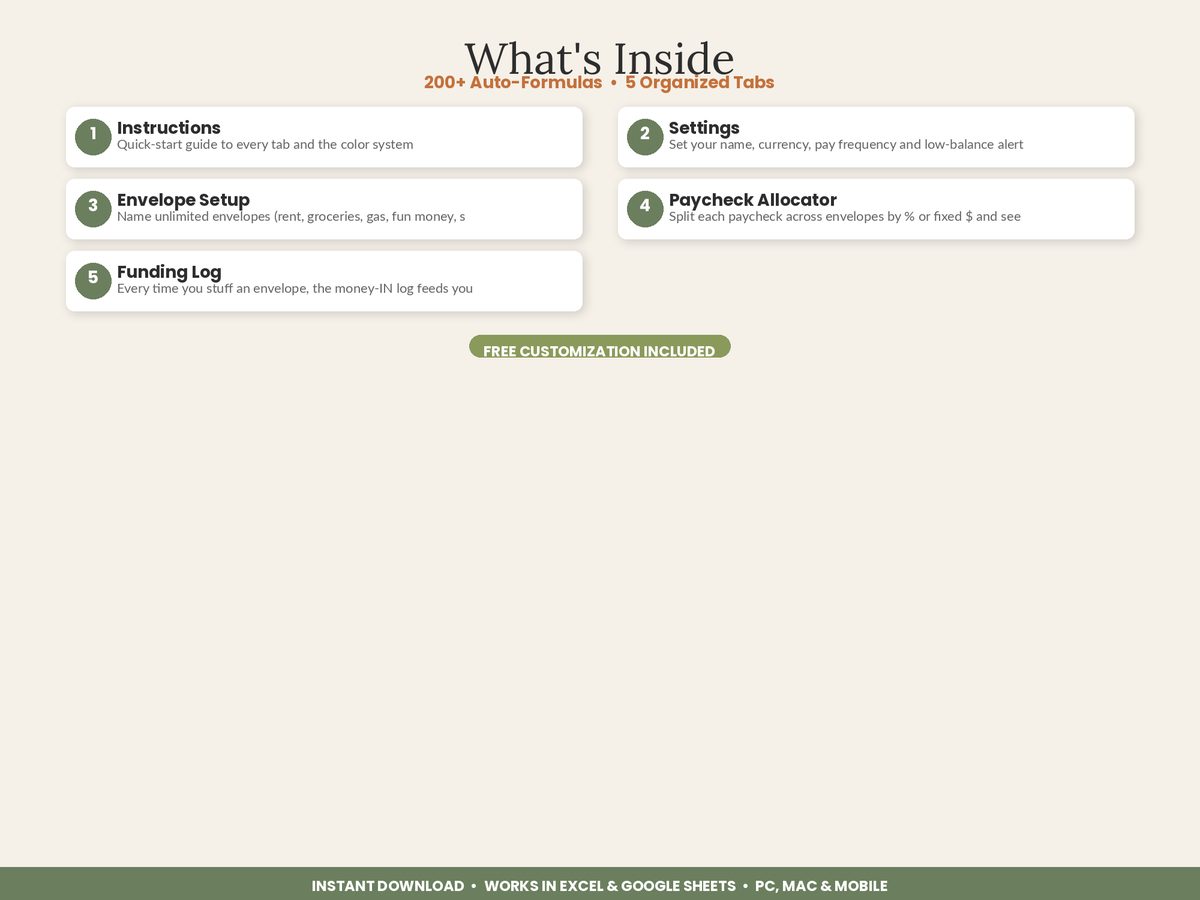
| Envelope | Monthly target | Weekly slice (÷4) |
|---|---|---|
| Groceries | $520 | $130 |
| Gas / transport | $160 | $40 |
| Eating out | $120 | $30 |
| Fun money | $100 | $25 |
| Household / misc | $80 | $20 |
| Car maintenance (sinking fund) | $80 | $20 |
| Total | $1,060 | $265 |
Each payday you stuff $265 across those envelopes in the slices shown. Four paydays later, every envelope has hit its full monthly target. Simple, and it never leaves a gap between checks.
Step 2: Handle bills that are due before you’ve fully funded them
The one wrinkle with weekly funding: a monthly bill or a big envelope might come due before four weeks of slices have accumulated. Two clean fixes:
- Keep fixed monthly bills on autopay from a separate “bills” balance that you also feed weekly, so the money is there when the bill hits. Feed it its own weekly slice just like an envelope.
- Front-load essentials in week one if timing is tight — put a little extra into groceries and transport early in the month, and lighter into discretionary envelopes, then even out later. Weekly funding is flexible; use the early slices for what you need first.
The goal is simply that money arrives in each envelope before you need to spend it.
Step 3: Plan for the five-paycheck month
Here’s the hidden bonus of weekly pay. Four weekly checks a month is only 48 checks a year — but there are 52 weeks. So about four times a year you get a fifth paycheck in a single month.
Because you funded your envelopes on a four-week baseline, that fifth check is almost entirely free money. Don’t let it dissolve into extra spending. Decide in advance where it goes:
- Straight onto debt (this is how weekly earners knock out a credit card fast)
- Into savings or an emergency fund
- To top up a lagging sinking fund like holidays or annual insurance
One extra $600–$1,000 check, four times a year, is $2,400–$4,000 you can put to work without touching your normal budget. Naming its destination ahead of time is the difference between it building your future and vanishing on takeout.
Quick check: to find your five-check months, look at a calendar and mark your payday each week — the months where your payday lands five times are your bonus months. Mark them now so they don’t surprise you.
Step 4: Let balances roll over week to week
With weekly slices, some weeks you’ll underspend an envelope. Let that surplus roll into next week’s balance rather than resetting it. A $130 grocery slice with $22 left becomes $152 available next week. This rollover is what stops the “ran out on Thursday” problem — good weeks quietly cushion tight ones.
Tracking rollover by hand across four or five weekly stuffs per envelope gets error-prone fast. This is where a tracker pays for itself: the Cash Stuffing & Cash Envelope Budget Tracker rolls unspent balances over automatically, so each week builds on the last without you doing the math. Its Paycheck Allocator lets you stuff each weekly check into your envelopes by fixed dollars or percentage with a “left to allocate” check, and the live dashboard shows funded, spent, and remaining per envelope so you always know if this week’s slice is holding. Because it runs in Excel and Google Sheets on your phone, funding a weekly paycheck takes under a minute.
The bottom line
Getting paid weekly is an advantage for cash stuffing, not an obstacle. Keep your envelope targets monthly, fund them in four equal weekly slices, make sure money lands before bills are due, and let balances roll week to week. Then pre-assign the four “fifth paycheck” months a year to debt or savings — that’s the quiet engine that lets weekly earners get ahead faster than they expect.
New to the method? Start with the full walkthrough on how to set up a cash envelope budget for beginners.
Featured on ReadySheetGo
The Cash Stuffing & Cash Envelope Budget Tracker handles weekly pay with ease: split each weekly check by % or fixed $, watch funded-vs-remaining on a live colour-coded dashboard, and let unspent balances roll over automatically week to week. 9 tabs, unlimited envelopes, Excel + Google Sheets, pre-filled samples. Instant digital download — $13.99.
Frequently Asked Questions
How do you do cash stuffing when you're paid weekly?
Divide each monthly envelope target by the number of paydays and fund that slice every week. If groceries need $520 a month and you're paid weekly, you stuff about $120 into groceries each payday. Weekly funding keeps envelopes topped up in small, manageable amounts instead of one big monthly stuff.
Should I budget weekly or monthly if I'm paid weekly?
Keep your envelope targets monthly but fund them weekly. Bills and many expenses are monthly, so a monthly plan matches your real costs — but you fill each envelope in weekly slices as pay arrives. This gives you the structure of a monthly budget with the cash-flow smoothness of weekly funding.
What do I do with the extra paycheck in a five-week month?
When paid weekly you get five paydays about four times a year instead of four. Because your envelopes are funded on a four-week baseline, that fifth check is largely free — send it straight to debt payoff, savings, or a sinking fund before it gets absorbed into everyday spending.
How do I stop running out of grocery money before the next weekly paycheck?
Fund groceries in equal weekly slices and only spend that week's slice, letting any leftover roll into the next week. If you consistently run short mid-week, your weekly slice is too low — raise the monthly target and trim a category with a surplus. A tracker that rolls balances over automatically makes this easy to see.