How to Set Up a Cash Envelope Budget for Beginners (Step-by-Step)
You’ve seen the videos — someone counting out cash into labelled envelopes, spending only what’s inside each one, and somehow always having money left at the end of the month. You want that control, but you have no idea where to start: How many envelopes? How much goes in each? What if you run out? This guide walks you through setting up a cash envelope budget from scratch, with a full worked example you can copy today. No prior budgeting experience needed.
What the cash envelope system actually is
The cash envelope system (also called cash stuffing) is simple: instead of one big pile of money you dip into all month, you divide your spending money into labelled categories — envelopes — and give each one a set amount. When an envelope is empty, you’re done spending in that category until your next payday.
That’s the whole trick. It works because it turns a vague number in a banking app into a hard, visible limit. “I have $600 in checking” is easy to overspend. “I have $40 left in the grocery envelope and it’s only the 20th” is not. The empty envelope makes you stop.
You do not need to withdraw physical cash to use this system. Plenty of beginners run it digitally, keeping money in the bank and tracking envelopes on a spreadsheet — you get the same discipline without carrying a wallet full of twenties. More on that below.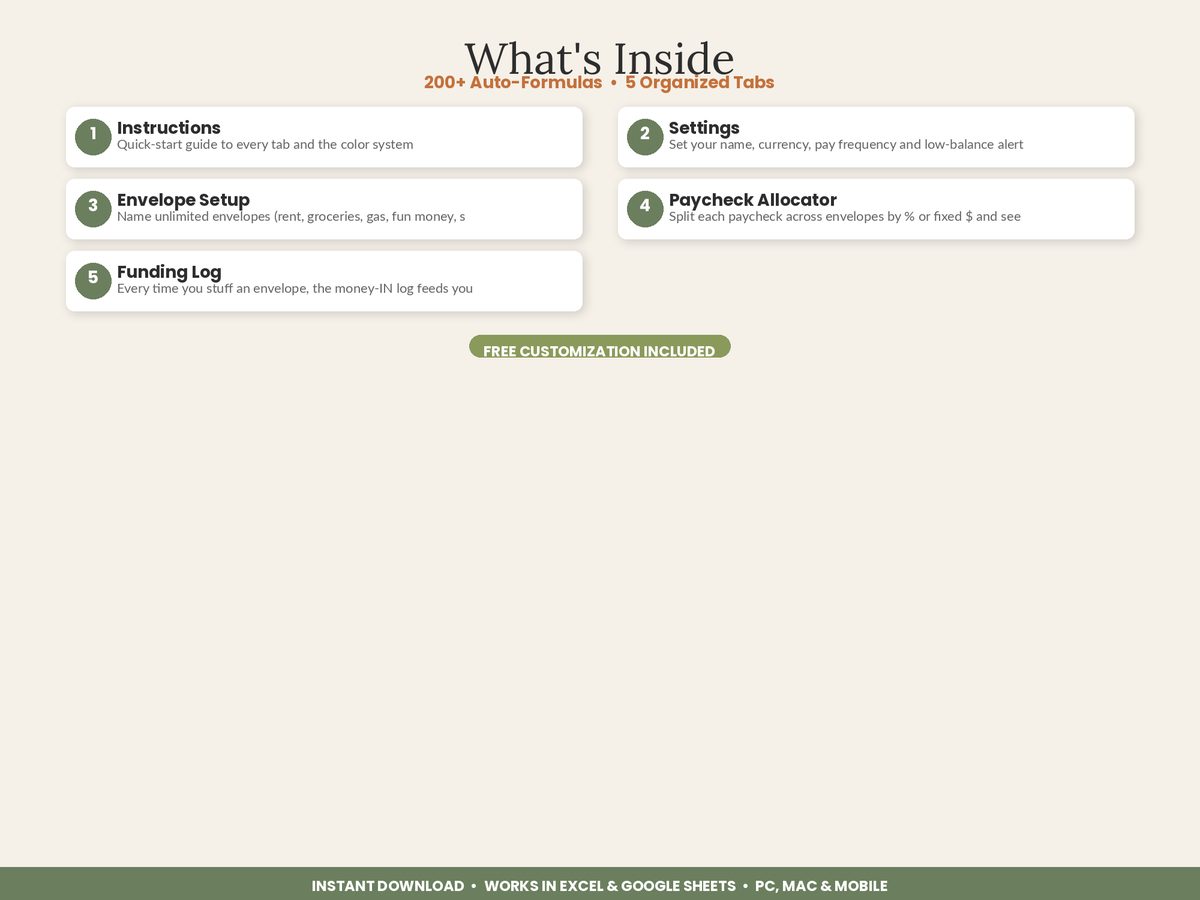
Step 1: Find your three core numbers
Before you label a single envelope, you need three numbers. Grab your last two or three months of bank and card statements.
- Monthly take-home pay — what actually lands in your account after tax, not your salary. If your pay varies, use your lowest recent month so you never over-budget.
- Fixed bills — costs that are the same every month and can’t really be flexed: rent or mortgage, utilities, insurance, phone, loan minimums, subscriptions.
- What’s left — take-home pay minus fixed bills. This leftover is the money you’ll actually divide into envelopes.
Here’s the mistake most beginners make: they try to put rent and every bill into an envelope too. Don’t. Fixed bills belong on autopay, paid straight from your account. The envelope system is for the variable, tempting, easy-to-overspend money — groceries, eating out, fun, gas. That’s where the leaks are, so that’s where you focus.
Step 2: Choose your starter envelopes
Beginners do best with five to eight envelopes. Fewer than five isn’t really budgeting; more than ten gets tedious and you’ll quit. Cover your biggest and most variable categories first.
A solid beginner set:
- Groceries — usually the biggest variable cost
- Gas / transport — fuel, transit passes, rideshares
- Eating out — restaurants, takeout, coffee, delivery
- Fun money — hobbies, entertainment, “no questions asked” spending
- Personal care — haircuts, toiletries, health and beauty
- Household / miscellaneous — cleaning supplies, small home items, the catch-all
- A sinking fund or two — small monthly amounts set aside for irregular costs like car maintenance or Christmas gifts (a sinking fund is just an envelope you fill a little each month so a big bill doesn’t wreck you later)
You don’t have to use all of these. Pick the ones that match where your money actually goes.
Step 3: Decide how much goes in each envelope
This is the step beginners get wrong most often — they guess, set the numbers too low, run out in week two, and give up. Do this instead: base each envelope on what you actually spent over the last two or three months.
Add up your recent grocery spending across two months and divide by two. That’s your realistic grocery envelope. Do the same for gas, dining, and the rest. Round to a clean, slightly generous number to start. You’ll tighten it over a couple of months once you have real data — but starting realistic is what keeps you from quitting.
A full worked example
Let’s put real numbers on it. Say your monthly take-home pay is $3,200.
First, the fixed bills on autopay:
| Fixed bill | Monthly |
|---|---|
| Rent | $1,250 |
| Utilities + internet | $260 |
| Phone | $70 |
| Car insurance | $130 |
| Subscriptions | $40 |
| Loan minimum | $250 |
| Total fixed | $2,000 |
That leaves $3,200 − $2,000 = $1,200 to divide into envelopes. Here’s a realistic beginner split:
| Envelope | Amount |
|---|---|
| Groceries | $500 |
| Gas / transport | $180 |
| Eating out | $120 |
| Fun money | $100 |
| Personal care | $60 |
| Household / misc | $80 |
| Car maintenance (sinking fund) | $60 |
| Christmas / gifts (sinking fund) | $50 |
| Buffer / overflow | $50 |
| Total | $1,200 |
Every dollar of the $1,200 now has a job. On payday you “stuff” each envelope with its amount. Through the month, every grocery run comes out of the $500 grocery envelope; every coffee comes out of the $120 eating-out envelope. When eating out hits zero on the 22nd, you cook at home until next payday — the grocery envelope isn’t a slush fund for restaurants.
Notice the two sinking funds quietly doing their job: $60 a month into car maintenance means that when you need $400 of tyres in October, roughly $600 is already waiting. No credit card, no panic.
Step 4: Spend, log, and watch the balances
Once envelopes are stuffed, the daily routine is tiny: spend from the right category and record it so the balance drops. With paper, you literally take cash out of the sleeve. Digitally, you log the purchase and the envelope updates.
The one rule that makes or breaks the system: don’t borrow between envelopes on a whim. If groceries run low, the honest move is to cook cheaper for a few days — not to raid the fun-money envelope. Occasionally you’ll make a deliberate transfer (that’s fine, you’re in control), but constant borrowing means your amounts are wrong and you should fix them at the next reset, not paper over them daily.
Step 5: Review at the end of the month and adjust
At month-end, look at each envelope. Empty on the 15th every month? That envelope is underfunded — raise it and trim somewhere with a surplus. Consistently $80 left in fun money? Lower it and send the difference to savings or a sinking fund. Two or three cycles of this and your envelopes settle into numbers that actually fit your life. This is the part that turns budgeting from a monthly fight into autopilot.
Paper or digital? For most beginners, digital wins
Paper envelopes are a great way to feel the method, but they have real downsides: you carry cash, you can lose it, you can’t split an exact paycheck neatly, and you do all the math by hand. Running the same system digitally keeps your money safe in the bank and does the arithmetic for you, while still giving you the empty-envelope stop signal.
That’s exactly what the Cash Stuffing & Cash Envelope Budget Tracker is built for. Its Paycheck Allocator splits any paycheck across your envelopes by percentage or fixed dollars, with a “left to allocate” check so nothing floats unassigned. The dashboard shows funded, spent, and remaining for every envelope and turns a category red the moment you overspend, and unspent balances roll over automatically into next month. It works in both Excel and Google Sheets, so you can log a purchase on your phone the second it happens.
Five beginner mistakes that make people quit
Almost everyone who abandons the envelope system trips on one of these. Know them going in and you’ll sail past the point where most people give up.
- Setting envelopes too low. Optimism budgeting — “I’ll only spend $300 on groceries” when you’ve spent $480 for months — guarantees you run dry in week two, feel like a failure, and quit. Budget your real spending first, then tighten gradually.
- Trying to envelope everything. Putting fixed bills and twenty micro-categories into envelopes turns a helpful system into a part-time job. Five to eight variable envelopes is enough. Keep it lean.
- Raiding envelopes constantly. The occasional deliberate transfer is fine. Habitually pulling from fun money to cover groceries means your amounts are wrong — fix them at month-end instead of quietly borrowing every week.
- Skipping sinking funds. Without a little set aside each month for car repairs, gifts, and annual bills, the first irregular expense blows the whole budget and lands on a credit card. Sinking funds are what make the system survive real life.
- Never reviewing. Set-and-forget doesn’t work in month one because your first amounts are guesses. The month-end review is where the budget actually gets good. Skip it and you’ll conclude “budgeting doesn’t work for me” when really you just never tuned it.
None of these are about willpower. They’re setup errors, and every one is fixable in a few minutes.
Your beginner setup checklist
- [ ] Pull the last 2–3 months of statements
- [ ] Write down take-home pay, total fixed bills, and the leftover
- [ ] Put fixed bills on autopay (keep them out of envelopes)
- [ ] Choose 5–8 starter envelopes for your variable spending
- [ ] Set each envelope from your real recent spending, rounded slightly generous
- [ ] Add one or two small sinking funds for irregular costs
- [ ] Stuff envelopes on payday; spend only from the right one
- [ ] Log every purchase so balances stay live
- [ ] Review at month-end and adjust amounts
Go deeper on the parts that matter to you
Once you’ve got the basics, dial in the details for your situation:
- Not sure how granular to get? See how many cash envelope categories you should actually have.
- Working with a tight budget? Read how to start cash stuffing on a low income.
- Budgeting with a partner? Here’s how to run cash stuffing for couples with a shared budget.
- Paid every week? Follow how to do cash stuffing when you get paid weekly.
The bottom line
Setting up a cash envelope budget as a beginner comes down to five moves: find your leftover after fixed bills, pick five to eight envelopes, fund them from your real spending, spend only what’s inside each, and adjust at month-end. Start slightly generous so you don’t quit, keep fixed bills on autopay, and let one or two sinking funds absorb the irregular costs that usually blow budgets up. Do that for two months and the system stops feeling like restriction and starts feeling like control.
Featured on ReadySheetGo
The Cash Stuffing & Cash Envelope Budget Tracker makes beginner setup painless: split any paycheck by % or fixed $, track funded-vs-remaining on a live colour-coded dashboard, add unlimited envelopes and sinking funds, and let unspent cash roll over automatically. 9 tabs, Excel + Google Sheets, pre-filled samples to copy. Instant digital download — $13.99.
Frequently Asked Questions
How do I start a cash envelope budget as a complete beginner?
Start with three numbers: your monthly take-home pay, your fixed bills, and what's left over. Put fixed bills like rent and insurance on autopay, then split the leftover across five to eight spending envelopes such as groceries, gas, eating out, and fun money. Assign a set dollar amount to each envelope on payday and only spend what's inside. When an envelope hits zero, you stop spending in that category until next payday.
How much money should a beginner put in each envelope?
Base each envelope on what you actually spent over the last two or three months, not a guess. Add up recent grocery, gas, and dining spending and average it, then round to a realistic number. Beginners often set envelopes too low, run out in week two, and quit — so start generous and tighten over a couple of months once you have real data.
How many cash envelopes should I have when starting out?
Five to eight is the sweet spot for beginners. Fewer than five and you're not really budgeting; more than ten and it becomes tedious to maintain and easy to abandon. Cover your biggest variable categories first — groceries, transport, eating out, fun money — plus one or two sinking funds for irregular costs like car maintenance.
Do I need to use real cash for the envelope system?
No. Many beginners run the envelope system digitally, keeping their money safely in the bank while 'stuffing' envelopes on a spreadsheet and logging each purchase against the right category. You get the same hard-limit discipline without withdrawing cash, carrying it, or risking losing it. Digital tracking also does the math for you and updates balances instantly.