How to Start Cash Stuffing on a Low Income (Tight Budget Guide)
When money is tight, budgeting advice can feel insulting — “just set aside 20% for savings” is useless if there’s nothing left after rent and groceries. But the cash envelope system is different. It doesn’t ask you to have spare money; it asks you to control the money you do have so the small leaks stop draining a budget that can’t afford to leak. On a low income, that control matters more, not less. Here’s how to start.
Why cash stuffing fits a tight budget so well
The envelope system’s whole job is to make every dollar visible and give it a limit. When you’re stretched, that’s exactly the problem you have: money vanishes on small, forgettable purchases — a few dollars here, a top-up there — and by the 20th the account is empty and you don’t know where it went. Envelopes stop that. A category with $12 left in it makes you pause in a way a bank balance never does.
There’s no minimum income to start. If you can divide what you earn into categories and stop spending when one is empty, the method works whether your leftover is $1,200 or $150.
Step 1: Fund survival first, everything else later
On a tight budget you fund envelopes top-down by priority — most essential first — and you stop when the money runs out. That’s not failure; that’s the system telling you the truth about your month.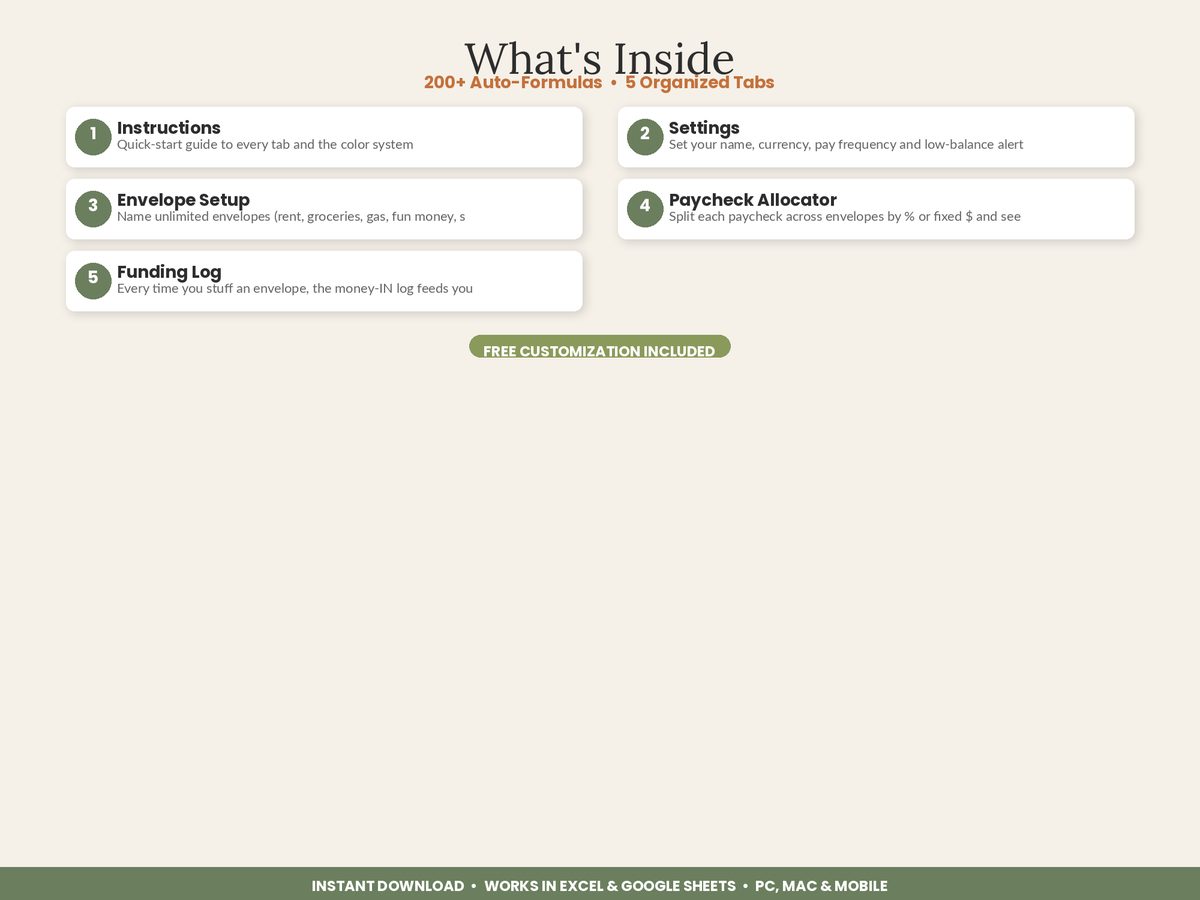
Rank your envelopes before payday so the order is decided in a calm moment, not at the checkout. A typical low-income priority order:
- Groceries / food
- Transport (getting to work)
- Any variable essential (medication, childcare co-pay)
- A tiny buffer
- One small “breathing room” discretionary envelope
Fill number one completely, then number two, and so on down the list. When the money’s gone, you’re done — and the unfunded envelopes at the bottom show you exactly the size of the gap you’re working to close.
Step 2: Keep it to four or five envelopes
Resist the urge to build a detailed budget with a dozen categories. On a low income you want survival envelopes, not granularity. Four or five is plenty:
- Groceries — your biggest controllable cost
- Transport — fuel or transit to earn income
- Buffer — a small catch-all for the unexpected
- Breathing room — a modest personal envelope so the plan is sustainable, not punishing
- Optionally, one sinking fund — even $5 a payday
Fewer envelopes means less chance one runs dry mid-week and knocks the whole system over. Simplicity is what makes it stick when there’s no margin for error.
A real worked example
Let’s use tight numbers. Say your take-home is $1,900 a month and your fixed bills come to $1,450:
| Fixed bill | Monthly |
|---|---|
| Rent (room/shared) | $850 |
| Utilities + phone | $180 |
| Insurance | $120 |
| Loan / minimums | $180 |
| Internet | $120 |
| Total fixed | $1,450 |
That leaves $1,900 − $1,450 = $450 for envelopes. Funded top-down:
| Priority | Envelope | Amount |
|---|---|---|
| 1 | Groceries | $260 |
| 2 | Transport | $90 |
| 3 | Buffer | $40 |
| 4 | Breathing room | $40 |
| 5 | Emergency sinking fund | $20 |
| Total | $450 |
It’s tight, but every dollar is doing something and nothing is floating loose to disappear. That $20 emergency fund looks tiny — but at $20 a payday it becomes $520 over a year, which is the difference between an unexpected car repair being a setback versus a crisis. Small and consistent beats big and never.
Step 3: Protect the buffer, and build it slowly
The single most valuable envelope on a low income is the buffer. A tight budget has no slack, so one surprise — a parking fine, a school fee — usually goes on a credit card and starts a debt spiral. Even a small buffer intercepts those. Guard it: it’s not spending money, it’s the thing that keeps a bad week from becoming a bad year.
Whenever you get anything extra — a shift of overtime, a tax refund, cash back — send a chunk straight to the buffer before you can absorb it into everyday spending. That’s how a fragile budget slowly becomes a resilient one.
Step 4: Let a tracker do the math so nothing slips
When margins are thin, a single tracking mistake — thinking you have $30 in groceries when you have $8 — can mean an overdraft fee you can’t afford. Doing the math in your head is where tight budgets break.
That’s where digital cash stuffing earns its keep. The Cash Stuffing & Cash Envelope Budget Tracker keeps every balance live and turns an envelope red the instant you overspend, so you get a warning before an overdraft, not after. Its Paycheck Allocator lets you split even a small paycheck top-down across your priority envelopes with a “left to allocate” check, and because it runs in Google Sheets on your phone for free, you can check a balance before you buy — no app fees, no cost to start.
The bottom line
Cash stuffing on a low income isn’t about having money to spare — it’s about refusing to let the little money you have leak away. Fund survival envelopes first, keep the list to four or five, protect a small buffer, and treat filling envelopes top-down until the money runs out as information, not failure. Do it consistently and a budget with no slack slowly grows some.
New to the method? Start with the full walkthrough on how to set up a cash envelope budget for beginners.
Featured on ReadySheetGo
The Cash Stuffing & Cash Envelope Budget Tracker is built for tight budgets: split any paycheck top-down by priority, get a live colour-coded warning before you overspend, and run it free in Google Sheets on your phone. 9 tabs, unlimited envelopes, pre-filled samples. Instant digital download — $13.99.
Frequently Asked Questions
Does cash stuffing work if you're on a low income?
Yes, and often better than for higher earners. When every dollar counts, the hard-limit discipline of the envelope system stops small leaks that a tight budget can't absorb. The method doesn't require spare money — it requires assigning the money you do have before it disappears.
How do you start cash stuffing when money is tight?
Fund your survival envelopes first — groceries, transport, and any variable essential — before anything discretionary. Fill them in the order you'd least want to lose, and only with money you actually have in the account. Even a $5 sinking fund counts; the habit matters more than the amount at the start.
How many envelopes should you have on a low income?
Keep it to four or five. On a tight budget you want survival categories, not granularity: groceries, transport, one small buffer, and maybe one discretionary envelope so you don't feel deprived. Fewer envelopes means less chance one runs dry and derails the whole system.
What if I can't fill every envelope on payday?
Fund top-down by priority and stop when the money runs out — that's the system working, not failing. The envelopes you couldn't fill show you exactly where the shortfall is. Fill essentials first, and add to the lower envelopes from the next paycheck or any extra income.