Tip-Out vs Tip Pool: How Much of Your Tips You Actually Keep
You wrote down $292 in tips on Saturday and went home with $258. You know the difference went to the bar and the busser. What you probably don’t know is what percentage that was, whether it was the same percentage as last month, or whether the structure your house uses is quietly charging you for other people’s bad tipping.
Those are three answerable questions, and one column in your log answers all of them.
Full walkthrough of the template used in this guide.
Two Different Things That Get Called the Same Thing
Tip-out is money leaving your tips and going to support staff — bar, barback, busser, runner, host. You received the tips; you pay a portion away.
Tip pool is money that never becomes solely yours in the first place. Tips are collected and redistributed, usually by hours worked, so a slow section and a busy section end the night closer together.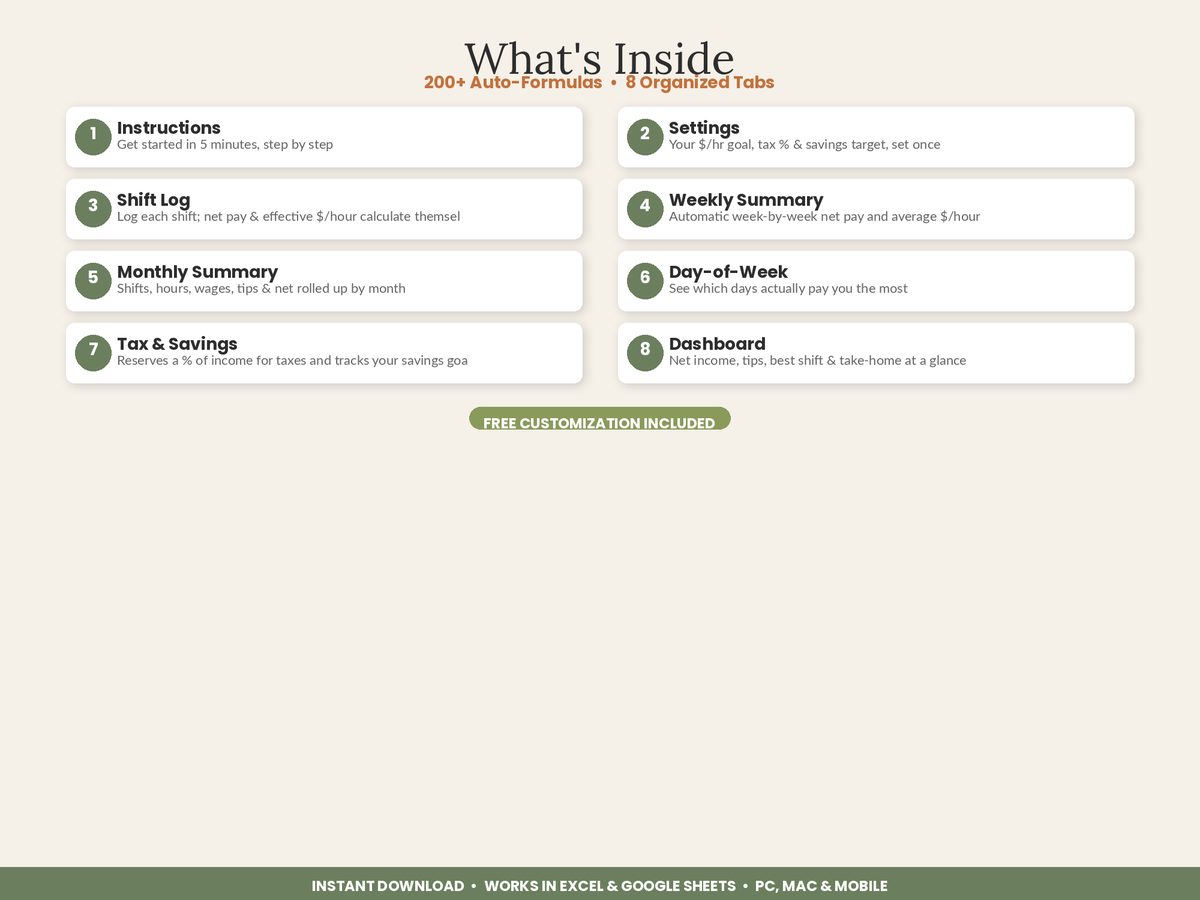
Many houses run both: a pooled front-of-house with a separate tip-out to the bar. Which is why your log needs a single column for “everything I paid away,” not a debate about what to call it.
The Rules on Who Can Be In It
Worth knowing, because these are the parts most commonly gotten wrong on the floor. Under the FLSA:
- Tips are the property of the employee. The employer may not keep any portion of employees’ tips for any purpose, whether directly or through a tip pool — and this holds regardless of whether the employer takes a tip credit.
- Managers and supervisors cannot take a share of a pool. They may keep a tip a customer gives them directly for a service they directly and solely provided, and nothing more (DOL Fact Sheet #15B).
- If your employer takes a tip credit, a mandatory pool is limited to employees who customarily and regularly receive tips — front of house.
- If your employer pays full minimum wage and takes no tip credit, the pool may include back-of-house staff such as cooks and dishwashers (DOL Fact Sheet #15).
So “can the kitchen be in the pool” has no universal answer. It depends on whether your cash wage is $2.13-style with a tip credit, or the full minimum. That’s one cell in your Settings tab, and it decides the whole question.
Percentage of Tips vs Percentage of Sales
This is the structural choice that costs servers the most money, and it is almost never explained when you’re hired.
Take two Saturdays with identical $1,600 in sales. On the first, guests tip an average of 18%. On the second, a large party runs a big check and leaves 8%, dragging the night’s average to 12%.
Structure A — tip-out is 15% of your tips: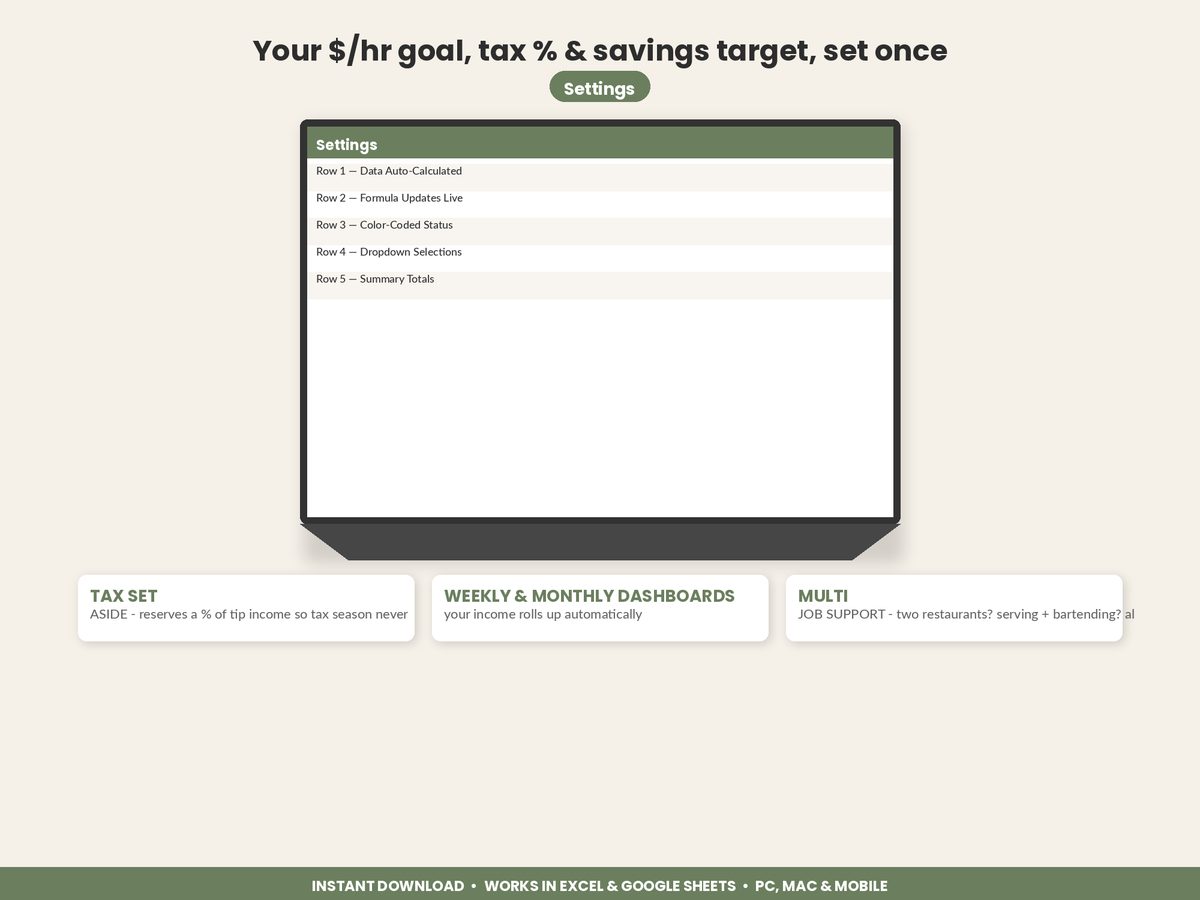
| Good night | Bad night | |
|---|---|---|
| Sales | $1,600 | $1,600 |
| Tips received | $288 | $192 |
| Tip-out (15% of tips) | $43.20 | $28.80 |
| You keep | $244.80 | $163.20 |
| Keep rate | 85.0% | 85.0% |
Structure B — tip-out is 3% of your sales:
| Good night | Bad night | |
|---|---|---|
| Sales | $1,600 | $1,600 |
| Tips received | $288 | $192 |
| Tip-out (3% of sales) | $48.00 | $48.00 |
| You keep | $240.00 | $144.00 |
| Keep rate | 83.3% | 75.0% |
Read the keep rate row. Under percentage-of-tips it doesn’t move — the tip-out shares the outcome with you. Under percentage-of-sales it collapses from 83.3% to 75%, because you owe the same $48 whether the party tipped you or not.
Percentage-of-sales transfers the risk of being stiffed from the house onto you. On a single night it’s $19.20. Across a year of one-in-five disappointing Saturdays it’s real money, and it explains the specific feeling of working a packed section and going home with less than you expected.
Neither structure is unlawful. But knowing which one you’re on tells you whether a bad-tipping shift costs you once or twice.
What a Pool Does to Your Night
Pools are usually settled by hours. Suppose a Saturday front of house collects $1,240 in tips across five servers working 8.5, 8.0, 6.0, 5.0 and 4.5 hours — 32.0 hours total.
$1,240 ÷ 32.0 = $38.75 per hour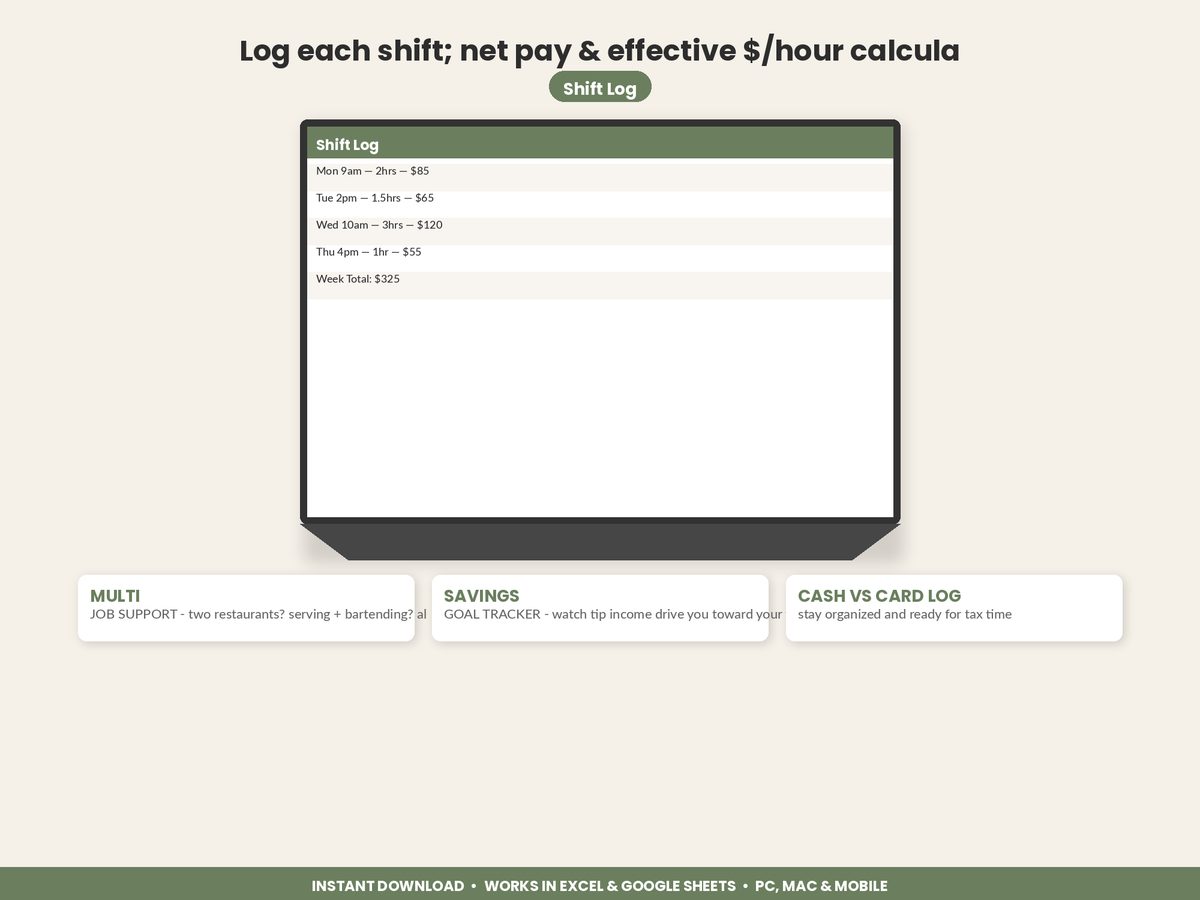
| Server | Hours | Pool share |
|---|---|---|
| You | 8.5 | $329.38 |
| B | 8.0 | $310.00 |
| C | 6.0 | $232.50 |
| D | 5.0 | $193.75 |
| E | 4.5 | $174.38 |
If your own section produced $292 that night, the pool gained you $37.38. If your section had produced $380, the pool cost you $50.62.
That is the entire argument about pooling, and it is not an argument — it’s a measurement. Over one night it’s noise. Over three months, your log tells you which side of the average you sit on, and that’s worth knowing before the next staff meeting about it.
The Column That Catches Drift
Tip-out structures change quietly. A new barback gets added. The percentage moves “temporarily.” The basis switches from tips to sales during a remodel and never switches back.
In the worked June from the pillar guide, the month came to $2,507 in gross tips and $290 in tip-out — 11.6%. That single percentage is the benchmark. Recalculate it every month and drift becomes visible immediately:
| Month | Gross tips | Tip-out | % |
|---|---|---|---|
| June | $2,507 | $290 | 11.6% |
| July | $2,640 | $340 | 12.9% |
| August | $2,415 | $338 | 14.0% |
That’s a 2.4-point move in two months. On $2,500 of monthly tips it’s $60 a month, $720 a year — and it is completely invisible to anyone who only writes down what they took home.
You can only compute it if you log gross tips and tip-out separately. The instinct is to write down the net, because the net is what’s in your hand. Resist it. Two columns, one subtraction, and the sheet keeps the benchmark for you.
The Tax Angle Nobody Mentions
Tip-out isn’t just a cost — it reduces the tips you report. In a tip-splitting or tip-pooling arrangement you report only the tips you receive and retain, not the portion you pass on to other employees — and your daily tip record is supposed to show the amounts paid out and the names of the employees you paid (IRS Publication 531). In the worked month that’s $2,217 rather than $2,507, a difference of $290 a month and $3,480 a year of income you are not taxed on.
The flip side, from the same publication: tips you receive from other employees are reportable by you. If you’re on the receiving end of the pool — barback, runner, support bartender — that share is your income, not a gift.
Claiming the reduction requires that you recorded it. A server who writes down only net tips has already claimed the reduction implicitly and can’t show why; a server who writes down only gross tips is over-reporting and paying tax on money they handed to the busser. How much to set aside once you know your real reportable figure.
Three Things to Do This Week
- Find out your basis. Percentage of tips, or percentage of sales? Ask, and write the answer in your sheet’s Settings.
- Log gross and tip-out separately for the next ten shifts. Ten rows gives you your real keep rate.
- Compare that rate to what you were told. “Roughly 10% to the bar” is often 13% by the time everything is counted, and the difference is the whole point of measuring.
Once the number exists, the conversation changes. “It feels like a lot” is easy to dismiss. “It’s 14.0%, up from 11.6% in June” is not.
Featured on ReadySheetGo
Server, Bartender & Tipped Worker Income Tracker — $11.99
The Shift Log keeps Cash Tips, Card Tips and Tip-Out Paid as three separate columns on every one of its 200 rows, then calculates net pay and effective $/hour from them automatically — so your keep rate and your reportable tip figure both fall out of the same log without extra work. Settings holds up to five venues with their roles and base hourly wages, so a house with a different tip-out structure is a dropdown rather than a second spreadsheet. Weekly, Monthly and Day-of-Week summaries build themselves, the Tax & Savings tab applies your set-aside rate to income net of tip-out, and the Dashboard returns total tips alongside net income and average effective $/hour. Eight tabs, sample data pre-filled. Works in Excel and Google Sheets.
Get the Server, Bartender & Tipped Worker Income Tracker →
Part of the complete guide to tracking tips as a server. This is general information, not legal or tax advice — state tip laws add requirements beyond the federal rules above, so confirm your own with a qualified professional.
Sources: DOL Fact Sheet #15: Tipped Employees Under the FLSA · DOL Fact Sheet #15A: Ownership of Tips Under the FLSA · DOL Fact Sheet #15B: Managers and Supervisors and Tips · IRS Publication 531, Reporting Tip Income
Frequently Asked Questions
What is the difference between a tip-out and a tip pool?
A tip-out is money you pay from your own tips to support staff — bar, barback, busser, food runner, host — usually as a percentage of your tips or of your sales. A tip pool is a system where tips are collected together and redistributed, commonly by hours worked, so your take-home reflects the whole shift rather than your own section. In a tip-out you keep your tips and pay some away; in a pool your tips go in and a share comes back.
Is percentage of sales or percentage of tips better for a server?
Percentage of tips is better for you because it moves with what you actually received. Percentage of sales charges you the same amount whether guests tipped 20% or 12%, which transfers the risk of being stiffed onto you. On identical $1,600 sales, a 3%-of-sales tip-out costs $48 on both a good night and a bad one — so your keep rate falls from 83.3% to 75% purely because of how guests behaved.
Can managers be in a tip pool?
No. Under the FLSA, employers — including managers and supervisors — may not keep any portion of employees' tips for any purpose, whether directly or through a tip pool, regardless of whether the employer takes a tip credit. A manager may keep a tip a customer gives them directly for a service the manager directly and solely provided, but they cannot take a share of a pool.
Can cooks and dishwashers be included in a tip pool?
Only if the employer pays the full minimum wage and takes no tip credit. When an employer claims a tip credit, a mandatory tip pool is limited to employees who customarily and regularly receive tips — front-of-house roles. If the employer pays full minimum wage instead, back-of-house staff can be included. So the answer depends on which wage structure your employer uses, which is worth knowing before you argue about it.