How Much Should a Server Set Aside for Taxes on Tips?
Your paycheck says $0.00 and you cleared $2,800 last month. Someone at work says tips aren’t taxed any more. Someone else says put away a third of everything. Neither of them has done the arithmetic, and the gap between those two pieces of advice is about $9,000 a year.
Here it is, worked, with 2026 numbers.
Full walkthrough of the template used in this guide.
Three Layers, Not One
The mistake behind both bad answers is treating “tax” as one thing. For a tipped worker it is three separate bills with three different rules:
| Layer | Applies to tips? | Who pays it |
|---|---|---|
| Social Security + Medicare (FICA), 7.65% | Yes, every dollar | Withheld from your paycheck |
| Federal income tax | Often $0 through 2028 | Withheld from your paycheck |
| State income tax | Depends entirely on your state | Usually withheld; sometimes not enough |
Notice that the layer that gets all the attention — federal income tax — is the one most likely to be zero, and the layer nobody mentions is the one that is definitely not.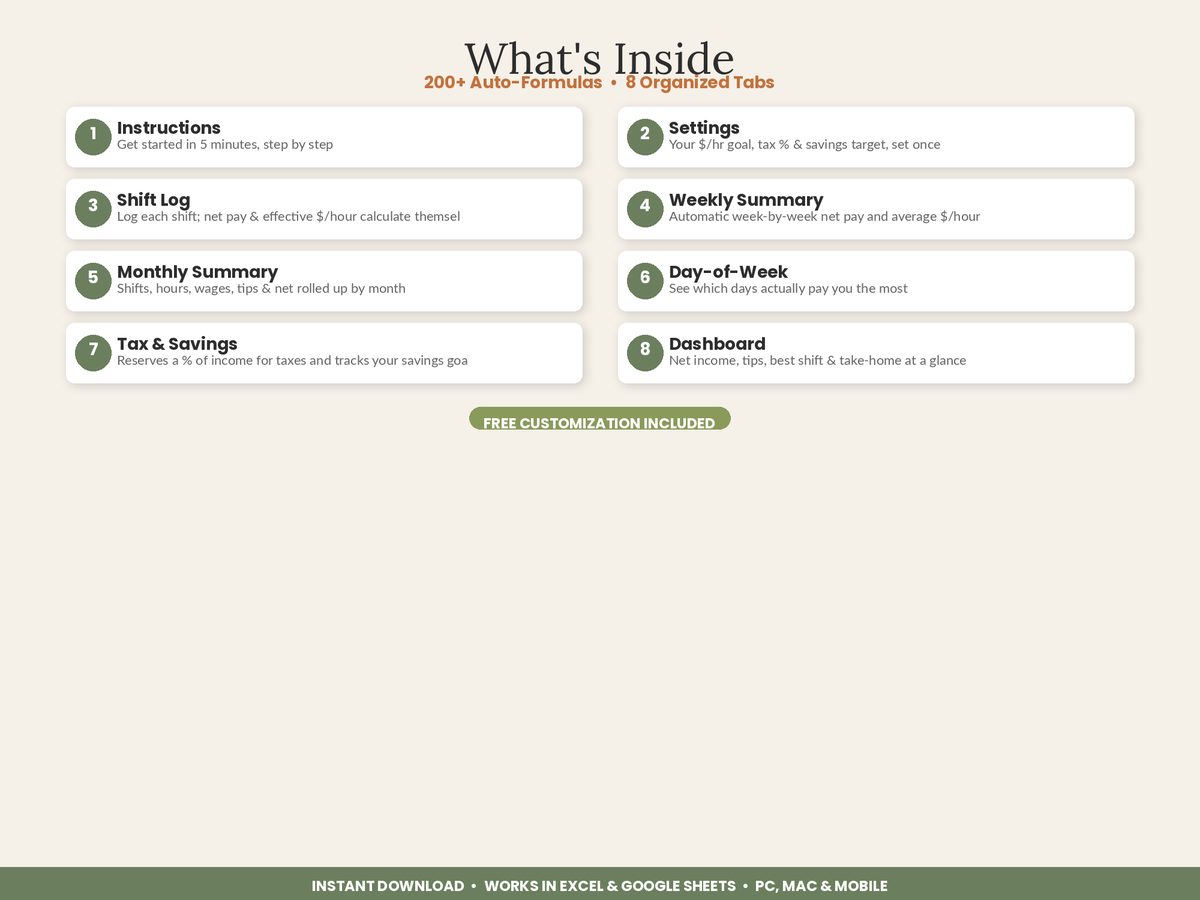
The Worked Year
Take the June shift log from the pillar guide and run it for twelve months. Stated assumptions, because these change the answer: single filer, no dependents, standard deduction, 2026 tax year, no other income, all tips earned in an IRS-listed tipped occupation.
| Amount | |
|---|---|
| Cash wages ($604.68 × 12) | $7,256 |
| Tips kept after tip-out ($2,217 × 12) | $26,604 |
| Total income | $33,860 |
Layer 1: FICA — $2,590
7.65% of $33,860 = $2,590.29. This is the employee half of Social Security (6.2%) and Medicare (1.45%). Your employer pays a matching amount.
There is no deduction, exemption or election that removes this from tips. It is the floor.
Layer 2: Federal income tax — $0
The One, Big, Beautiful Bill — the IRS also refers to this package as the Working Families Tax Cuts — created a deduction for qualified tips, available for tax years 2025 through 2028, capped at $25,000 a year, and, importantly for most servers, available whether you itemize or take the standard deduction (IRS: What the “No Tax on Tips” deduction means for you).
The 2026 standard deduction for a single filer is $16,100 (IRS tax year 2026 inflation adjustments).
So: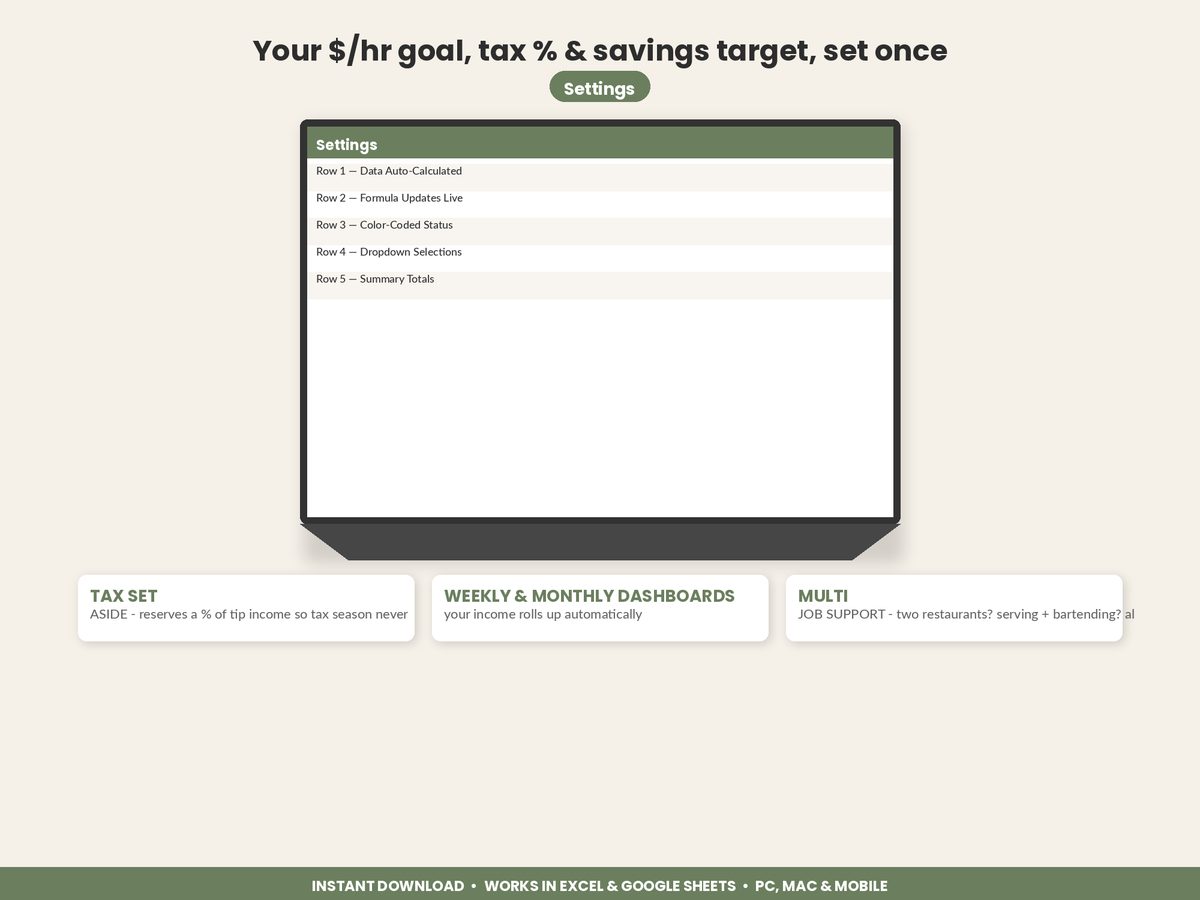
Total income                       $33,860
− Standard deduction              −$16,100
                                  ────────
                                   $17,760
− Qualified tip deduction (capped) −$25,000
                                  ────────
Taxable income                          $0
Qualified tips were $26,604, so the deduction is capped at $25,000 — and $25,000 is already more than the $17,760 left after the standard deduction. Taxable income floors at zero.
Federal income tax: $0. Any federal income tax withheld during the year comes back as a refund.
One condition that does a lot of work here: the tips have to be reported. The IRS requires qualified tips to appear on an information return furnished to you — a W-2, 1099-NEC, 1099-MISC or 1099-K — or to be reported by you on Form 4137. The $0 above assumes all $26,604 was reported. Cash you kept off the books isn’t quietly tax-free; it’s ineligible for the deduction that would have made it tax-free, and it still owes Social Security and Medicare.
Where that stops being true
Taxable income becomes positive once total income exceeds the standard deduction plus the tip deduction. For a single filer in 2026 whose tips are at least $25,000, that break point is:
$16,100 + $25,000 = $41,100
Below roughly $41,100 of income, a heavily tipped single filer likely owes no federal income tax. Above it, the excess starts getting taxed — at $50,000 of income, taxable income is $8,900 and the bill is about $890 at the 10% rate.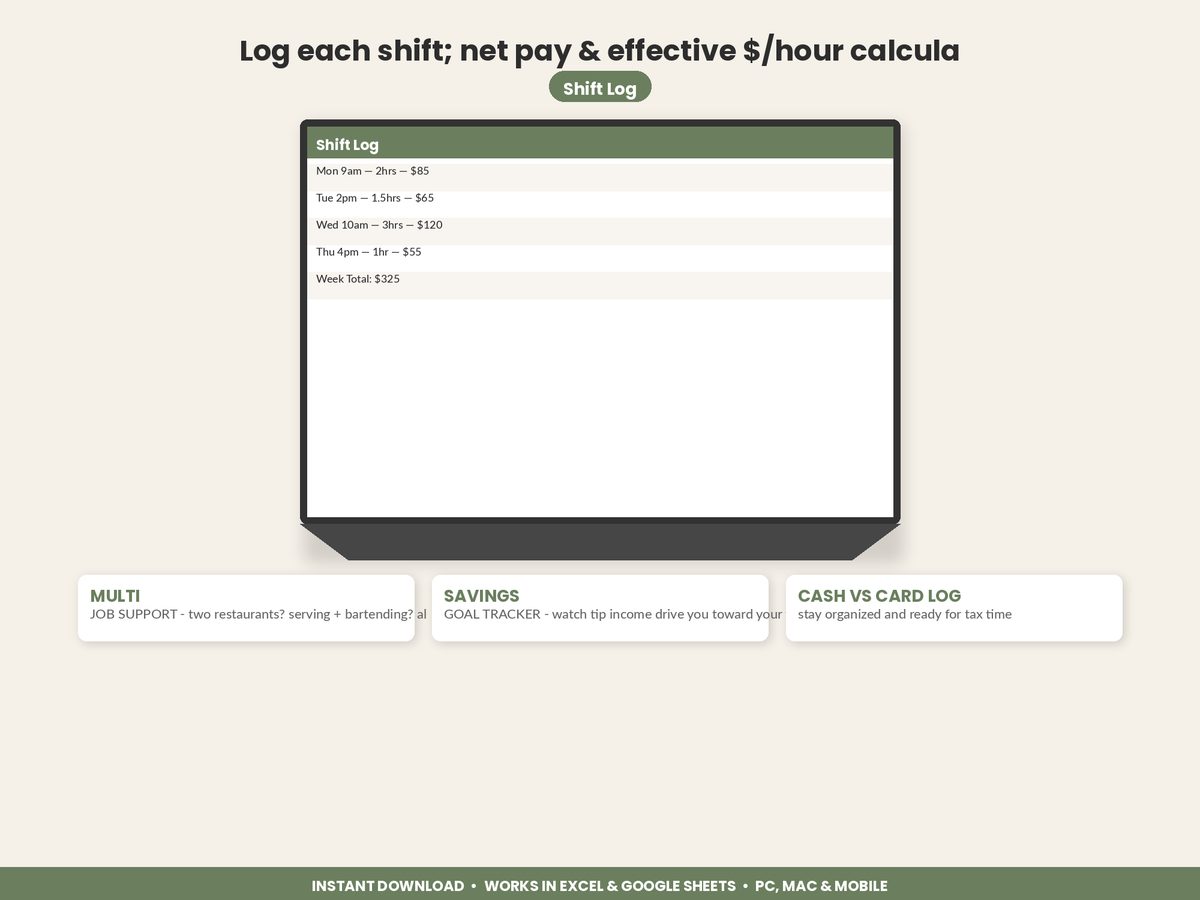
That single number, $41,100, is more useful than any percentage rule of thumb, because it tells you whether layer 2 is a real bill for you or not.
Layer 3: State income tax — the one that bites
Most states that tax income wrote their codes before 2025 and do not automatically mirror a new federal deduction. Assume yours doesn’t unless you’ve confirmed otherwise.
Worked with a stated assumption of a flat 4.5% state rate and no state exclusion for tips, ignoring any state standard deduction for simplicity:
4.5% × $33,860 = $1,523.70
That is a real bill, on income where federal tax was zero, and it is the single most common reason a tipped worker who “did nothing wrong” owes money in April. Your employer withholds state tax from your paycheck too — but as we’ll see, there may be nothing in the paycheck to withhold it from.
The total
| Layer | Amount | % of income |
|---|---|---|
| FICA | $2,590.29 | 7.65% |
| Federal income tax | $0 | 0% |
| State (assumed 4.5% flat) | $1,523.70 | 4.5% |
| Total | $4,113.99 | 12.1% |
Twelve percent. Not the third that gets repeated in break rooms, and not the zero that gets repeated on social media.
Why Your Paycheck Is $0.00
This is the mechanic that confuses everyone, and it is worth understanding because it determines whether you actually need to set anything aside.
Your employer must withhold FICA on your tips as well as your wages — but the only money they physically hold is the wages. Take one venue from the worked month: Harbor Grill, a $2.13 cash wage.
| Amount | |
|---|---|
| Gross wages for the month | $109.68 |
| Reported income (wages + tips kept) | $798.68 |
| FICA owed at 7.65% | $61.10 |
| Left in the paycheck | $48.58 |
Then state withholding takes a slice of that $48.58, and the paycheck lands somewhere near zero. Nothing is broken. Your income already reached you — in cash and on your card tip payout — and the paycheck is simply the vehicle the tax rides out on.
The practical consequence: the smaller your cash wage, the more likely withholding runs out before the bill is covered. At $2.13 an hour there is very little room. At $9.00 an hour there is more.
So What Should You Actually Set Aside?
Don’t start with a percentage. Start with your pay stub.
Step 1 — Read the year-to-date box on your stub. It shows federal withheld, Social Security, Medicare and state withheld. That is what’s already handled.
Step 2 — Compare against your log. Your shift log knows your true year-to-date income. Multiply it by 7.65% and check the Social Security + Medicare boxes roughly match. If they’re well short, tips aren’t being reported through payroll and you have a real liability building.
Step 3 — Set aside the gap. Which, for most W-2 servers in the worked scenario, is state tax and nothing else:
| Your situation | Set-aside rate on net income |
|---|---|
| W-2, no state income tax, withholding keeping up | 0–3% (buffer only) |
| W-2, state income tax, mid-rate | 5% |
| W-2, high cash-tip share (withholding can’t keep up) | 8–10% |
| Paid on a 1099 for banquet or private-event work | 15% minimum |
That last row is not a rounding difference
If the same $33,860 arrives as self-employment income rather than W-2 wages — private events, contracted bartending, gig catering — you owe self-employment tax instead of the employee half of FICA. That is 15.3% on 92.35% of net earnings:
$33,860 × 0.9235 × 0.153 = $4,784
Federal income tax is still $0 (the tip deduction applies to self-employed tips too, capped at your net business income before the deduction). But the FICA-equivalent bill nearly doubles: $2,590 as an employee, $4,784 as a contractor. Same money, same work, $2,194 difference — because as a contractor you pay both halves.
Nobody withholds it for you either, so it’s also the case where quarterly estimated payments come into play.
Where the Log Earns Its Keep
Three things you cannot do without a shift log:
Report cash tips correctly. If you receive $20 or more in tips in a month from an employer, you must report them to that employer (IRS tip recordkeeping and reporting). A dated log is the record that makes this a five-minute task rather than a reconstruction.
Reduce reportable tips by tip-out. If you’re in a tip-splitting or tip-pooling arrangement, you report only the tips you receive and retain — not the portion you pass on to other employees — and your daily tip record is supposed to show the amounts paid out and the names of the employees you paid (IRS Publication 531). In the worked month that’s $2,217 rather than $2,507 — a $290 monthly difference, $3,480 a year. You can only claim it if you recorded tip-out as its own column. How tip-out and tip pools work.
Catch the shortfall early. Checking withholding against your log in July costs you nothing. Finding out in April costs you a lump sum.
Set the rate once in your sheet’s Settings and let it apply itself to every shift. The point of a set-aside rate isn’t precision — it’s that the money is in a different account by the time you’d otherwise have spent it.
Featured on ReadySheetGo
Server, Bartender & Tipped Worker Income Tracker — $11.99
The Tax & Savings tab takes the set-aside rate you enter in Settings and applies it to year-to-date net income automatically — total net income, recommended taxes to reserve, and estimated take-home after tax, updating with every shift you log. Because the Shift Log records cash tips, card tips and tip-out in separate columns, your reportable tip figure is net of tip-out without any extra work. The Income Dashboard shows taxes to reserve next to total tips and effective $/hour, and the same tab tracks an annual savings goal with a % to goal so the reserved money has somewhere to go. Eight tabs, 200-shift capacity, sample data pre-filled. Works in Excel and Google Sheets.
Get the Server, Bartender & Tipped Worker Income Tracker →
Part of the complete guide to tracking tips as a server. This is general information, not tax advice — the figures above rest on the stated assumptions and your own situation, state and filing status will change them, so confirm yours with a qualified tax professional.
Sources: IRS: What the “No Tax on Tips” deduction means for you · IRS tax year 2026 inflation adjustments · IRS Publication 531, Reporting Tip Income · IRS Tip recordkeeping and reporting · IRS: Occupations that customarily and regularly received tips · IRS About Form 4137
Frequently Asked Questions
Does the No Tax on Tips deduction mean servers pay no tax on tips?
No — it removes federal *income* tax on qualified tips up to $25,000 a year, but Social Security and Medicare tax still apply to every dollar of tips. On $33,860 of wages plus tips that is $2,590 of FICA the deduction does nothing about. The deduction is available for tax years 2025 through 2028, phases out above $150,000 modified AGI ($300,000 joint), requires a valid Social Security number, requires married filers to file jointly, and only applies to occupations the IRS listed as customarily tipped.
What percentage should a server set aside for taxes?
If you are a W-2 employee, the honest answer is: check your pay stub first, because your employer is already withholding. The number to set aside is whatever your withholding does not cover — typically state income tax, if your state has one and does not mirror the federal tip deduction. Around 5% of net income covers that in a mid-rate state. If you are paid as a 1099 contractor for banquet or private-event work, set aside 15% minimum for self-employment tax before you think about income tax at all.
Why is my paycheck $0 when I made good money in tips?
Because your employer withholds Social Security and Medicare tax on your tips as well as your wages, but can only take it out of the wages — and at a $2.13 cash wage there is barely anything to take it out of. On a month with $798.68 of income at one venue, FICA alone is $61.10 while the cash wages are $109.68. The tips already reached you in cash and on card, so the paycheck absorbs the entire tax bill and lands near zero. That is working correctly, not a payroll error.
Do I have to report cash tips if nobody sees them?
Yes. All tips are taxable income, and if you receive $20 or more in tips in a month from one employer you are required to report them to that employer. Unreported cash tips also mean unpaid Social Security and Medicare tax, which is reported on Form 4137 at filing. There is a practical cost too: unreported tips are invisible to a lender, invisible to a landlord, and reduce the earnings record your future Social Security benefit is calculated from.