Year-End Inventory Count and Cost of Goods Sold: A Worked Example
You sell products, and your accountant has asked for your ending inventory and cost of goods sold. Neither is a number you can pull from a bank statement. A year-end inventory count and cost of goods sold calculation needs a shelf count, a unit cost for every item and one short formula. Here is the whole thing worked through.
This is a record-keeping walkthrough, not tax or accounting advice. Valuation methods and rules vary, so confirm yours with your accountant.
Full walkthrough of the template used in this guide.
The formula
Cost of goods sold = beginning inventory + purchases during the year - ending inventory.
Beginning inventory is last year’s ending figure. Purchases come from your ledger. Ending inventory is the thing you have to produce, and that comes from counting.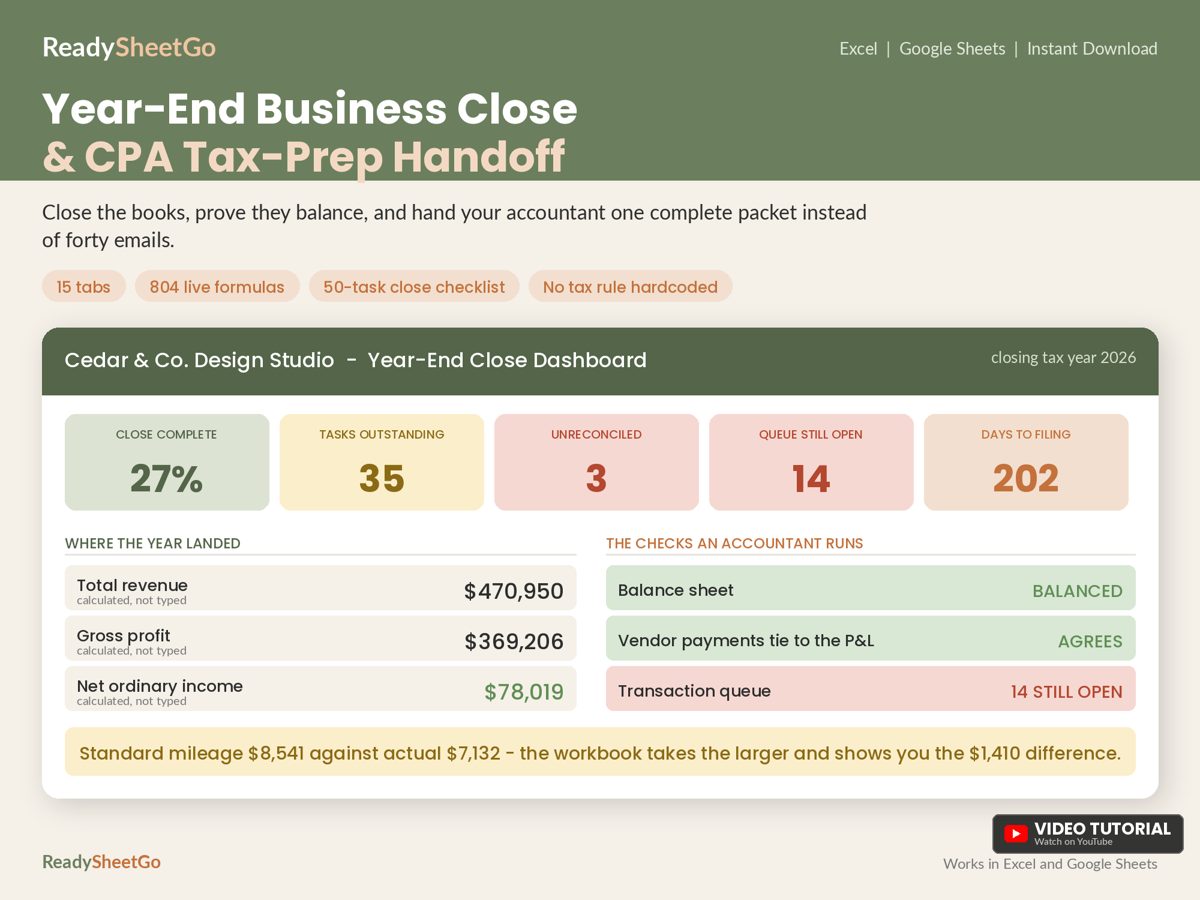
Step 1: Pick a count day and freeze movement
Count on 31 December if you can, or as close as possible, and note any sales or deliveries between the count and year end so you can adjust. Stop receiving stock during the count, or log it separately.
Step 2: Count by item, not by shelf
Use one row per item (or SKU) with units, unit cost and extended value. Here is a worked example for a fictional candle maker. Raw materials and finished goods are both included:
| Item | Units counted | Unit cost | Value |
|---|---|---|---|
| Soy candles, 8 oz (finished) | 240 | $4.10 | $984.00 |
| Wax melts, 6-pack (finished) | 310 | $1.85 | $573.50 |
| Empty jars (materials) | 1,150 | $0.62 | $713.00 |
| Shipping boxes (supplies) | 400 | $0.45 | $180.00 |
| Ending inventory | $2,450.50 |
Whether supplies such as shipping boxes belong in inventory or expenses depends on your situation; ask your accountant. We include them here only to show the arithmetic.
Step 3: Calculate cost of goods sold
| Line | Amount |
|---|---|
| Beginning inventory | $3,100.00 |
| Plus: purchases during the year | $11,800.00 |
| Goods available for sale | $14,900.00 |
| Less: ending inventory | $2,450.50 |
| Cost of goods sold | $12,449.50 |
Now it feeds your profit and loss. If revenue were $30,000, gross profit would be $17,550.50, a gross margin of about 58.5 percent (17,550.50 / 30,000 = 0.585).
Step 4: See what a miscount costs
An error in ending inventory moves cost of goods sold by the same amount in the opposite direction. If the true count is 10 percent higher than you recorded, ending inventory is understated by $245.05 and cost of goods sold is overstated by $245.05. At an assumed 24 percent tax rate (a planning assumption only), that is about $58.81 of tax effect, which is why a sloppy count costs real money on a larger stock.
Step 5: Check for shrinkage
Compare the count with what your records say should be on hand:
| Item | Records say | Count | Difference |
|---|---|---|---|
| Soy candles, 8 oz | 270 | 240 | -30 |
Thirty candles at $4.10 is $123.00. Note the reason, whether breakage, samples given away, or a recording error. Damaged goods should be written off with a note, not silently absorbed.
Common mistakes
- Valuing at retail price. Use cost. For the difference, see how much is my inventory worth, cost versus retail.
- Forgetting materials and work in progress.
- Counting after shipping resumes.
- Not saving the count sheet. Your accountant may want it, and next year’s beginning figure comes from it.
- Skipping unit cost updates when supplier prices changed.
Copy-ready count sheet
Columns: Item | Location | Units counted | Unit cost | Value (=units x cost) | Counted by | Date | Notes. Total the Value column; that total is your ending inventory. Pair it with beginning inventory and purchases in three more cells to produce cost of goods sold.
If you also track reorder points, see how to calculate a reorder point for your inventory. For how this step fits the whole close, see the year-end business close checklist.
The Year-End Business Close and CPA Tax-Prep Handoff Workbook has an Inventory and COGS tab with a count worksheet that calculates cost of goods sold and feeds it into the profit and loss. It works in Excel and Google Sheets.
Featured on ReadySheetGo
Year-End Business Close and CPA Tax-Prep Handoff Workbook — $19.99
An inventory count worksheet that calculates cost of goods sold and feeds your profit and loss. Works in Excel and Google Sheets.
General information only, not tax, legal or accounting advice. Example figures are fictional.
Frequently Asked Questions
How do you calculate cost of goods sold?
Beginning inventory plus purchases during the year, minus ending inventory. The ending inventory comes from a physical count valued at unit cost. Using a $3,100 start, $11,800 of purchases and a $2,450.50 count gives $12,449.50 of cost of goods sold.
Do I need to count inventory at year end?
If you hold stock for sale or materials to make it, your accountant will usually need an ending inventory figure, and a count is the best evidence. Ask your accountant how detailed it needs to be for your business.
How do I value inventory?
Multiply units on hand by the cost you paid per unit, not the selling price. Methods such as first-in first-out affect which cost you use, and your accountant can tell you which applies to you.
What if my count does not match my records?
The difference is shrinkage: damage, loss, theft or recording errors. Record the difference, investigate large gaps, and write off damaged goods separately so the reason is visible.